Stock Analysis · Taylor Morn Home (TMHC)
Stock Analysis · Taylor Morn Home (TMHC)

Overview

Taylor Morrison Home is a U.S. homebuilder that designs, builds, and sells single-family homes and communities. The company operates across a broad mix of states and targets several buyer groups, including entry-level, move-up, luxury, and active-adult customers. In practical terms, it makes money by acquiring land, developing communities, constructing homes, and then delivering those homes to buyers. It also has related operations that support the core business, including financial services tied to home closings.

Its revenue is heavily concentrated in homebuilding, which is typical for the industry. Based on company reporting, the business mix can be summarized approximately as follows:

  • Home closings / homebuilding revenue: roughly more than 90% of total revenue. This is the sale of newly built homes and is by far the main engine of the business.
  • Land sales and other housing-related revenue: a small single-digit percentage. This can include sales of land parcels and other community-related items.
  • Financial services: also a small single-digit percentage. This generally includes mortgage-related and title-related activities that help customers complete purchases.

The business model is straightforward but cyclical: when demand for new homes is healthy and construction costs are controlled, profits can expand quickly. When mortgage rates rise or affordability weakens, orders and margins can come under pressure. Even so, Taylor Morrison has built a national platform large enough to compete with major builders while still keeping a sharper focus on selected regional markets.

The broad financial flow shows a company that has remained solidly profitable in recent years, with revenue staying around the $7 billion to $8 billion range and earnings holding up better than many investors might expect in a tougher housing environment. Gross profit and operating income pulled back from the 2022 peak, but the company still appears to convert a meaningful share of revenue into profit.

Key Figures

MetricValueSector
DateJul 18, 2026
Context
SectorConsumer Cyclical
IndustryResidential Construction
Market Cap $6.64B
Beta 1.44
Value
(Cheapness)
P/E Ratio 10.7518.58
FCF Yield 10.69%7.99%
EBIT / EV 11.23%5.91%
PEG 1.41
Growth
(Business expansion)
Revenue Growth -26.80%5.50%
RPS Growth (5Y CAGR) 8.31%9.20%
EPS Growth (5Y CAGR) -45.09%-26.43%
Margin Growth (5Y Trend) 2.01%-0.18%
FCF Growth (5Y CAGR) 22.77%5.02%
Quality
(Business durability)
ROIC (Latest) 8.50%12.03%
ROIC (5Y Median) 13.88%10.82%
Net Debt / EBIT (Latest) 1.872.12
Net Debt / EBIT (5Y Median) 1.392.25
Operating Margin (Latest) 12.40%9.28%
Operating Margin (5Y Median) 13.72%9.64%
Debt to Equity (Latest) 38.65%75.23%
Profit Margin (Latest) 8.77%5.28%
Free Cash Flow (Latest) $709.65M
Momentum
(Price trend)
3Y Return +39.90%+10.68%
12M Return (excl. last month) +25.09%+5.26%
6M Return +12.44%-2.41%
Price vs. 200-Day MA +14.57%+1.55%
Better than sector median
Slightly worse than sector median
More than 20% worse than sector median

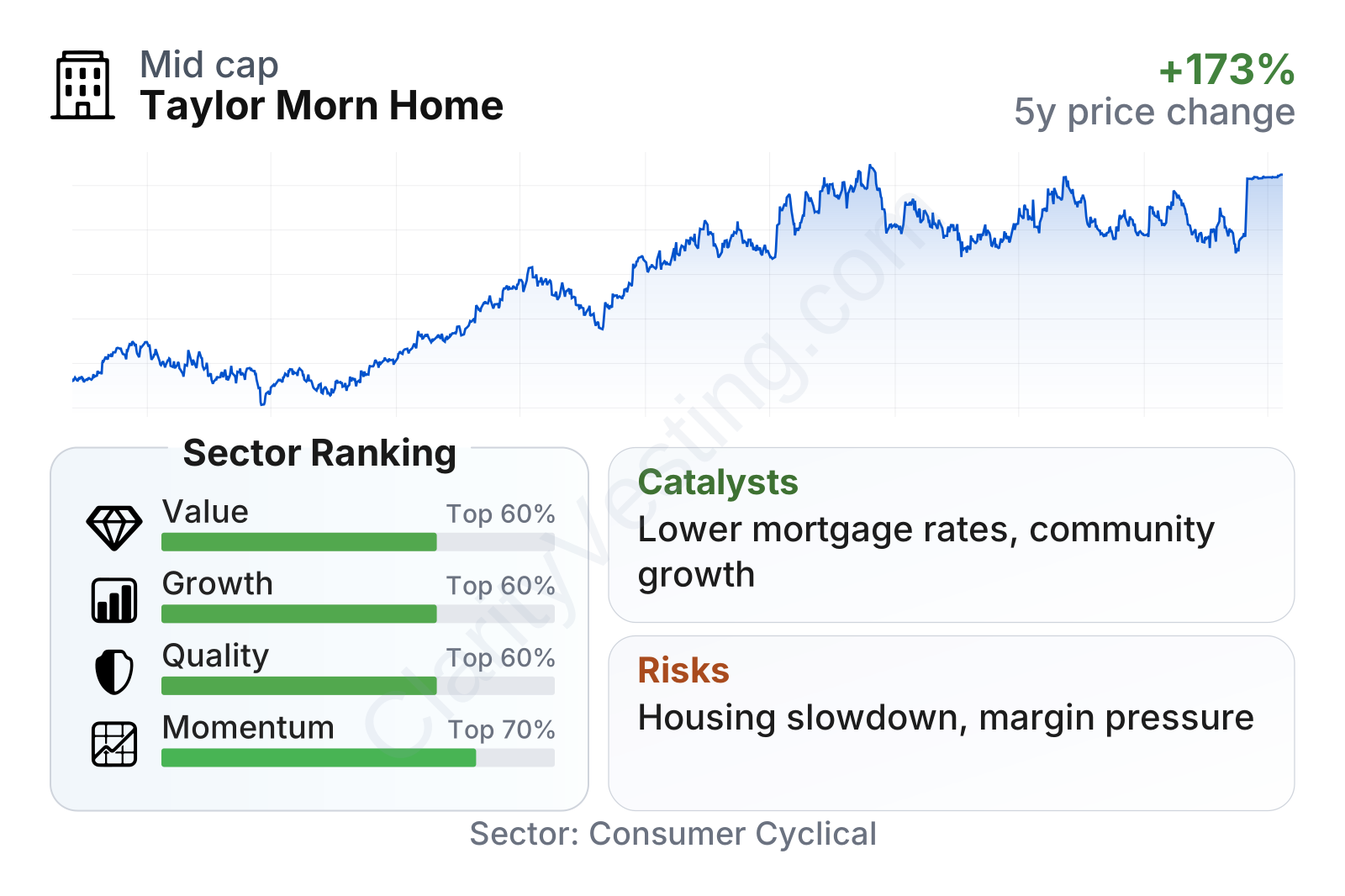
Taylor Morrison sits in the mid-to-upper range of its sector on several measures rather than standing out in only one area. The most notable point is valuation: its earnings multiple is well below the sector median, while cash generation and operating profitability look stronger than many peers. Growth is more mixed, with recent revenue pressure offset by much better long-term free cash flow improvement and a margin record that has held up relatively well. The share price has been volatile, which is normal for homebuilders, but the longer-term performance has still been materially better than much of the broader sector.

At roughly a mid-single-digit-billion market value, Taylor Morrison is large enough to benefit from scale in land buying, construction management, and overhead absorption, yet still smaller than the very largest national builders. Its beta above 1 also signals that the stock tends to move more sharply than the overall market, which fits the cyclical nature of residential construction.

Growth

The company operates in a sector with durable long-term demand drivers. The U.S. continues to face a structural housing shortage in many markets, and affordability challenges in the resale market can still support demand for new homes, especially when builders use incentives, mortgage-rate buydowns, and product mix changes to keep monthly payments within reach. That does not remove short-term volatility, but it does provide an underlying reason the sector remains important over time.

Taylor Morrison’s strategy also makes sense in that context. The company has maintained exposure across multiple customer categories instead of depending on a single niche. That diversification matters because entry-level, move-up, and active-adult buyers do not all react the same way to rates, employment trends, or household wealth. The active-adult business in particular adds an additional angle beyond the standard first-time buyer cycle, supported by demographic aging and migration into lifestyle-oriented communities.

Recent top-line momentum has clearly softened. Year-over-year revenue growth has moved from strong post-pandemic expansion to declines more recently, including a sharp drop in the latest reading. That suggests the business is in a digestion phase rather than a clean acceleration phase. For a homebuilder, that usually reflects a mix of tougher comparisons, community timing, mortgage-rate pressure, and changes in closing volumes or pricing.

Even with slower recent revenue growth, cash generation has recovered well. Free cash flow was much stronger in the latest period than a year earlier and remains meaningfully above earlier-cycle levels. That matters because in this industry, cash flow says a lot about land discipline, inventory turns, and how aggressively a company is expanding. Stronger cash generation gives Taylor Morrison more flexibility for land investment, debt management, and capital returns without depending too heavily on outside financing.

A meaningful catalyst is the company’s ability to keep balancing volume and price. If mortgage rates stabilize or ease, large builders like Taylor Morrison could benefit from improved demand conversion, especially because many smaller builders have less flexibility to absorb incentives. Another positive factor is that publicly traded builders have generally gained competitive ground from fragmented local operators thanks to scale, supplier relationships, and financing tools. In that setting, a builder with steady margins and a broad community footprint can continue taking share even when the overall market is not booming.

Recent company communications and filings have continued to emphasize community growth, land positioning, and disciplined capital allocation rather than growth at any cost. That is an important distinction for a cyclical business: future expansion is more credible when it is backed by lot supply and balance-sheet capacity rather than just optimistic demand assumptions.

Risks

The largest risk is the housing cycle itself. Taylor Morrison is highly exposed to mortgage rates, consumer confidence, employment conditions, and affordability. If financing costs stay elevated for longer, monthly payments remain stretched, and that can reduce orders, increase cancellations, or force builders to offer more incentives. In a homebuilding company, those pressures can hit both revenue and margins at the same time.

Balance-sheet risk looks relatively controlled compared with many peers. Debt to equity has fallen sharply over the last several years and remains well below the sector median. That does not eliminate risk, because homebuilding always requires large land and inventory commitments, but it does suggest the company has been more conservative than much of the industry. Net debt relative to earnings also appears manageable by sector standards, which is useful if the market weakens.

Profitability is another area where Taylor Morrison compares favorably. Profit margin has come down from its peak, which is not surprising after the unusually strong homebuilding environment of 2022 and early 2023, but it still remains well above the sector median. That indicates a real competitive advantage in execution, even if it does not make the company the industry leader. Its edge seems to come more from disciplined operations, product mix, and cost management than from having the biggest national scale.

The competitive landscape is intense. Major public peers include D.R. Horton, Lennar, PulteGroup, NVR, KB Home, Toll Brothers, and Meritage Homes. Compared with the largest builders, Taylor Morrison is not the category leader in size or national reach. However, it appears well placed as a second-tier national builder with enough scale to compete effectively while still showing better leverage and margin characteristics than many companies in the group. That can be a good position, but it also means the company has less room for error than the biggest players if market conditions deteriorate.

Another risk is land and construction execution. Builders need to buy land years in advance, estimate demand correctly, and manage labor, materials, permitting, and community timing. If the company overpays for land, misjudges a local market, or faces delays, returns can fall quickly. There is also ongoing exposure to geographic concentration, weather events, insurance costs, and regulation in key states, especially in Sun Belt markets where many large builders are active.

There does not appear to be any widely reported recent scandal or governance event fundamentally changing the risk profile. The more relevant near-term concern is operational: weaker revenue growth and softer margins could continue if incentives rise or if buyers remain sensitive to mortgage rates.

Valuation

Taylor Morrison trades at an earnings multiple that is clearly below the sector median, which usually signals either market caution or potential undervaluation relative to fundamentals. In this case, the lower multiple likely reflects both the normal discount placed on cyclical homebuilders and concern that earnings are past their peak for this cycle.

The valuation has remained below sector norms for years, not just recently. That pattern is common in homebuilding because investors often assume profits are less durable than those of asset-light or recurring-revenue businesses. Still, when a builder combines below-average leverage with above-average margins and strong cash generation, a discount that wide begins to look more notable.

The key question is whether the current price properly reflects the likely path of earnings. On one hand, recent revenue contraction and margin normalization argue against using peak-cycle profitability as a base case. On the other hand, the company is still producing healthy profits, solid cash flow, and balance-sheet metrics that compare well with peers. That makes the stock look inexpensive relative to present profitability, though not necessarily cheap if one assumes a much weaker housing market ahead.

In other words, the valuation seems to embed caution rather than optimism. Given the company’s financial profile, that caution does not look irrational, but it may also understate the benefit of disciplined execution if housing conditions remain merely stable instead of severely weak.

Conclusion

Taylor Morrison stands out as a financially solid homebuilder operating in a cyclical but fundamentally important industry. The company is not the largest player, yet it has built a credible position through broad customer exposure, healthy margins, improving balance-sheet discipline, and strong cash generation. Those qualities matter because they can help a builder navigate rate pressure better than weaker rivals.

The main challenge is timing. Recent revenue growth has turned negative, profits are no longer at cycle highs, and the housing market remains heavily influenced by mortgage rates and affordability. That limits how aggressive any interpretation of the current numbers should be. Homebuilding can look inexpensive right before a downturn, so low multiples alone are never enough.

Even with that caution, Taylor Morrison’s overall profile looks sturdier than a typical cyclical stock. It combines operational profitability above sector norms with leverage below sector norms, and that is a meaningful combination. The valuation appears to reflect market skepticism about the cycle more than deterioration in the underlying franchise, leaving the company positioned as a comparatively strong operator whose appeal depends largely on how durable U.S. housing demand proves over the next few years.

Sources:

  • Taylor Morrison Home Corporation — Annual Report on Form 10-K for fiscal year 2025, filed with the SEC in 2026
  • Taylor Morrison Home Corporation — Quarterly Report on Form 10-Q for the quarter ended March 31, 2026
  • SEC EDGAR — Taylor Morrison Home Corporation filings and company profile
  • Taylor Morrison Investor Relations — earnings releases and investor presentation materials published in 2026
  • Wikipedia — Taylor Morrison Home Corporation, basic company background and history

This article is for informational purposes only and does not constitute financial advice. Some content is AI-generated. See Disclaimer


Sign up for exclusive research and insights.

Unsubscribe anytime.
