Stock Analysis · Millicom International Cellular SA (TIGO)
Overview
Millicom International Cellular SA, better known through the Tigo brand, is a telecommunications and digital infrastructure company focused on Latin America. It sells mobile phone services, fixed broadband, pay TV, business connectivity, mobile financial services, and related enterprise solutions. In simple terms, it operates the networks that let households go online, stream content, make calls, and increasingly use digital payments and business data services.
The business is concentrated in a handful of markets, with Guatemala, Colombia, Panama, Bolivia, Honduras, El Salvador, Nicaragua, Costa Rica, and Paraguay among its main operating countries in recent company reporting. Over the last few years, Millicom has reshaped itself around Latin America and around convergent telecom services, meaning it aims to serve the same customer with several products at once: mobile, home internet, television, and business services.
Its revenue base mainly comes from recurring telecom subscriptions and usage. Company reporting typically groups revenue by service line rather than publishing one simple global split every quarter, but the broad mix is clear.
- Mobile services: about 50% to 60% of revenue. This includes prepaid and postpaid mobile plans, voice, mobile data, and mobile-related services.
- Home and fixed services: about 25% to 35% of revenue. This includes broadband, pay TV, fixed voice, and bundled household offers.
- B2B and enterprise services: about 10% to 15% of revenue. This includes corporate connectivity, data transport, cloud-related services, cybersecurity, and managed solutions.
- Mobile financial services and other revenue: generally a small single-digit percentage. This includes digital wallets, financial transactions, tower- or infrastructure-related items, and miscellaneous services depending on the market.
This mix matters for long-term analysis because fixed broadband and business services are usually more stable and can support higher customer lifetime value than prepaid mobile alone. Millicom’s strategy has been to increase these more durable revenue streams while using its mobile network as the entry point for customer acquisition.
The financial flow also shows a useful pattern: revenue has stayed around the mid-single-digit billions of dollars in recent years, but operating income and net income improved sharply into 2025. That suggests the recent equity market enthusiasm has not come only from sales growth, but also from better profitability and cash conversion.
Key Figures
| Metric | Value | Sector ⓘ |
|---|---|---|
| Date | Sep 12, 2026 | |
| Context | ||
| Sector | Communication Services | |
| Industry | Telecom Services | |
| Market Cap ⓘ | $16.21B | |
| Beta ⓘ | 0.90 | |
Value (Cheapness) | ||
| P/E Ratio ⓘ | 24.17 | 18.61 |
| FCF Yield ⓘ | 9.51% | 13.68% |
| EBIT / EV ⓘ | 6.12% | 4.54% |
| PEG ⓘ | 0.34 | |
Growth (Business expansion) | ||
| Revenue Growth ⓘ | 59.40% | 5.40% |
| RPS Growth (5Y CAGR) ⓘ | 7.52% | 4.62% |
| EPS Growth (5Y CAGR) ⓘ | 24.23% | -18.01% |
| Margin Growth (5Y Trend) ⓘ | 1.86% | 1.10% |
| FCF Growth (5Y CAGR) ⓘ | 122.81% | 5.88% |
Quality (Business durability) | ||
| ROIC (Latest) ⓘ | 9.54% | 8.38% |
| ROIC (5Y Median) ⓘ | 5.61% | 8.32% |
| Net Debt / EBIT (Latest) ⓘ | 6.63 | 1.99 |
| Net Debt / EBIT (5Y Median) ⓘ | 7.66 | 2.94 |
| Operating Margin (Latest) ⓘ | 23.01% | 14.89% |
| Operating Margin (5Y Median) ⓘ | 19.35% | 12.96% |
| Debt to Equity (Latest) ⓘ | 470.02% | 59.59% |
| Profit Margin (Latest) ⓘ | 9.18% | 8.77% |
| Free Cash Flow (Latest) ⓘ | $1.54B | |
Momentum (Price trend) | ||
| 3Y Return ⓘ | +626.99% | +46.64% |
| 12M Return (excl. last month) ⓘ | +142.56% | +2.16% |
| 6M Return ⓘ | +40.84% | +5.05% |
| Price vs. 200-Day MA ⓘ | +27.32% | +2.88% |
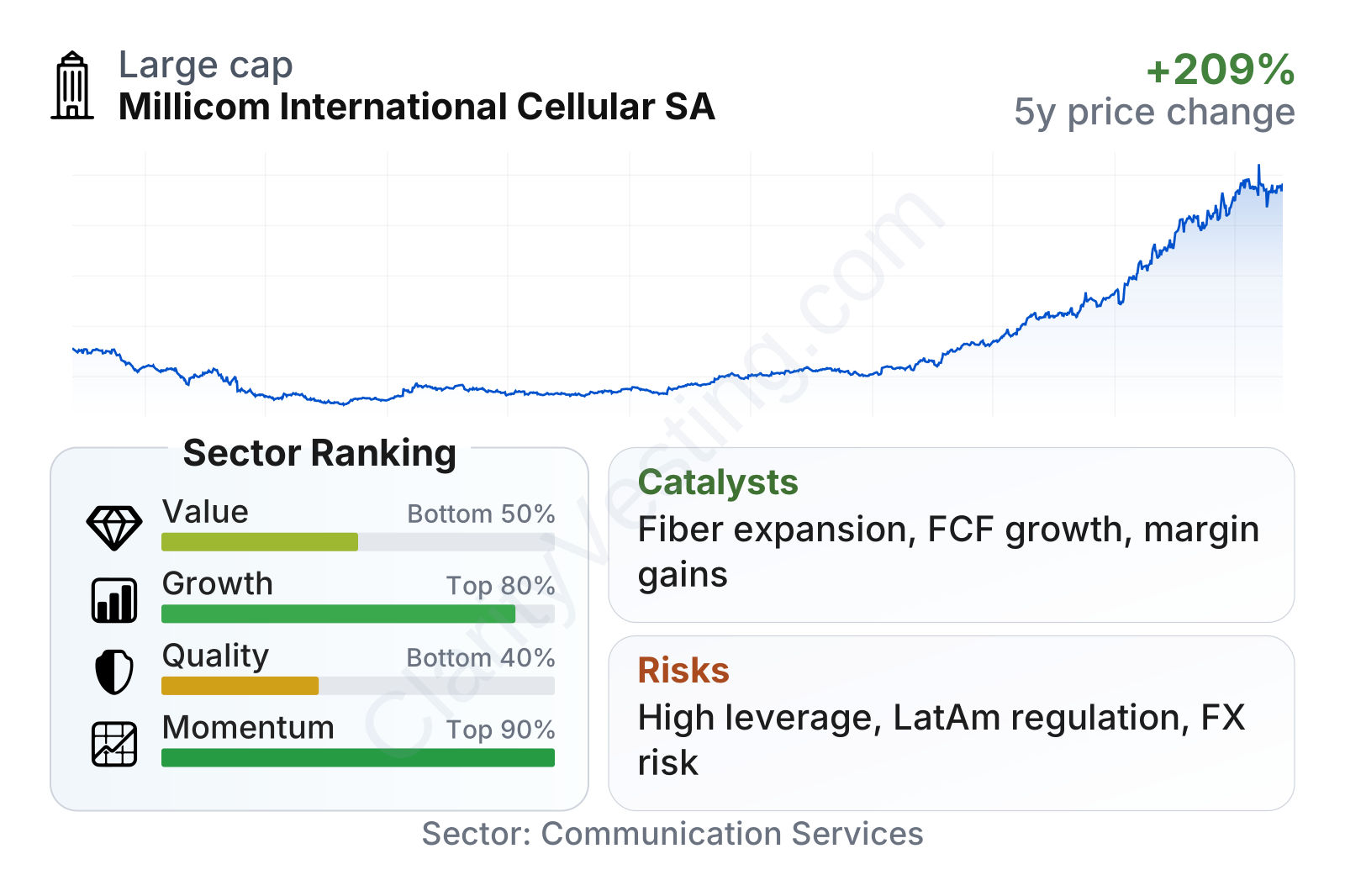
Millicom is a large regional telecom operator rather than a global giant, with a stock that has been much stronger than most of its sector over the last year and over the last three years. The factor profile is unusual: growth and momentum rank well above the sector, profitability is mixed but improving, while balance-sheet leverage remains a major weak point. The value picture is not obviously cheap on standard earnings multiples, even though some operating metrics still compare well with peers.
Growth
Telecom is not a fast-growth sector in the same way as software or semiconductors, but it is still a structurally important one. In Latin America, demand for mobile data, fiber broadband, streaming capacity, enterprise connectivity, and digital financial services continues to expand. That puts Millicom in a part of the market where long-term demand is real, even if competition and regulation keep pricing disciplined.
Millicom’s strategy broadly makes sense for future growth because it is centered on network ownership and bundling. Telecom operators that can connect customers both on mobile and at home often reduce churn and raise average revenue per user. Fiber expansion is especially relevant because broadband households tend to be more stable than prepaid mobile users, and enterprise clients can add a higher-margin revenue layer on top.
The recent growth trend looks stronger than the sector median, with revenue growth rebounding sharply in the latest periods after a softer stretch in 2024 and parts of 2025. That kind of acceleration can come from a mix of acquisitions, market recovery, pricing, currency effects, and customer growth, so it deserves some caution. Still, compared with many mature telecom names, Millicom currently shows a much stronger top-line profile.
Free cash flow is one of the most encouraging points in the case. It has climbed from a few hundred million dollars a few years ago to well above $1 billion on a trailing basis. For a capital-intensive telecom group, that matters more than revenue alone because it shows the business is converting its network footprint into cash after major operating and investment needs. Stronger free cash flow can support debt reduction, shareholder distributions, or reinvestment in fiber and mobile networks.
Recent company communications have also emphasized operational simplification, capital discipline, and extracting more value from existing assets. If that continues, one of the strongest catalysts is not necessarily explosive subscriber growth, but a steadier combination of margin expansion, cash generation, and balance-sheet repair. In telecom, that can be powerful over time.
Risks
This article is for informational purposes only and does not constitute financial advice. Some content is AI-generated. See Disclaimer


