Stock Analysis · Gentherm Inc (THRM)
Overview
Gentherm Inc. is a thermal management company best known for technologies that heat, cool, and regulate temperature inside vehicles. Its products are used by automakers to improve comfort, energy efficiency, and increasingly to support health and sensing features in the cabin. The company also has a smaller medical business that provides temperature management systems used in healthcare settings.
For long-term analysis, Gentherm is easiest to understand as an automotive supplier with a specialized niche: it does not build entire car systems, but it provides components and modules that can become more important as vehicles shift toward electric platforms, where efficient cabin heating and cooling matters more because it affects driving range.
Based on recent annual reporting, revenue is heavily concentrated in automotive products, with medical representing a much smaller share. The main revenue sources can be summarized as follows:
- Automotive Climate and Comfort Solutions: approximately 85% to 90% of revenue. This includes heated seats, ventilated seats, steering wheel heaters, neck and surface climate products, and other occupant comfort technologies supplied to global vehicle manufacturers.
- Automotive Electronics and Safety-Related Solutions: approximately 5% to 10% of revenue. This includes sensing and electronic modules tied to thermal control and in-cabin applications, including newer sensing and wellness-oriented technologies.
- Medical: approximately 5% to 10% of revenue. This business includes patient temperature management systems and related disposables used by hospitals and healthcare providers.
Geographically, Gentherm is also diversified across North America, Europe, and Asia, which helps reduce dependence on a single auto market but still leaves results tied to global vehicle production. One notable business pattern is that revenue has grown over the last several years, while profitability has been much more uneven. That suggests demand exists, but converting sales into strong earnings has been the harder part.
The long-term pattern shows a business that expanded from a little above $1.0 billion in annual revenue in 2021 to roughly $1.5 billion in 2025, but with a much less stable bottom line. Cost of goods sold remains high, and operating expenses—especially selling, general and administrative costs plus research and development—have taken a larger share of revenue than they did earlier in the cycle. In simple terms, Gentherm has become larger, but not consistently more profitable.
Key Figures
| Metric | Value | Sector ⓘ |
|---|---|---|
| Date | Sep 12, 2026 | |
| Context | ||
| Sector | Consumer Cyclical | |
| Industry | Auto Parts | |
| Market Cap ⓘ | $1.19B | |
| Beta ⓘ | 1.34 | |
Value (Cheapness) | ||
| P/E Ratio ⓘ | 45.17 | 17.10 |
| FCF Yield ⓘ | 3.42% | 8.53% |
| EBIT / EV ⓘ | 4.53% | 6.46% |
| PEG ⓘ | 1.02 | |
Growth (Business expansion) | ||
| Revenue Growth ⓘ | 11.00% | 5.75% |
| RPS Growth (5Y CAGR) ⓘ | 11.53% | 9.14% |
| EPS Growth (5Y CAGR) ⓘ | -3.94% | -18.21% |
| Margin Growth (5Y Trend) ⓘ | -8.04% | -0.23% |
| FCF Growth (5Y CAGR) ⓘ | -10.92% | 4.91% |
Quality (Business durability) | ||
| ROIC (Latest) ⓘ | 3.56% | 12.61% |
| ROIC (5Y Median) ⓘ | 8.41% | 10.72% |
| Net Debt / EBIT (Latest) ⓘ | 1.91 | 2.10 |
| Net Debt / EBIT (5Y Median) ⓘ | 1.07 | 2.32 |
| Operating Margin (Latest) ⓘ | 3.72% | 9.25% |
| Operating Margin (5Y Median) ⓘ | 6.92% | 9.64% |
| Debt to Equity (Latest) ⓘ | 44.96% | 75.78% |
| Profit Margin (Latest) ⓘ | 1.68% | 5.33% |
| Free Cash Flow (Latest) ⓘ | $40.89M | |
Momentum (Price trend) | ||
| 3Y Return ⓘ | -32.31% | +14.53% |
| 12M Return (excl. last month) ⓘ | +21.44% | +3.08% |
| 6M Return ⓘ | +37.62% | +0.55% |
| Price vs. 200-Day MA ⓘ | +11.71% | -0.54% |
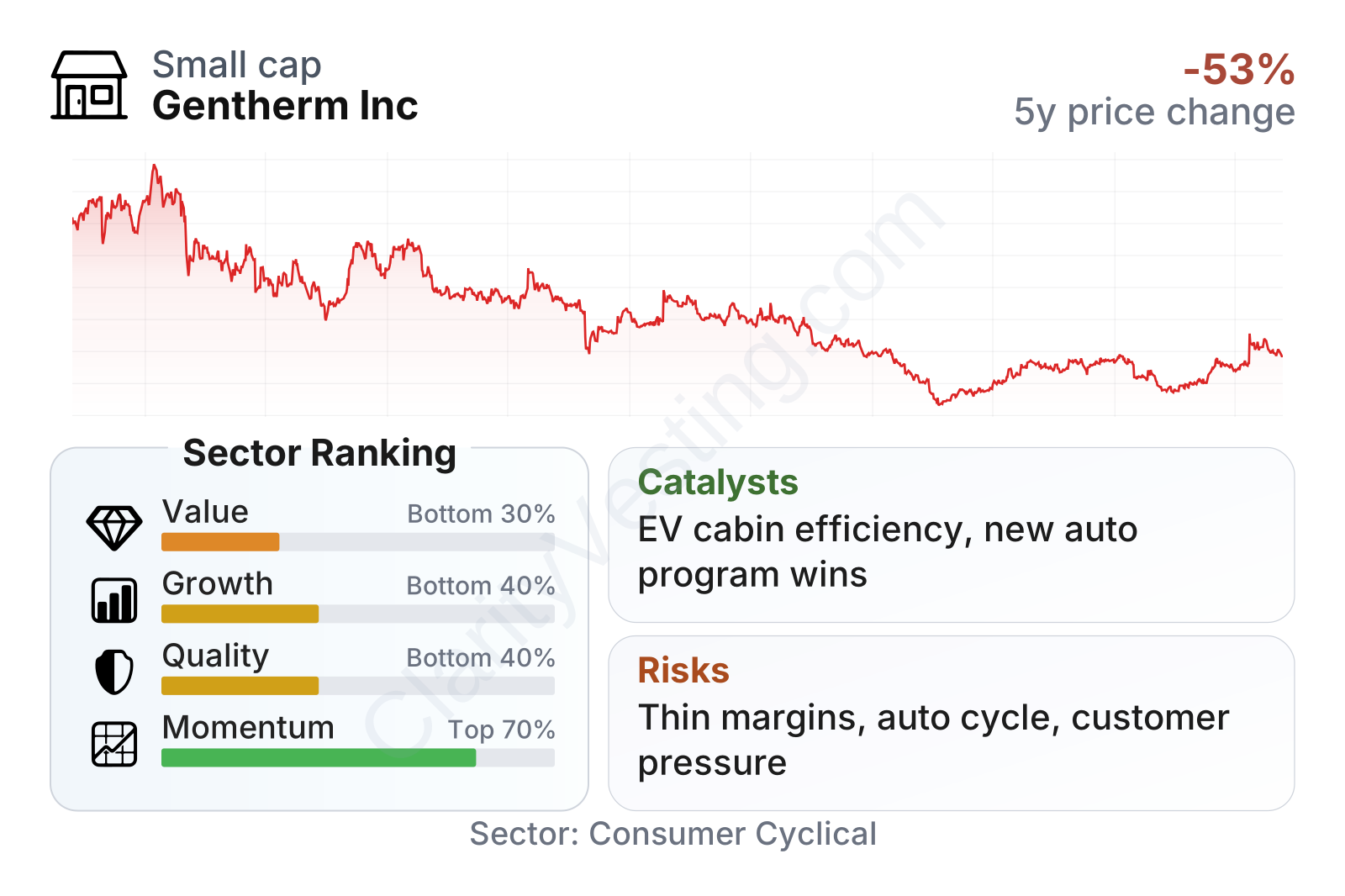
Gentherm is a mid-sized auto-parts company with a stock that has been volatile rather than steadily compounding. Recent price momentum has improved, but the longer three-year share performance still trails much of the sector. The metric mix is also unusual: revenue growth has recently been better than the sector median, while quality and valuation scores remain weaker because margins and returns on capital are still modest. The balance sheet is not the central concern here, since leverage is lower than many peers; the main issue is whether revenue growth can turn into stronger and more durable profitability.
The stock price history reinforces that picture. Shares traded much higher in 2021 and 2022, fell sharply through 2023 and 2025, and remain well below prior peaks. That matters because long-term returns in cyclical suppliers often depend not just on growth, but on buying at a point when margins can recover. Gentherm’s market behavior suggests the market has been re-pricing the company around weaker earnings quality rather than around a collapse in sales.
Growth
Gentherm operates in a part of the vehicle market that still has room to expand. Heated and ventilated seats have moved from premium features toward mainstream adoption, and electric vehicles create a stronger case for localized heating and cooling because warming or cooling the passenger directly can use less energy than conditioning the entire cabin. That can make Gentherm’s products relevant not only in luxury cars, but across a wider range of vehicle programs.
The company’s strategy also makes sense on paper. It is building around three themes: deeper content per vehicle, broader adoption across more trim levels and regions, and adjacent technologies such as cabin sensing and wellness applications. If automakers keep adding comfort, efficiency, and occupant-monitoring features, Gentherm has a path to sell more value into each vehicle instead of relying only on unit growth in global car production.
Recent revenue growth has turned positive again and is running around low-double-digit percentages year over year, which is better than the sector median. Over a five-year period, revenue per share growth has also been ahead of many peers. The challenge is that this growth has been uneven, with periods of contraction mixed with rebounds. That is typical of automotive suppliers, but it means headline sales gains need to be read with caution.
Cash generation has shown a more encouraging recent trend. Free cash flow has recovered strongly from earlier weak levels and moved materially higher in the most recent trailing period. For a manufacturing business, this is important because it suggests operations are still capable of producing cash even when reported earnings remain under pressure. If sustained, stronger cash generation could give Gentherm more flexibility for product development, debt management, and selective capital allocation.
As for catalysts, the most relevant ones are not dramatic one-time events but business developments that can compound over time: new automotive platform launches, greater penetration of thermal comfort systems in non-luxury vehicles, further adoption in electric vehicles, and expansion of the medical business. Recent company updates have also pointed to continued program awards and a pipeline tied to automotive comfort and electronics, which supports the view that customer demand has not disappeared even as profitability remains a work in progress.
Risks
This article is for informational purposes only and does not constitute financial advice. Some content is AI-generated. See Disclaimer


