Stock Analysis · Thor Industries Inc (THO)
Overview
Thor Industries is one of the largest recreational vehicle manufacturers in the world. The company designs, builds, and sells a wide range of RVs, including travel trailers, fifth wheels, motorhomes, and camper vans. Through well-known brands such as Airstream, Jayco, Keystone, Heartland, and European names like Hymer, Thor serves both North American and European customers. Its products are mainly sold through independent dealer networks rather than directly to consumers.
The business is centered on RV manufacturing, but it is diversified across several categories and regions. Based on recent annual reporting, revenue is primarily generated from the sale of:
- North American Towable RVs — roughly half of total revenue, making this the largest segment.
- North American Motorized RVs — about one-quarter to one-third of revenue.
- European RVs — around one-fifth to one-quarter of revenue.
- Other — a small remainder from related parts, services, or smaller activities.
This mix matters because towables are usually more affordable and broad-market, while motorized and premium brands can support stronger pricing. Europe also gives Thor a second geographic engine, which can soften some of the swings of the U.S. cycle, even if it does not remove them.
The long-term pattern in Thor’s business has been highly cyclical. Revenue and profit surged during the post-pandemic outdoor travel boom, then normalized as dealers reduced inventory and consumer demand cooled. That backdrop explains why today’s business is smaller and less profitable than its 2022 peak, even though the company remains one of the industry’s heavyweight operators.
The operating picture shows a clear downshift from the 2022 high point: revenue has fallen materially since then, and profits have compressed even faster. Cost of goods remains the dominant use of sales, while selling and administrative expenses have stayed relatively sticky, which has weighed on operating income as volume came down.
Key Figures
| Metric | Value | Sector ⓘ |
|---|---|---|
| Date | Sep 12, 2026 | |
| Context | ||
| Sector | Consumer Cyclical | |
| Industry | Recreational Vehicles | |
| Market Cap ⓘ | $3.79B | |
| Beta ⓘ | 1.33 | |
Value (Cheapness) | ||
| P/E Ratio ⓘ | 14.75 | 17.10 |
| FCF Yield ⓘ | 5.26% | 8.53% |
| EBIT / EV ⓘ | 8.67% | 6.46% |
| PEG ⓘ | 0.70 | |
Growth (Business expansion) | ||
| Revenue Growth ⓘ | -3.90% | 5.75% |
| RPS Growth (5Y CAGR) ⓘ | -5.10% | 9.14% |
| EPS Growth (5Y CAGR) ⓘ | -40.34% | -18.21% |
| Margin Growth (5Y Trend) ⓘ | -4.03% | -0.23% |
| FCF Growth (5Y CAGR) ⓘ | 3.42% | 4.91% |
Quality (Business durability) | ||
| ROIC (Latest) ⓘ | 5.55% | 12.61% |
| ROIC (5Y Median) ⓘ | 8.41% | 10.72% |
| Net Debt / EBIT (Latest) ⓘ | 1.67 | 2.10 |
| Net Debt / EBIT (5Y Median) ⓘ | 1.22 | 2.32 |
| Operating Margin (Latest) ⓘ | 3.75% | 9.25% |
| Operating Margin (5Y Median) ⓘ | 5.37% | 9.64% |
| Debt to Equity (Latest) ⓘ | 22.87% | 75.78% |
| Profit Margin (Latest) ⓘ | 2.67% | 5.33% |
| Free Cash Flow (Latest) ⓘ | $199.65M | |
Momentum (Price trend) | ||
| 3Y Return ⓘ | -21.01% | +14.53% |
| 12M Return (excl. last month) ⓘ | -19.97% | +3.08% |
| 6M Return ⓘ | -10.29% | +0.55% |
| Price vs. 200-Day MA ⓘ | -16.47% | -0.54% |
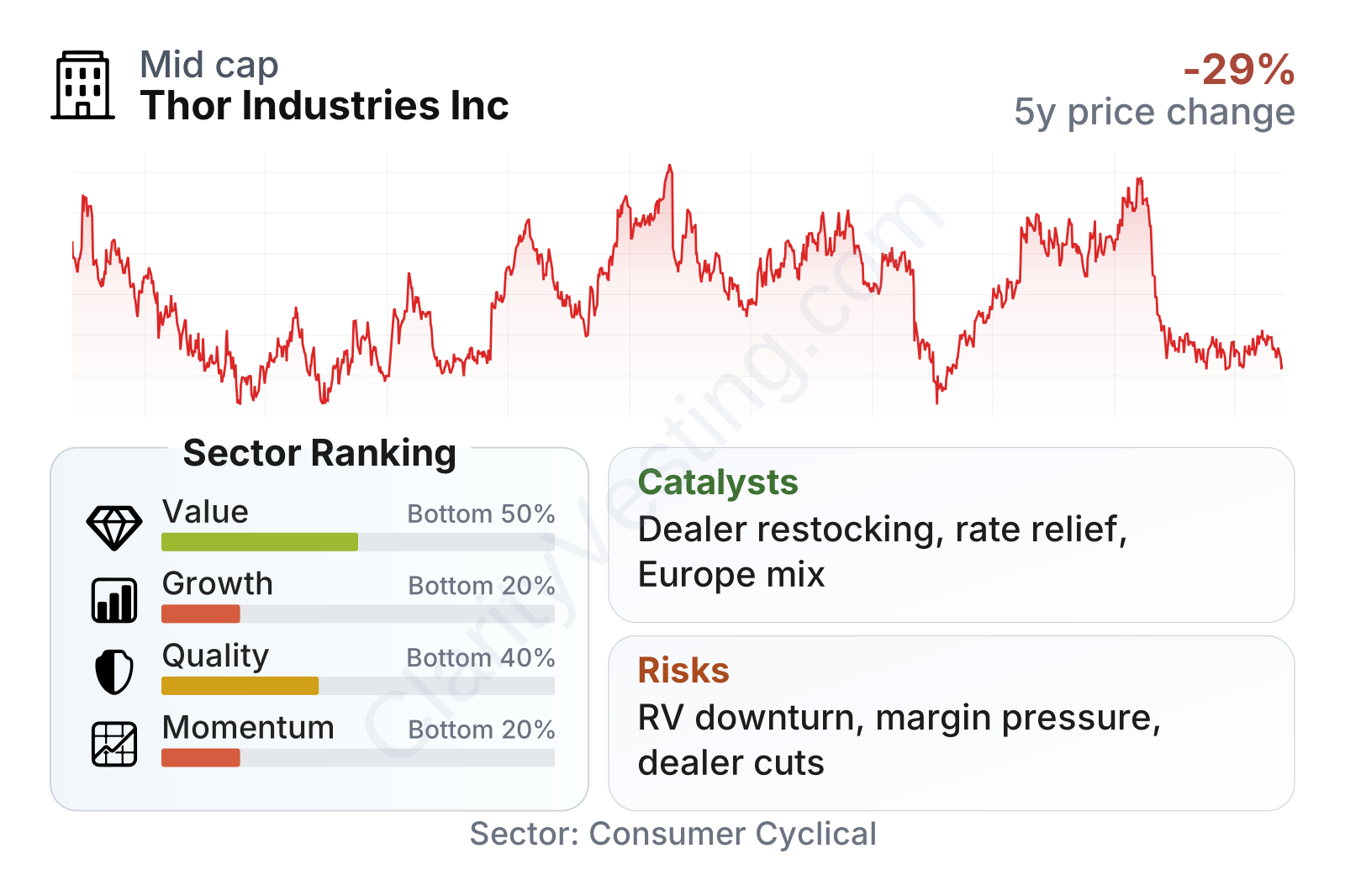
Thor currently sits in the middle of the pack on valuation, but weaker on growth, quality, and market performance versus much of the broader consumer cyclical sector. The market capitalization is in the mid-single-digit billions, and the stock’s beta above 1 suggests it tends to move more than the overall market. One important offset is balance sheet strength: debt levels are much lighter than the sector median, which gives the company more flexibility than many cyclical peers when conditions are difficult.
The share price history also reflects the nature of the business. The stock has gone through sharp swings over the past several years, rising when RV demand and margins improved and falling when the market began to price in slower orders, dealer caution, and weaker profitability.
Growth
Thor operates in a sector that can grow over long periods, but not in a straight line. RV demand benefits from several structural themes: the appeal of outdoor travel, flexible and mobile lifestyles, retiree spending, campground investment, and interest in more experience-based leisure. In Europe, the camper van and motorhome market also has long-term relevance, supported by domestic tourism and changing travel habits. Still, this is a cyclical industry tied to consumer confidence, interest rates, and the availability of dealer financing.
Thor’s strategy for future growth is logical. The company has built a broad brand portfolio across price points and vehicle types, it has a large dealer network, and it has maintained exposure to both North America and Europe. It has also emphasized innovation in lighter products, improved manufacturing efficiency, and features that respond to consumer preferences around usability, power systems, and comfort. Those moves do not eliminate cyclicality, but they can help Thor capture demand when the market recovers.
Recent sales trends show that the business is still working through a choppy recovery rather than a smooth expansion. Year-over-year growth turned positive at points after a long contraction, which suggested that the worst of the post-boom reset may have passed, but the latest reading slipped back slightly negative. That points to a market that remains uneven, with demand and dealer restocking not yet firmly established.
Cash generation has also cooled materially from the unusually strong levels seen a few years ago. Even so, Thor is still producing positive free cash flow, which matters in a cyclical manufacturing business. Positive cash flow gives management room to support operations, invest in products and capacity, and continue capital allocation without relying too heavily on borrowing.
A meaningful catalyst for Thor is any sustained normalization in dealer inventories. When dealers become comfortable that retail demand is holding, wholesale orders can rebound sharply because production has been held below prior peak levels for a prolonged period. Another catalyst is lower financing pressure on consumers: RV purchases are often financed, so a friendlier rate environment can improve affordability and support unit demand. The company’s premium brands, especially Airstream and parts of its European portfolio, can also help if buyers continue to favor differentiated products over entry-level offerings.
Recent company updates have also pointed to ongoing efforts around cost control, inventory discipline, and production alignment with demand. In a cyclical downturn, those actions may not look exciting, but they are important because they can position the company to translate a future recovery in shipments into stronger margin improvement.
Risks
This article is for informational purposes only and does not constitute financial advice. Some content is AI-generated. See Disclaimer


