Stock Analysis · Teradyne Inc (TER)
Overview
Teradyne is a technology equipment company best known for building automated test systems used by semiconductor manufacturers and electronics companies. In simple terms, its machines help customers verify that chips and electronic products work correctly before they are shipped. Teradyne also owns a large industrial automation business focused on collaborative robots, autonomous mobile robots, and software that helps factories automate repetitive tasks.
The company’s business is split between semiconductor test and industrial automation. Semiconductor test has historically been the core profit engine, while robotics and automation represent the longer-term expansion area. Demand is tied to major industry cycles such as smartphone upgrades, data center investment, artificial intelligence infrastructure, automotive electronics, and factory automation spending.
Based on recent company reporting, Teradyne’s main revenue sources can be summarized as follows:
- Semiconductor Test: about 65% to 75% of revenue. This includes systems used to test wafer-level and packaged chips, especially for system-on-chip devices, memory, and high-performance compute applications.
- Robotics: about 15% to 25% of revenue. This includes collaborative robots from Universal Robots and mobile robots and software from the company’s automation platforms.
- System Test and other: about 10% to 15% of revenue. This covers test equipment for storage, wireless, defense, aerospace, and other specialized electronics applications.
Over the last several years, the mix has remained centered on semiconductor test, but management has kept investing in robotics to reduce dependence on the chip cycle and to build exposure to factory automation. Profitability has remained strong even during weaker demand periods, showing that the core franchise still carries significant pricing power and scale advantages.
The long-term pattern shows a business that went through a cyclical revenue decline after 2021, then rebuilt sales and earnings. Even during that downturn, gross profit stayed solid, which suggests the company’s products remain valuable to customers and that the business model can absorb volatility better than many capital equipment peers.
Key Figures
| Metric | Value | Sector ⓘ |
|---|---|---|
| Date | Sep 12, 2026 | |
| Context | ||
| Sector | Technology | |
| Industry | Semiconductor Equipment & Materials | |
| Market Cap ⓘ | $59.37B | |
| Beta ⓘ | 1.78 | |
Value (Cheapness) | ||
| P/E Ratio ⓘ | 50.76 | 29.51 |
| FCF Yield ⓘ | 1.35% | 4.25% |
| EBIT / EV ⓘ | 2.35% | 2.85% |
| PEG ⓘ | 0.68 | |
Growth (Business expansion) | ||
| Revenue Growth ⓘ | 103.90% | 15.40% |
| RPS Growth (5Y CAGR) ⓘ | 0.09% | 8.56% |
| EPS Growth (5Y CAGR) ⓘ | 4.87% | -11.88% |
| Margin Growth (5Y Trend) ⓘ | -11.73% | 0.46% |
| FCF Growth (5Y CAGR) ⓘ | -17.36% | 9.80% |
Quality (Business durability) | ||
| ROIC (Latest) ⓘ | 37.97% | 9.44% |
| ROIC (5Y Median) ⓘ | 34.04% | 8.30% |
| Net Debt / EBIT (Latest) ⓘ | -0.18 | 0.54 |
| Net Debt / EBIT (5Y Median) ⓘ | -0.75 | 0.44 |
| Operating Margin (Latest) ⓘ | 30.29% | 9.58% |
| Operating Margin (5Y Median) ⓘ | 21.73% | 8.25% |
| Debt to Equity (Latest) ⓘ | 2.91% | 33.33% |
| Profit Margin (Latest) ⓘ | 25.77% | 7.14% |
| Free Cash Flow (Latest) ⓘ | $799.93M | |
Momentum (Price trend) | ||
| 3Y Return ⓘ | +292.36% | +45.48% |
| 12M Return (excl. last month) ⓘ | +261.70% | +23.48% |
| 6M Return ⓘ | +32.59% | +20.93% |
| Price vs. 200-Day MA ⓘ | +18.52% | +7.43% |
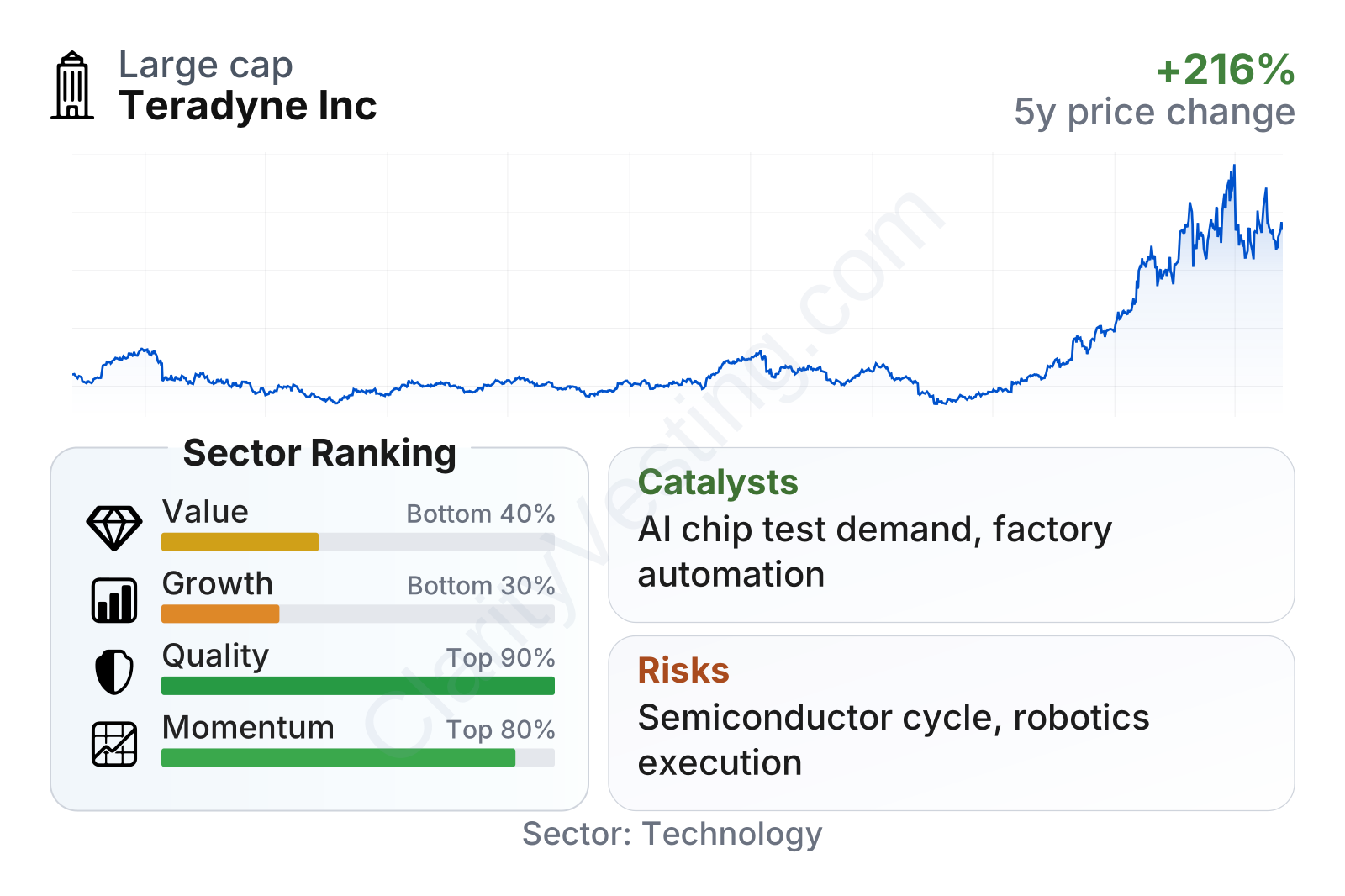
Teradyne stands out more for business quality than for cheap valuation. Profitability, returns on invested capital, and balance sheet strength rank well above much of the technology equipment sector, while recent share performance has also been exceptionally strong. By contrast, the valuation profile looks rich versus sector norms, and longer-term growth measures still reflect the industry downturn that affected results over the last few years.
The company is a large-cap technology name with above-average share price volatility, which is not unusual for a business tied to semiconductor and industrial spending cycles. The combination of very high quality and expensive valuation usually means the market is already recognizing the strength of the franchise.
Growth
Teradyne operates in two markets with credible long-term tailwinds. The first is semiconductor testing, where chip complexity keeps increasing. Advanced processors for artificial intelligence, automotive electronics, data centers, and connected devices require more sophisticated test steps, and that tends to support demand for premium equipment. The second is industrial automation, where manufacturers continue looking for ways to offset labor shortages, improve productivity, and automate repetitive work.
Its strategy for future growth is logical. In semiconductor test, the company is positioned where technical requirements are rising, especially in high-performance computing and advanced packaging. In automation, it has built a broader offering that goes beyond a single robot arm and includes mobile robots and software. This gives it exposure to a larger share of customer spending inside factories, even if robotics demand can be uneven from quarter to quarter.
The recent revenue trend shows a sharp acceleration after a long weak patch. That does not erase the cyclical nature of the business, but it does suggest that Teradyne is benefiting from a stronger demand environment and possibly from new product ramps. A rebound of this size usually matters because semiconductor equipment companies often see margin improvement as volume returns.
Cash generation has been positive throughout the period shown, although not at peak levels seen earlier in the cycle. That is still important: even when revenue was under pressure, the company remained cash generative. For a long-term analysis, this supports the view that Teradyne has the financial flexibility to continue funding research, acquisitions, and shareholder returns without relying heavily on debt.
A meaningful recent catalyst is the broader buildout of AI-related chip infrastructure. Testing needs typically rise when chips become more complex and more expensive, because customers cannot afford failures. Another catalyst is the gradual adoption of collaborative robots and mobile automation across manufacturing, logistics, and warehousing. If factory automation spending strengthens, Teradyne has a platform that can participate beyond its traditional semiconductor niche.
Risks
This article is for informational purposes only and does not constitute financial advice. Some content is AI-generated. See Disclaimer


