Stock Analysis · Tenable Holdings Inc (TENB)
Overview
Tenable Holdings is a cybersecurity software company focused on helping organizations understand where they are exposed to cyber risk. Its products are designed to find, assess, and prioritize vulnerabilities across traditional IT systems, cloud environments, identity systems, operational technology, and other connected assets. In simple terms, Tenable helps customers answer a basic but important question: where are the weak points in our digital environment, and which ones matter most?
The company sells mainly through subscriptions, which is common in security software because customers need continuous monitoring rather than one-time checks. Tenable’s platform has expanded over time from its well-known vulnerability management roots into broader exposure management, including cloud security and identity-related risk. That matters because many companies now operate across on-premise infrastructure, multiple clouds, remote devices, and machine identities, making cyber risk harder to track in one place.
Revenue is overwhelmingly recurring and subscription-based. Based on recent annual filings, the business mix can be summarized approximately as follows:
- Subscription revenue: about 95% to 97% of total revenue. This includes cloud-delivered security offerings, term-based software subscriptions, and recurring platform access.
- Professional services and other revenue: about 3% to 5% of total revenue. This generally includes consulting, training, implementation, and support-related services tied to customer deployments.
By product family, Tenable does not always provide a precise revenue split in public filings for every category, but the business is still centered on exposure management and vulnerability management, with growing contributions from cloud security, identity exposure, and operational technology security.
The financial flow also shows a useful pattern: revenue has risen steadily from a little above $500 million in 2021 to nearly $1.0 billion in 2025, while gross profit has remained strong. The main pressure point has been operating expenses, especially research and development and sales-related spending, which explains why accounting profits have lagged revenue growth even as cash generation improved.
Key Figures
| Metric | Value | Sector ⓘ |
|---|---|---|
| Date | Sep 12, 2026 | |
| Context | ||
| Sector | Technology | |
| Industry | Software - Infrastructure | |
| Market Cap ⓘ | $3.32B | |
| Beta ⓘ | 0.96 | |
Value (Cheapness) | ||
| P/E Ratio ⓘ | N/A | 29.51 |
| FCF Yield ⓘ | 8.09% | 4.25% |
| EBIT / EV ⓘ | 1.72% | 2.85% |
| PEG ⓘ | 1.09 | |
Growth (Business expansion) | ||
| Revenue Growth ⓘ | 8.60% | 15.40% |
| RPS Growth (5Y CAGR) ⓘ | 13.09% | 8.56% |
| EPS Growth (5Y CAGR) ⓘ | 12.30% | -11.88% |
| Margin Growth (5Y Trend) ⓘ | N/A | 0.46% |
| FCF Growth (5Y CAGR) ⓘ | 29.62% | 9.80% |
Quality (Business durability) | ||
| ROIC (Latest) ⓘ | 3.58% | 9.44% |
| ROIC (5Y Median) ⓘ | -6.08% | 8.30% |
| Net Debt / EBIT (Latest) ⓘ | 4.72 | 0.54 |
| Net Debt / EBIT (5Y Median) ⓘ | N/A | 0.44 |
| Operating Margin (Latest) ⓘ | 6.02% | 9.58% |
| Operating Margin (5Y Median) ⓘ | -6.53% | 8.25% |
| Debt to Equity (Latest) ⓘ | 212.48% | 33.33% |
| Profit Margin (Latest) ⓘ | 0.65% | 7.14% |
| Free Cash Flow (Latest) ⓘ | $268.41M | |
Momentum (Price trend) | ||
| 3Y Return ⓘ | -33.88% | +45.48% |
| 12M Return (excl. last month) ⓘ | +24.92% | +23.48% |
| 6M Return ⓘ | +48.40% | +20.93% |
| Price vs. 200-Day MA ⓘ | +14.98% | +7.43% |
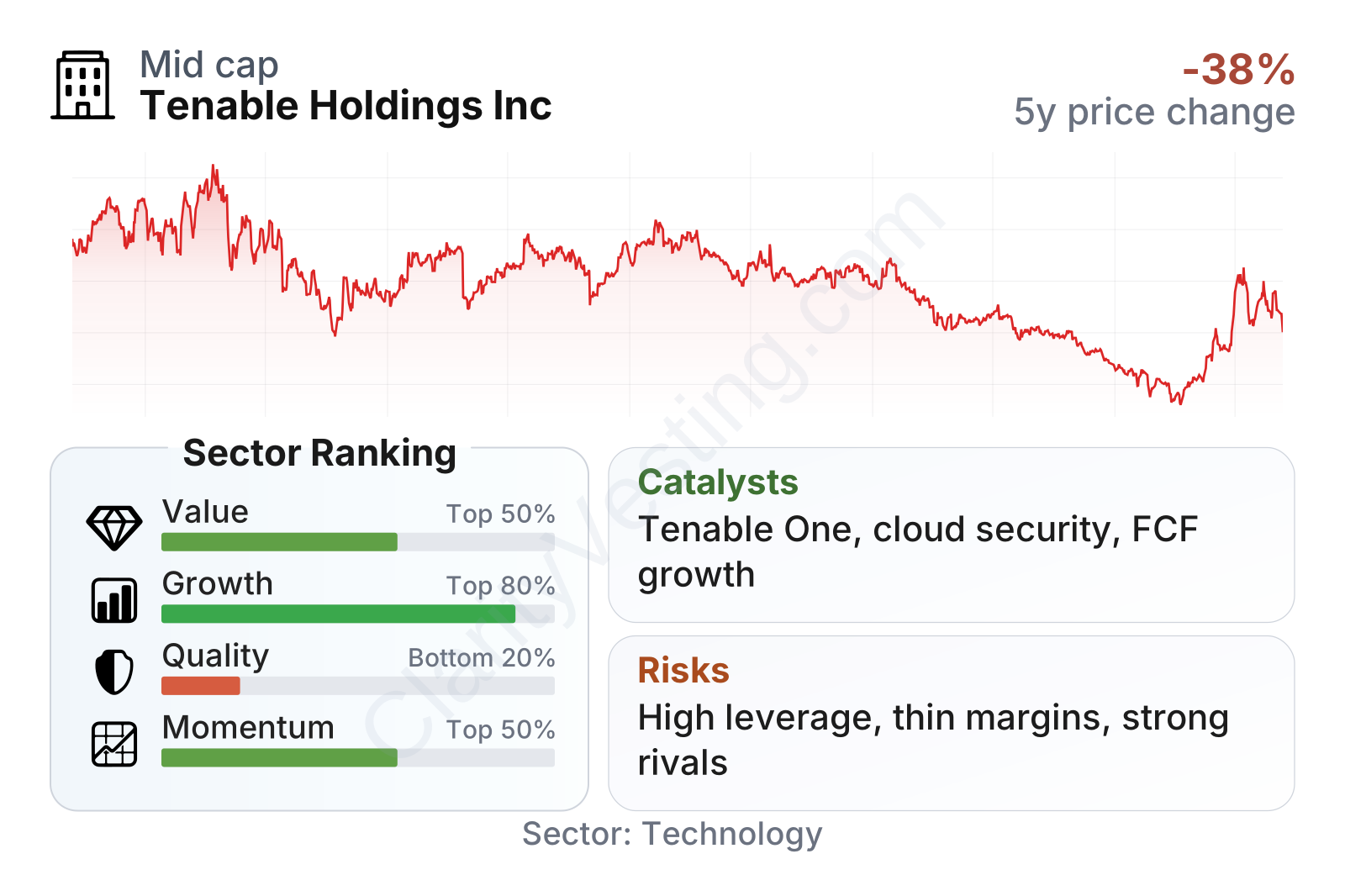
Tenable sits in the mid-cap range within software, with share-price volatility that has been lower than many technology names. The broader picture from the metrics is mixed but understandable: growth and cash generation look better than profitability, while balance-sheet leverage is weaker than much of the sector. Value indicators are not stretched on cash flow, but the absence of a meaningful positive P/E reflects how thin net earnings still are.
Growth
Cybersecurity remains a structurally growing market. Companies are dealing with a larger attack surface as more workloads move to cloud environments, identity systems become more complex, and industrial and connected devices stay online longer. Tenable’s focus on exposure management fits this trend because organizations increasingly want a broader view of risk rather than a long list of isolated alerts. That places the company in a part of the security market that still has room to expand over several years.
Tenable’s strategy also makes sense in that context. The company started with vulnerability management, where it built strong brand recognition through Nessus and related products, then moved into adjacent areas such as cloud security, identity exposure, and operational technology security. This kind of expansion gives it a chance to sell more products into its existing customer base while remaining relevant as cybersecurity budgets shift toward platform consolidation.
Revenue growth has clearly slowed from the very strong levels seen in 2021 and 2022, when year-over-year growth was often above 20%, to high-single-digit growth more recently. That deceleration is important, but it does not necessarily mean the growth case is broken. It suggests Tenable is moving from a faster early scaling phase into a more mature stage where execution, cross-selling, and margin discipline matter more. Over a five-year view, revenue per share growth remains stronger than the sector median, which points to a business that has still compounded at a respectable pace.
One of the more encouraging trends is cash generation. Free cash flow has increased materially over the last several years and is now well above earlier levels, reaching roughly the mid-$200 million range on a trailing basis. That is a meaningful sign because it shows the business is producing real cash even though accounting earnings remain modest. In software, that often reflects the advantages of recurring revenue, disciplined customer retention, and upfront billing dynamics.
Recent company updates have also emphasized platform development around Tenable One, cloud security, and identity exposure. Those are notable opportunities because customers increasingly want fewer tools and more integrated visibility across different environments. If Tenable can deepen its role as a central risk-view platform rather than only a vulnerability scanner, its addressable market becomes broader and its customer relationships can become stickier.
Risks
This article is for informational purposes only and does not constitute financial advice. Some content is AI-generated. See Disclaimer


