Stock Analysis · Atlassian Corp Plc (TEAM)
Overview
Atlassian is a software company focused on helping teams plan work, build products, manage IT services, and collaborate. Its best-known products include Jira for project and software workflow management, Confluence for team knowledge sharing, and Trello for visual task management. Over time, the company has expanded from tools used mainly by software developers into broader workplace, operations, and service management categories.
The business model is largely subscription-based, which makes revenue more recurring and easier to forecast than one-time software sales. Atlassian has been pushing customers toward cloud versions of its products, while also adding features tied to automation, analytics, and artificial intelligence.
Based on recent annual reporting, revenue comes mainly from software subscriptions, with smaller contributions from maintenance and other services. The broad mix is approximately:
- Subscriptions: about 90%+ of revenue. This includes cloud and data center subscriptions for products such as Jira, Confluence, Jira Service Management, Trello, and related apps.
- Maintenance: about 5%–10% of revenue. This mainly reflects support and maintenance tied to older server and data center arrangements.
- Other: low single-digit share of revenue. This includes professional services and a small amount of other activities.
Inside subscriptions, cloud is the key engine. Atlassian has spent several years moving customers away from older server deployments, which has made the company more dependent on recurring cloud spending and on expansion within existing customers.
The business also benefits from an ecosystem of third-party developers that build applications on the Atlassian Marketplace, increasing the usefulness of core products and raising switching costs for customers that standardize on the platform.
The financial flow highlights a software model with very high gross profit, but also unusually heavy spending on research and development. Revenue has expanded strongly over the past several years, while operating losses have narrowed at times and then widened again as product investment remained aggressive.
Key Figures
| Metric | Value | Sector ⓘ |
|---|---|---|
| Date | Sep 12, 2026 | |
| Context | ||
| Sector | Technology | |
| Industry | Software - Application | |
| Market Cap ⓘ | $45.46B | |
| Beta ⓘ | 1.16 | |
Value (Cheapness) | ||
| P/E Ratio ⓘ | N/A | 29.51 |
| FCF Yield ⓘ | 2.90% | 4.25% |
| EBIT / EV ⓘ | 0.02% | 2.85% |
| PEG ⓘ | 1.85 | |
Growth (Business expansion) | ||
| Revenue Growth ⓘ | 27.60% | 15.40% |
| RPS Growth (5Y CAGR) ⓘ | 22.92% | 8.56% |
| EPS Growth (5Y CAGR) ⓘ | 28.67% | -11.88% |
| Margin Growth (5Y Trend) ⓘ | N/A | 0.46% |
| FCF Growth (5Y CAGR) ⓘ | 15.14% | 9.80% |
Quality (Business durability) | ||
| ROIC (Latest) ⓘ | -0.13% | 9.44% |
| ROIC (5Y Median) ⓘ | -2.45% | 8.30% |
| Net Debt / EBIT (Latest) ⓘ | -0.64 | 0.54 |
| Net Debt / EBIT (5Y Median) ⓘ | N/A | 0.44 |
| Operating Margin (Latest) ⓘ | 0.16% | 9.58% |
| Operating Margin (5Y Median) ⓘ | -1.31% | 8.25% |
| Debt to Equity (Latest) ⓘ | 116.48% | 33.33% |
| Profit Margin (Latest) ⓘ | -0.82% | 7.14% |
| Free Cash Flow (Latest) ⓘ | $1.32B | |
Momentum (Price trend) | ||
| 3Y Return ⓘ | -14.92% | +45.48% |
| 12M Return (excl. last month) ⓘ | -1.75% | +23.48% |
| 6M Return ⓘ | +145.02% | +20.93% |
| Price vs. 200-Day MA ⓘ | +63.50% | +7.43% |
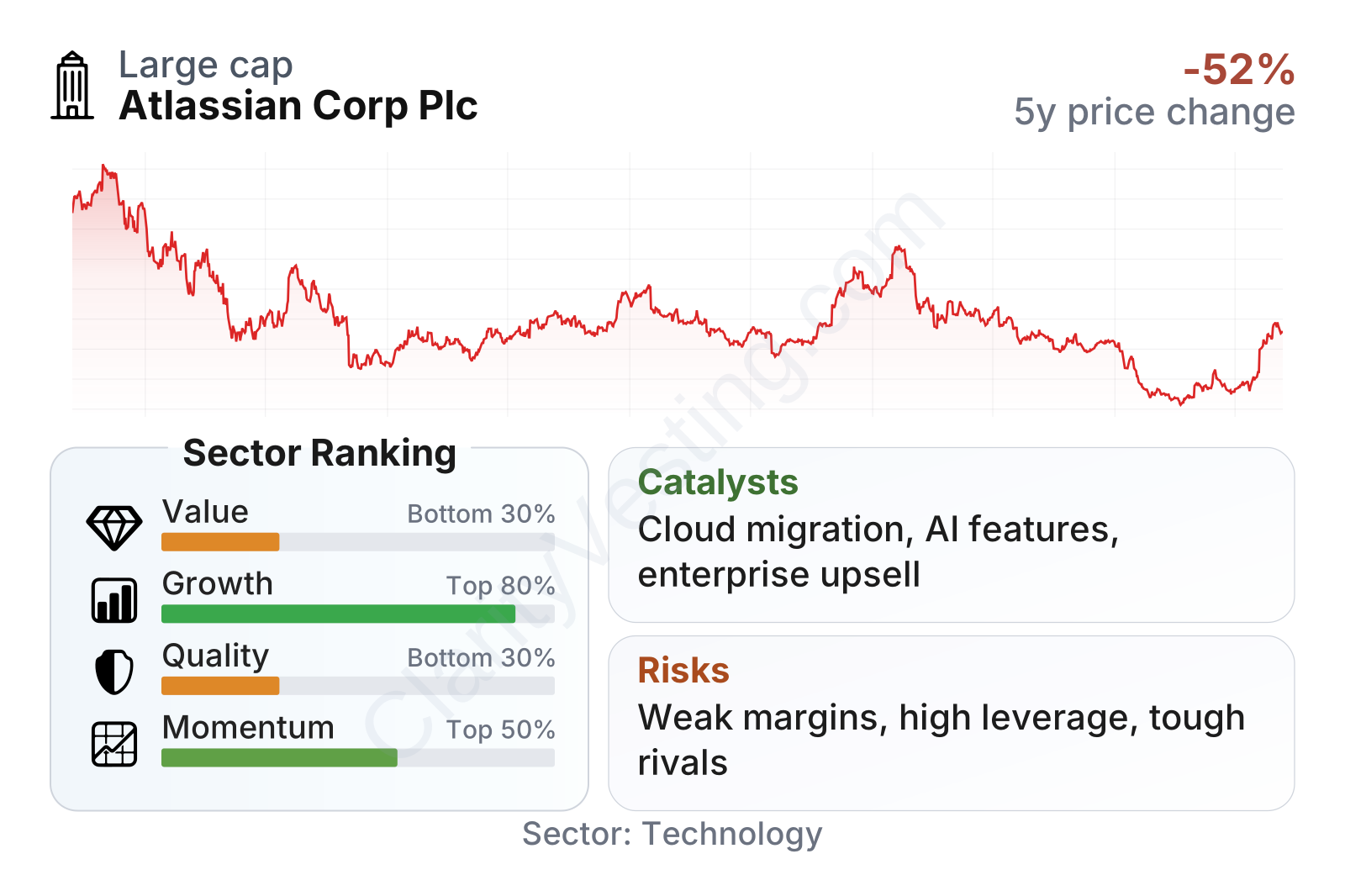
Atlassian stands out more for growth than for current profitability. Relative to the broader software group, revenue growth and multi-year expansion remain strong, while quality measures such as operating margin, return on invested capital, and profit margin still lag. Free cash flow remains an important offset: even with weak accounting profits, the company is producing meaningful cash and sits in the upper range of the sector on that measure.
The stock’s history also shows how much market expectations have changed. After a very strong period in 2021, the shares went through a deep reset and have remained volatile. More recently, momentum improved from depressed levels, but the longer-term price record still reflects the market’s caution around valuation and profitability.
Growth
Atlassian operates in a favorable long-term segment of software: work management, developer tools, collaboration, and IT service management. These are categories supported by durable trends such as digital transformation, hybrid work, rising software complexity, and the need for teams to organize workflows across departments. This is not a niche demand cycle; it is tied to how modern organizations operate.
The company’s strategy is coherent. Atlassian began with strong positions in technical teams, especially software development, then expanded into adjacent functions such as knowledge management and IT support. That matters because it lets the company grow in two ways at once: winning new customers and selling more products to organizations already using Jira or Confluence.
Revenue growth has stayed strong for several years and has generally remained above the software sector median. There is one extremely high recent reading that likely reflects an unusual comparison effect rather than a new normal, so the more useful takeaway is that Atlassian has mostly sustained growth in the 20%+ range, which is robust for a company of its size.
A major growth catalyst is cloud migration. As customers move from older self-managed products to cloud subscriptions, Atlassian can improve recurring revenue visibility, release new features faster, and create more opportunities to add premium capabilities. The company is also emphasizing enterprise customers, which typically have larger deployments and more cross-sell potential.
Artificial intelligence is another meaningful opportunity. Atlassian has been embedding AI across its platform to help teams search knowledge, summarize work, automate tasks, and improve service management. In practical terms, this can make the products more valuable rather than simply more complex. If these features help customers work faster or reduce support workloads, that can support higher adoption and pricing power over time.
Another favorable point is distribution efficiency. Atlassian has long relied on a relatively low-touch sales approach compared with many enterprise software peers. That model helped it scale efficiently in earlier years and still provides an advantage in reaching small and mid-sized teams that may later expand into larger contracts.
Cash generation has risen significantly over the last several years, even though the latest trailing figure is below its recent peak. That pattern suggests the core business has real financial strength beneath the accounting losses. For long-term analysis, this is important: strong cash creation gives the company flexibility to keep investing in product development, infrastructure, and enterprise expansion without the same pressure faced by weaker software names.
Recent company updates also point to continued focus on enterprise cloud, service management, and AI-powered workflows. These are sensible areas to prioritize because they build on existing customer behavior rather than asking Atlassian to enter entirely unrelated markets.
Risks
This article is for informational purposes only and does not constitute financial advice. Some content is AI-generated. See Disclaimer


