Stock Analysis · Telephone and Data Systems Inc (TDS)
Overview
Telephone and Data Systems Inc. is a U.S. telecommunications company that provides wireless and wireline connectivity. Its best-known asset is its majority ownership of UScellular, a regional wireless carrier serving customers across many mid-sized and rural markets. TDS also operates broadband, hosted services, and traditional phone infrastructure through its TDS Telecom business.
The business has changed meaningfully in recent years. Historically, wireless service represented the largest share of revenue, but the company has been reshaped by announced and ongoing transactions involving UScellular assets. That makes TDS less of a simple telecom income business and more of a company in transition, with future value depending heavily on how it reallocates capital, manages remaining operations, and develops its fiber and broadband footprint.
Based on recent company disclosures, the main revenue sources have been:
- Wireless services and equipment via UScellular — historically the largest contributor, generating a clear majority of consolidated revenue before the recent asset sales process. This includes monthly service plans, device sales, roaming, and related wireless operations.
- Wireline and broadband services via TDS Telecom — the second-largest contributor, coming from residential broadband, commercial connectivity, video, voice, managedIP, and transport services. Fiber-based broadband has become an increasing strategic priority within this segment.
- Other and intercompany-related items — a much smaller share, including corporate and miscellaneous activities.
At a high level, the company’s revenue mix has been concentrated in telecom access: recurring subscription revenue from wireless and broadband, plus a smaller layer of equipment sales. The recent sharp drop in total revenue shown in the business flow is tied less to normal customer demand swings and more to structural changes from divestitures and portfolio repositioning.
The long-term pattern shows a business with relatively steady gross profit for several years, but with pressure from operating costs, interest expense, and restructuring effects. More recently, the company’s scale has contracted sharply, which highlights how different the post-transaction TDS may look compared with the older version of the company.
Key Figures
| Metric | Value | Sector ⓘ |
|---|---|---|
| Date | Sep 12, 2026 | |
| Context | ||
| Sector | Communication Services | |
| Industry | Telecom Services | |
| Market Cap ⓘ | $4.31B | |
| Beta ⓘ | 0.34 | |
Value (Cheapness) | ||
| P/E Ratio ⓘ | 9.48 | 18.61 |
| FCF Yield ⓘ | -10.50% | 13.68% |
| EBIT / EV ⓘ | 18.91% | 4.54% |
| PEG ⓘ | 7.79 | |
Growth (Business expansion) | ||
| Revenue Growth ⓘ | 3.60% | 5.40% |
| RPS Growth (5Y CAGR) ⓘ | -30.59% | 4.62% |
| EPS Growth (5Y CAGR) ⓘ | N/A | -18.01% |
| Margin Growth (5Y Trend) ⓘ | 11.07% | 1.10% |
| FCF Growth (5Y CAGR) ⓘ | N/A | 5.88% |
Quality (Business durability) | ||
| ROIC (Latest) ⓘ | 28.83% | 8.38% |
| ROIC (5Y Median) ⓘ | 2.47% | 8.32% |
| Net Debt / EBIT (Latest) ⓘ | -1.11 | 1.99 |
| Net Debt / EBIT (5Y Median) ⓘ | 15.58 | 2.94 |
| Operating Margin (Latest) ⓘ | 67.50% | 14.89% |
| Operating Margin (5Y Median) ⓘ | 5.22% | 12.96% |
| Debt to Equity (Latest) ⓘ | 24.16% | 59.59% |
| Profit Margin (Latest) ⓘ | 33.20% | 8.77% |
| Free Cash Flow (Latest) ⓘ | -$452.35M | |
Momentum (Price trend) | ||
| 3Y Return ⓘ | +122.19% | +46.64% |
| 12M Return (excl. last month) ⓘ | -14.50% | +2.16% |
| 6M Return ⓘ | -14.15% | +5.05% |
| Price vs. 200-Day MA ⓘ | -7.23% | +2.88% |
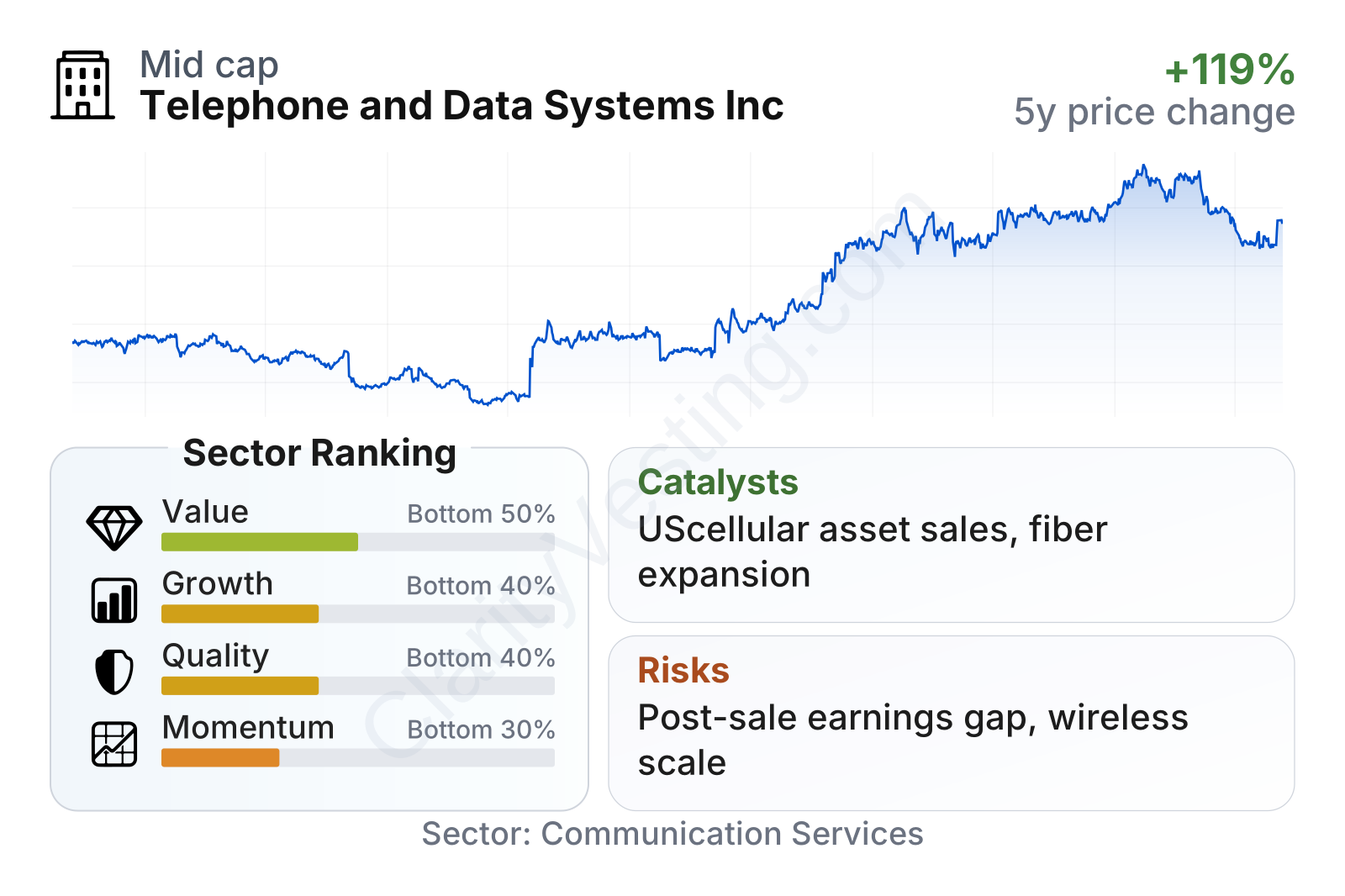
TDS is currently a mid-sized public company with an unusually low beta of about 0.35, meaning its stock has tended to move less than the broader market. In the factor summary, valuation looks mixed: the earnings multiple is below the sector median, but free cash flow is negative, which weakens the case for calling the shares plainly cheap. Quality and growth rankings both sit in the lower part of the sector, even though some recent profitability measures look unusually strong because they were influenced by one-time items rather than a clean operating trend. Momentum has also cooled after a strong multiyear run, with the shares below their 200-day average and weaker over the last six months.
Growth
The telecom sector is mature, but not stagnant. Growth today comes less from adding basic phone lines and more from upgrading networks, selling faster broadband, expanding fiber, and monetizing wireless spectrum and infrastructure more efficiently. For TDS, that means the most relevant growth question is not whether telecom demand exists, but whether the company can shift toward the parts of telecom still gaining strategic value.
TDS Telecom’s fiber expansion is the clearest industrial logic inside the group. Fiber broadband tends to support better customer retention, higher service quality, and a stronger long-term competitive position than legacy copper networks. In many smaller and rural communities, fiber deployment can also face less intense overbuilding than in major urban markets. If TDS continues converting more of its footprint toward fiber-based service, that supports a more durable operating base.
The problem is that reported revenue growth is currently not a good picture of ordinary operating momentum. Recent year-over-year declines are extremely large, but they mainly reflect major portfolio changes rather than a simple collapse in demand. That makes top-line comparisons difficult to interpret. Earlier periods already showed uneven growth, and the latest readings confirm that TDS is in a transition phase rather than a steady expansion phase.
Cash generation also tells an important part of the story. Free cash flow improved materially from deeply negative levels to solidly positive territory through 2025, then turned negative again more recently. That swing suggests the company’s underlying economics are being affected by both investment spending and transaction-related timing. For a telecom operator, stable free cash flow is especially important because the business requires continuous spending on networks and spectrum-related obligations.
A major catalyst has been the series of announced transactions involving UScellular spectrum licenses, customers, and operations. Those deals can unlock value from assets that may be worth more to larger national carriers than to TDS as a standalone regional operator. In parallel, TDS has discussed using proceeds to strengthen the balance sheet and support strategic priorities. This is the single biggest reason the market has paid close attention to the company: asset monetization can materially change its financial structure and future business mix.
Another positive strategic angle is that a simpler company centered more heavily on wireline broadband could become easier to understand and evaluate. Telecom investors often place more confidence in businesses with a clearer operating identity than in groups that combine shrinking legacy assets with capital-intensive wireless operations lacking national scale.
Risks
This article is for informational purposes only and does not constitute financial advice. Some content is AI-generated. See Disclaimer


