Stock Analysis · Teradata Corp (TDC)
Overview
Teradata is a software company focused on enterprise data analytics. In simple terms, it helps large organizations collect, store, manage, and analyze very large amounts of information so they can make business decisions, run artificial intelligence models, and improve operations. Its main platform is Teradata Vantage, which is offered both in the cloud and in hybrid environments that combine cloud and on-premises systems.
The company mainly serves large businesses and public-sector clients that need reliable analytics at scale. Teradata’s pitch is not to be the broadest cloud platform overall, but to be strong in complex, high-volume data workloads where performance, governance, and security matter.
Based on recent company filings, revenue is primarily generated from recurring software and service relationships. The mix has been shifting toward subscription and cloud-based arrangements, while legacy on-premises activity continues to decline.
- Recurring revenue: approximately 80%+ of total revenue. This includes subscription software, cloud offerings, maintenance, and other recurring contractual payments. This is the core of the business and provides better visibility than one-time sales.
- Consulting and services: roughly 10% to 15%. These activities include implementation, support, and advisory work that help customers deploy and optimize Teradata’s platform.
- Perpetual licenses and other non-recurring software revenue: less than 10%. This is the legacy part of the model and has been shrinking as the company moves customers toward subscription and cloud contracts.
Geographically, Teradata has a diversified footprint across the Americas, Europe, the Middle East, Africa, and Asia-Pacific, with no single small market defining the investment case. The more important business split is between newer recurring cloud activity and older legacy contracts.
At a high level, the business has become leaner over the past several years. Revenue has trended lower, but operating expenses have also been reduced, especially selling and administrative costs, which has supported profitability.
The long-term pattern shows a company generating high gross profit from a relatively stable cost base, while trimming operating expenses to protect earnings and cash generation even as total revenue has eased.
Key Figures
| Metric | Value | Sector ⓘ |
|---|---|---|
| Date | Sep 12, 2026 | |
| Context | ||
| Sector | Technology | |
| Industry | Software - Infrastructure | |
| Market Cap ⓘ | $2.54B | |
| Beta ⓘ | 0.58 | |
Value (Cheapness) | ||
| P/E Ratio ⓘ | 5.87 | 29.51 |
| FCF Yield ⓘ | 29.28% | 4.25% |
| EBIT / EV ⓘ | 26.80% | 2.85% |
| PEG ⓘ | 3.35 | |
Growth (Business expansion) | ||
| Revenue Growth ⓘ | 0.50% | 15.40% |
| RPS Growth (5Y CAGR) ⓘ | 0.35% | 8.56% |
| EPS Growth (5Y CAGR) ⓘ | -6.43% | -11.88% |
| Margin Growth (5Y Trend) ⓘ | -0.67% | 0.46% |
| FCF Growth (5Y CAGR) ⓘ | -9.80% | 9.80% |
Quality (Business durability) | ||
| ROIC (Latest) ⓘ | 63.88% | 9.44% |
| ROIC (5Y Median) ⓘ | 19.33% | 8.30% |
| Net Debt / EBIT (Latest) ⓘ | -0.52 | 0.54 |
| Net Debt / EBIT (5Y Median) ⓘ | 0.75 | 0.44 |
| Operating Margin (Latest) ⓘ | 36.07% | 9.58% |
| Operating Margin (5Y Median) ⓘ | 10.70% | 8.25% |
| Debt to Equity (Latest) ⓘ | 16.69% | 33.33% |
| Profit Margin (Latest) ⓘ | 27.09% | 7.14% |
| Free Cash Flow (Latest) ⓘ | $745.00M | |
Momentum (Price trend) | ||
| 3Y Return ⓘ | -36.77% | +45.48% |
| 12M Return (excl. last month) ⓘ | +29.68% | +23.48% |
| 6M Return ⓘ | +4.04% | +20.93% |
| Price vs. 200-Day MA ⓘ | -6.69% | +7.43% |
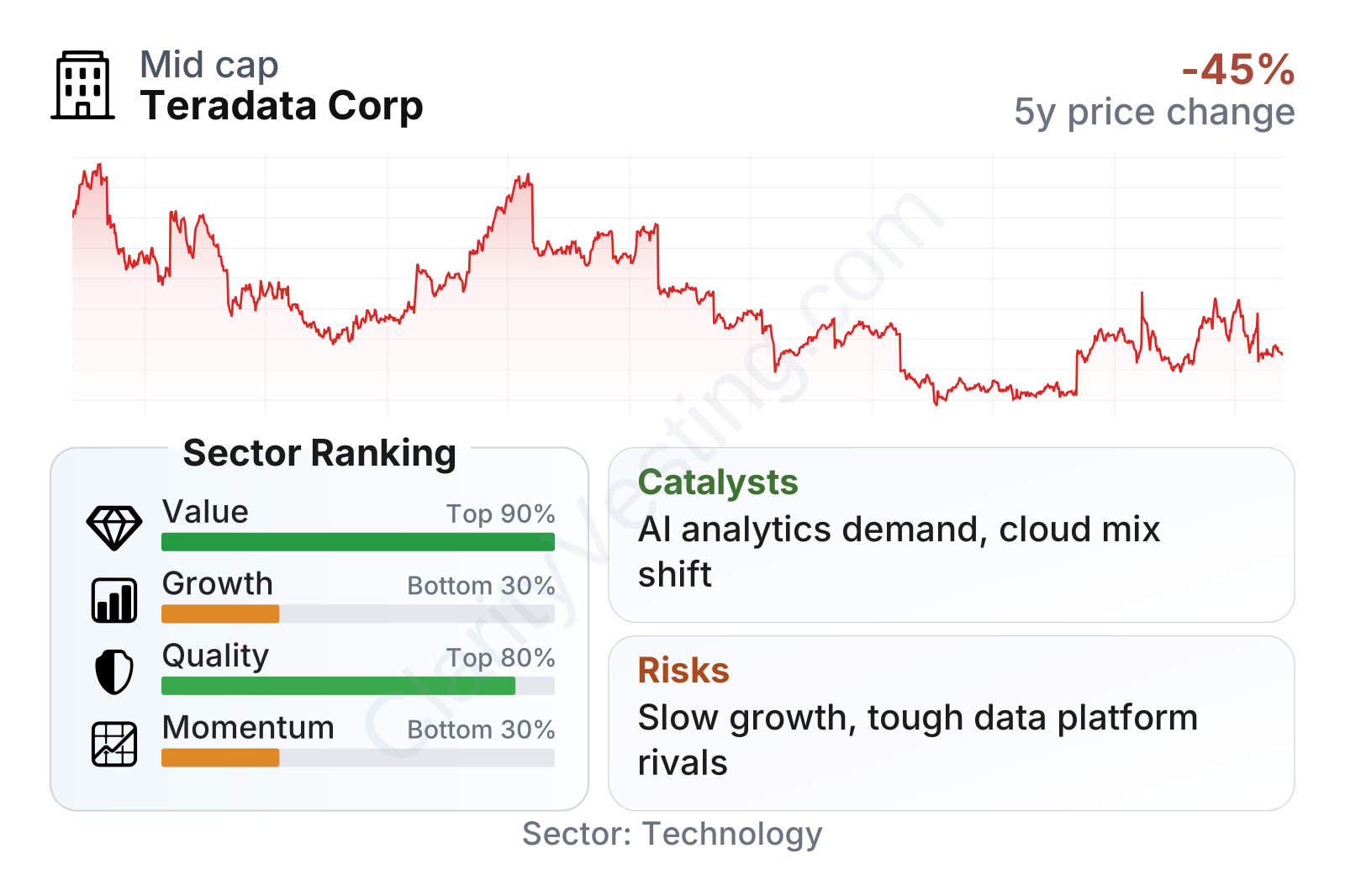
Teradata is a mid-sized software company with unusually strong profitability and cash generation compared with much of the infrastructure software sector, but weaker growth. The latest metrics point to a business that scores very well on value and quality, with a low share-price volatility profile, while growth and longer-term stock performance remain clear weak spots.
The stock history reflects that tension. The shares were much higher in 2021, then fell sharply during the following years before recovering part of the decline more recently. That pattern suggests the market has been reassessing Teradata from a slower-growth legacy software name toward a more cash-generative, potentially underappreciated analytics platform.
Growth
Teradata operates in a sector with favorable long-term demand. Companies continue to spend on cloud migration, data platforms, analytics, and AI tools. Those trends are real and durable. The challenge is that Teradata is not growing at the same pace as many newer software peers, so the sector tailwind does not automatically translate into strong company-wide expansion.
Its strategy still makes sense in that context. Management has been centered on moving customers to recurring cloud subscriptions, improving the economics of the installed base, and positioning Teradata as a platform for trusted enterprise AI and advanced analytics. That focus is logical because large companies increasingly want to use AI on governed internal data rather than on disconnected tools.
Revenue growth has been inconsistent over the last several years, including multiple periods of contraction. More recently, the pace has improved from the earlier declines, but the latest year-over-year growth remains close to flat and well below the sector median. In other words, Teradata is participating in an attractive market, but it is not yet converting that opportunity into broad, sustained top-line acceleration.
Cash generation is a more encouraging part of the picture. Free cash flow had weakened earlier, then rebounded sharply in the latest period, rising from the low hundreds of millions to a much stronger level. That matters because it suggests the company’s transition work, cost discipline, and recurring revenue mix are producing real financial benefits even without fast revenue growth.
Recent company announcements have also emphasized AI-related product development, cloud partnerships, and enterprise use cases around trusted data for AI. For Teradata, that is the most credible catalyst: not a consumer AI wave, but practical adoption by large organizations that need analytics, governance, and performance across complex data environments. If the company can deepen usage within existing customers and win more cloud-native workloads, the current growth profile could improve.
Risks
This article is for informational purposes only and does not constitute financial advice. Some content is AI-generated. See Disclaimer