Stock Analysis · USA TODAY Co. Inc (TDAY)
Overview
USA TODAY Co. Inc. appears to refer to Gannett Co., Inc., the publisher behind USA TODAY and a large portfolio of local media brands across the United States and the United Kingdom. The company operates a broad news and information network that includes national and local newspapers, websites, mobile products, digital marketing services, and business-to-business events and data products. Its core idea is straightforward: attract audiences through news, sports, opinion, and local information, then monetize that attention through subscriptions, advertising, and marketing services.
For long-term analysis, the most important point is that this is no longer just a traditional newspaper company. Management has spent years shifting the business toward digital subscriptions, digital advertising, and marketing solutions for small and medium-sized businesses. Even so, print-related activities still matter, and that keeps the company exposed to the structural decline of legacy publishing.
Based on recent company reporting, revenue is mainly generated from the following areas, with broad approximations that help show the business mix:
- Advertising and marketing solutions: roughly the largest share, around 40% to 45% of revenue. This includes digital advertising, print advertising, and marketing services.
- Circulation and subscriptions: about 35% to 40%. This includes print subscriptions and digital-only subscriptions.
- Commercial printing, events, and other services: about 15% to 20%.
The broad direction of that mix matters more than the exact split: digital revenue has become more important, while print remains a large but pressured source of cash flow. That creates a business in transition rather than a pure growth platform.
The flow of revenue and costs over the last several years shows a company that has reduced its expense base as sales declined, but not enough to produce consistently strong bottom-line results. Revenue has moved down materially since 2021, operating income has been uneven, and interest expense has remained meaningful, which helps explain why net income stayed weak for several years even when operating performance improved somewhat.
Key Figures
| Metric | Value | Sector ⓘ |
|---|---|---|
| Date | Jul 18, 2026 | |
| Context | ||
| Sector | Communication Services | |
| Industry | Publishing | |
| Market Cap ⓘ | $1.28B | |
| Beta ⓘ | 1.40 | |
Value (Cheapness) | ||
| P/E Ratio ⓘ | 48.22 | 19.52 |
| FCF Yield ⓘ | 4.66% | 12.73% |
| EBIT / EV ⓘ | 5.89% | 4.37% |
| PEG ⓘ | 0.94 | |
Growth (Business expansion) | ||
| Revenue Growth ⓘ | -4.00% | 6.10% |
| RPS Growth (5Y CAGR) ⓘ | -9.78% | 5.02% |
| EPS Growth (5Y CAGR) ⓘ | -26.96% | -26.68% |
| Margin Growth (5Y Trend) ⓘ | 2.76% | 0.79% |
| FCF Growth (5Y CAGR) ⓘ | -8.02% | 5.18% |
Quality (Business durability) | ||
| ROIC (Latest) ⓘ | 0.18% | 8.74% |
| ROIC (5Y Median) ⓘ | N/A | 8.07% |
| Net Debt / EBIT (Latest) ⓘ | 7.65 | 2.09 |
| Net Debt / EBIT (5Y Median) ⓘ | 28.36 | 3.02 |
| Operating Margin (Latest) ⓘ | 6.00% | 15.46% |
| Operating Margin (5Y Median) ⓘ | 1.49% | 13.17% |
| Debt to Equity (Latest) ⓘ | 797.56% | 59.09% |
| Profit Margin (Latest) ⓘ | 1.27% | 9.11% |
| Free Cash Flow (Latest) ⓘ | $59.52M | |
Momentum (Price trend) | ||
| 3Y Return ⓘ | +207.97% | +36.38% |
| 12M Return (excl. last month) ⓘ | +130.23% | +8.16% |
| 6M Return ⓘ | +39.12% | +2.31% |
| Price vs. 200-Day MA ⓘ | +36.09% | +1.57% |
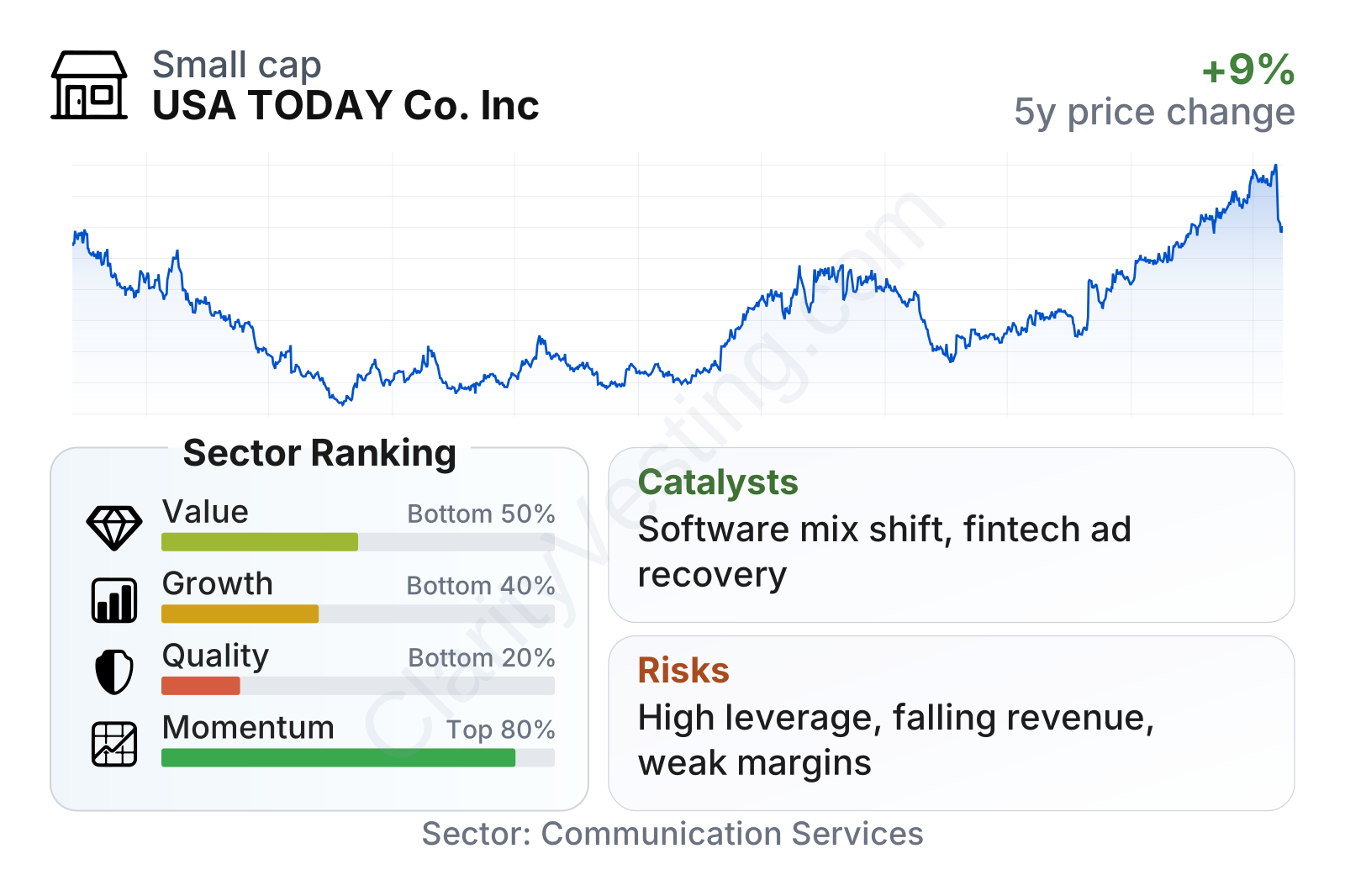
The market value is a little above $1.1 billion, which places the company in small-cap territory and can make the stock more volatile. That volatility is visible in the beta above 1.4 and in the share-price history, which shows large swings over the last few years. The factor breakdown is mixed: momentum is unusually strong versus much of the sector, but quality and growth rank weakly. In practical terms, the market has recently rewarded the turnaround narrative more than the underlying business has proven it through sustained revenue expansion or strong returns on capital.
Growth
The sector itself is split in two directions. Digital media, audience subscriptions, and marketing services remain relevant long-term markets, but traditional print publishing continues to shrink. That means the company is operating in a part-growing, part-declining industry. The main question is whether digital gains can outpace print erosion for long enough to create durable growth. So far, that has been difficult.
Revenue trends still look challenging. Year-over-year sales have remained negative for an extended period, although the pace of decline has moderated from the worst levels. That is an improvement, but it is not the same as returning to real top-line growth. Over a five-year period, both revenue per share and free cash flow growth have been negative, placing the company behind the sector on growth measures.
The more encouraging point is cash generation. Free cash flow has remained positive in most recent periods after a sharp dip earlier in the cycle. That suggests the company still has a meaningful ability to convert its audience and operating base into cash, even while revenue is under pressure. For a mature media business, that matters because cash flow supports debt service, internal investment, and strategic flexibility.
The strategic logic does make sense on paper. Gannett has continued building digital subscriptions, expanding its direct audience relationships, and offering digital marketing services to local businesses through its broader platform. If that ecosystem grows, the company could become less dependent on print and more anchored in recurring and digitally delivered revenue. A stronger subscription base is especially important because it is generally more stable than advertising alone.
A notable catalyst is the company’s continued effort to scale digital-only subscriptions and improve monetization of its large audience network. Another is the possibility of better earnings leverage if revenue stabilizes, because the company has already cut a significant amount of cost from the system over the last few years. In a business with a large fixed-cost base, even modest stabilization can have an outsized effect on profitability.
Recent company updates have also emphasized debt reduction and digital execution. Those are not headline-grabbing developments, but for a long-term view they are more important than short bursts of market excitement. The key opportunity remains simple: if digital subscription and marketing revenue keep improving while cost discipline holds, the company’s earnings profile could look much better than it did during the worst part of the print decline.
Risks
The biggest risk is that the company is still trying to offset a structural decline in legacy publishing. Print circulation and print advertising have been shrinking across the industry for years, and the transition to digital has not fully replaced those lost economics. That leaves the company exposed to a long-running revenue headwind that may continue even with solid operational execution.
Balance-sheet risk is another major issue. Debt compared with equity is extremely high relative to the sector, and net debt to EBIT is also far above the peer median. That does not automatically mean distress, but it does mean less room for error. When leverage is elevated, weak revenue trends or an advertising slowdown can have a disproportionate impact on equity value.
Profitability is also thin. The company’s profit margin has improved from prior losses and is now slightly positive, but it remains well below sector norms. Operating margin has recovered from very weak historical levels, yet it is still modest for a business facing secular pressure. This means the turnaround is real enough to notice, but not yet strong enough to remove concern.
Competitive advantages exist, but they are narrower than those of the largest digital platforms. Gannett’s main strengths are its national brand recognition through USA TODAY, its wide network of local media properties, and its established relationships with local advertisers and communities. That local scale is hard to replicate quickly. However, the company is not the leader in digital advertising overall, and it competes for both audience attention and ad budgets against far larger and more technologically powerful players.
Main competitors include:
- The New York Times and other subscription-led publishers, which are generally stronger in premium national digital news.
- Local broadcasters and regional publishers, which compete for local advertising and local audience attention.
- Large digital advertising platforms such as Alphabet and Meta, which absorb a major share of advertising spending.
- Marketing services firms serving small and medium-sized businesses, where differentiation can be difficult.
Compared with these groups, Gannett stands out more for scale in local publishing than for superior profitability or digital platform strength. That creates a mixed competitive position: broad reach and strong brands on one side, but weaker economics and heavier leverage on the other.
Another risk worth noting is that the recent stock performance has been much stronger than the company’s long-term business growth. When price momentum rises faster than business fundamentals, expectations can become harder to satisfy. There is no clear sign here of a major scandal or governance event based on company disclosures, but the underlying operating and financial risks are substantial enough on their own.
Valuation
The valuation picture is complicated because standard earnings multiples can look distorted when profits are only modestly positive. The current price-to-earnings ratio is well above the sector median, which on the surface makes the stock look expensive. At the same time, the PEG ratio is below 1 and EBIT relative to enterprise value is not obviously weak, suggesting the market may be valuing the company on turnaround potential rather than current quality.
That tension is the central issue. On one hand, the business has weak growth, low returns on capital, thin margins, and elevated leverage, which normally would argue for a discounted valuation. On the other hand, the company still generates meaningful free cash flow, has reduced costs, and has shown enough operational stabilization to support a recovery narrative. The recent rise in the share price indicates that the market is giving considerable weight to that second interpretation.
In that context, the current valuation looks demanding relative to present fundamentals. It seems easier to justify if one assumes continued progress in digital subscriptions, ongoing cost control, and further debt improvement. Without those advances, the premium to sector earnings multiples looks difficult to defend for a company that still ranks poorly on growth and quality measures.
Conclusion
USA TODAY’s parent company is best understood as a large media network in the middle of a long transition. Its strongest attributes are brand recognition, national and local audience reach, and an ability to keep producing free cash flow despite a difficult industry backdrop. Management’s focus on digital subscriptions, marketing services, and debt reduction is strategically sensible, and recent operating stabilization has given the equity new momentum.
Still, the business remains constrained by shrinking legacy revenue, modest profitability, and a balance sheet that is far more stretched than most of the sector. That combination makes the long-term picture highly dependent on execution. If digital progress continues and leverage comes down, the company could gradually look more durable and financially resilient. If revenue pressure persists, the current market optimism would appear ahead of the business itself. Overall, the company now looks more like a recovery case with visible progress but still limited financial margin for error than a fully established long-term compounder.
Sources:
- U.S. Securities and Exchange Commission — EDGAR filings for Gannett Co., Inc., including 2026 quarterly filings and recent current reports
- Gannett Co., Inc. Investor Relations — quarterly earnings releases and investor presentation materials
- Gannett Co., Inc. — Annual Report and company overview materials hosted on investor relations pages
- Wikipedia — Gannett basic company history and corporate background
This article is for informational purposes only and does not constitute financial advice. Some content is AI-generated. See Disclaimer


