Stock Analysis · AT&T Inc (T)
Overview
AT&T is one of the largest telecommunications companies in the United States. Its core business is providing wireless phone service, broadband internet, and business connectivity. In simple terms, the company owns and operates large communications networks that let consumers and organizations make calls, use mobile data, access home internet, and connect offices, cloud systems, and devices.
After years of major acquisitions and later divestitures, AT&T is now much more focused than it was a few years ago. The business is centered mainly on U.S. connectivity rather than media ownership. That makes the company easier to understand for long-term readers: it is primarily a network operator with recurring monthly revenue from mobile and broadband subscriptions.
Based on AT&T’s recent reporting structure, revenue is largely concentrated in three operating areas:
- Communications - Mobility: about 45% to 50% of total revenue. This includes wireless service, equipment sales, and related mobile offerings for consumers and businesses.
- Communications - Business Wireline: about 20% to 25% of total revenue. This covers connectivity, fiber, legacy voice, networking, security, and related services sold to companies and public-sector customers.
- Communications - Consumer Wireline: about 15% to 20% of total revenue. This mainly includes fiber broadband, other home internet services, and legacy fixed-line consumer services.
- Latin America and other activities: generally below 10% of total revenue. This is much smaller than the U.S. core business.
The most important economic feature of AT&T’s business is that a large share of revenue is recurring. Customers usually pay every month for phone and internet access, which can create dependable cash generation when the network is well managed and customer losses stay under control.
The business flow also shows a company with very large revenue, substantial operating income, and meaningful interest expense because debt remains a major part of the capital structure. More recently, profitability has looked healthier than during the post-restructuring period, which supports the view that AT&T has become a more focused telecom operator.
Key Figures
| Metric | Value | Sector ⓘ |
|---|---|---|
| Date | Sep 12, 2026 | |
| Context | ||
| Sector | Communication Services | |
| Industry | Telecom Services | |
| Market Cap ⓘ | $178.57B | |
| Beta ⓘ | 0.43 | |
Value (Cheapness) | ||
| P/E Ratio ⓘ | 8.60 | 18.61 |
| FCF Yield ⓘ | 9.89% | 13.68% |
| EBIT / EV ⓘ | 10.41% | 4.54% |
| PEG ⓘ | 1.55 | |
Growth (Business expansion) | ||
| Revenue Growth ⓘ | 2.30% | 5.40% |
| RPS Growth (5Y CAGR) ⓘ | -0.51% | 4.62% |
| EPS Growth (5Y CAGR) ⓘ | -20.41% | -18.01% |
| Margin Growth (5Y Trend) ⓘ | 0.15% | 1.10% |
| FCF Growth (5Y CAGR) ⓘ | -6.49% | 5.88% |
Quality (Business durability) | ||
| ROIC (Latest) ⓘ | 11.79% | 8.38% |
| ROIC (5Y Median) ⓘ | 8.81% | 8.32% |
| Net Debt / EBIT (Latest) ⓘ | 4.36 | 1.99 |
| Net Debt / EBIT (5Y Median) ⓘ | 5.58 | 2.94 |
| Operating Margin (Latest) ⓘ | 26.22% | 14.89% |
| Operating Margin (5Y Median) ⓘ | 21.68% | 12.96% |
| Debt to Equity (Latest) ⓘ | 147.48% | 59.59% |
| Profit Margin (Latest) ⓘ | 16.94% | 8.77% |
| Free Cash Flow (Latest) ⓘ | $17.65B | |
Momentum (Price trend) | ||
| 3Y Return ⓘ | +111.17% | +46.64% |
| 12M Return (excl. last month) ⓘ | -10.84% | +2.16% |
| 6M Return ⓘ | -2.57% | +5.05% |
| Price vs. 200-Day MA ⓘ | +5.44% | +2.88% |
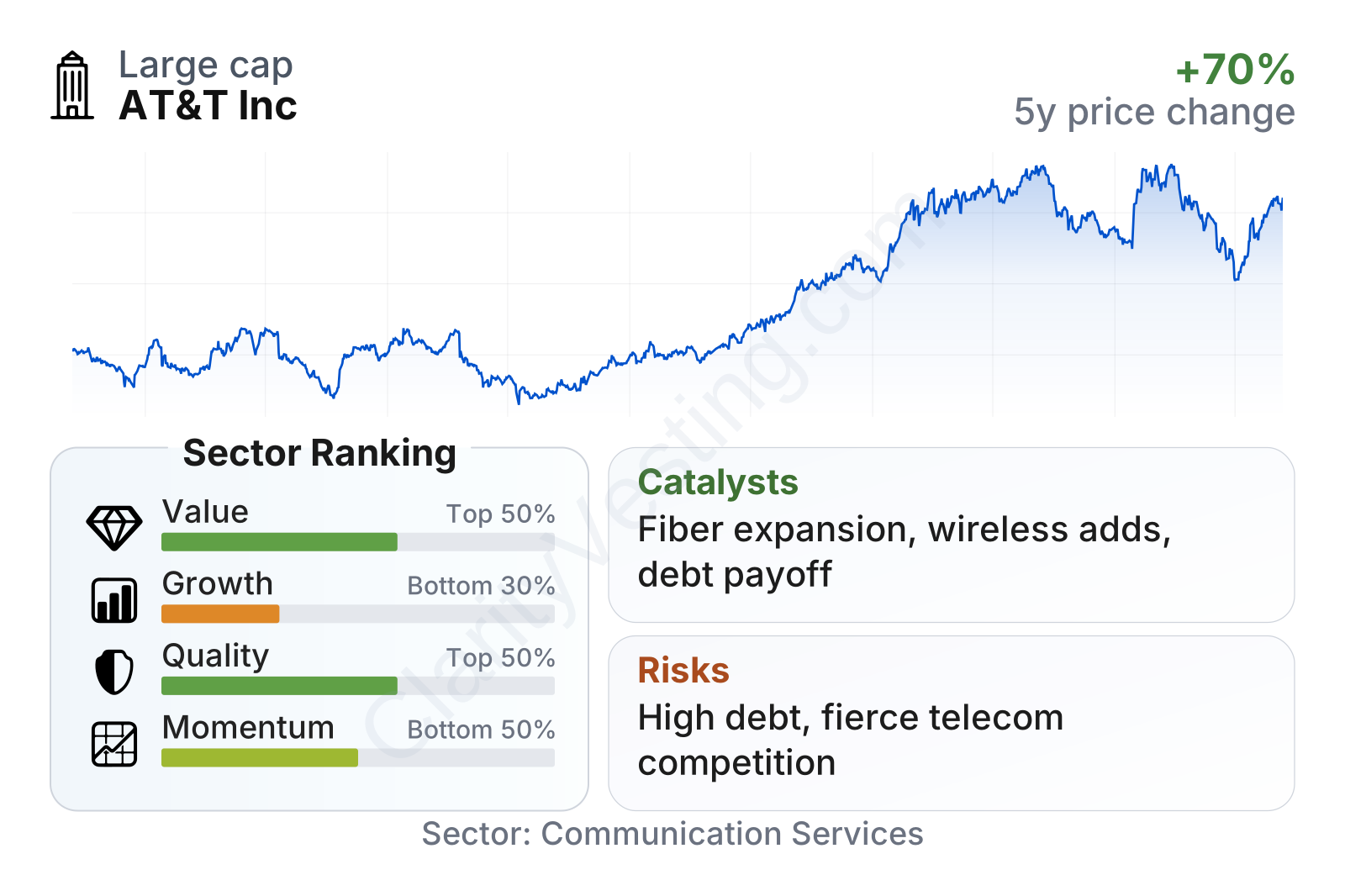
AT&T is a very large company with relatively low share-price volatility, as reflected by a beta well below 1. In the factor breakdown, valuation looks inexpensive against much of the sector, especially on earnings and enterprise-value-based measures. Quality is more mixed: operating margin, profit margin, and return on invested capital are solid, but leverage remains clearly heavier than the sector median. Growth is the weaker area, with revenue and cash-flow trends lagging broader Communication Services peers. In short, the profile combines scale, cash generation, and established profitability with slower expansion and a still-demanding balance sheet.
Growth
Telecom is not a fast-growth industry in the same way as software or semiconductors, but it does operate in a structurally important sector. Data usage keeps rising, wireless networks remain essential, and demand for reliable home broadband continues to expand. That gives AT&T exposure to a durable market, even if the pace of growth is usually moderate rather than explosive.
AT&T’s current strategy is built around two main priorities: expanding high-value wireless subscribers and increasing fiber broadband coverage. That logic is sensible. Wireless service tends to produce recurring revenue and can support bundled offerings, while fiber is one of the strongest fixed-network products because it offers faster speeds, lower maintenance needs over time, and better competitive positioning against cable in many neighborhoods.
Recent revenue growth has returned to positive territory, but it remains modest. Year-over-year gains have mostly been in the low-single-digit range recently, which is an improvement from earlier periods of contraction but still slower than the sector median. That suggests AT&T is stabilizing and growing again, though not at a pace that would normally justify aggressive expectations.
A more important point for a long-term view is cash generation. Telecom networks require heavy capital spending, so free cash flow matters more than headline revenue alone. AT&T still produces large amounts of cash after operating and investment needs, even though the recent trend is below the stronger levels reached in earlier recovery periods.
Free cash flow remains substantial, sitting in the tens of billions of dollars on a trailing basis, but it has cooled from its peak. For a mature telecom operator, that is still a meaningful strength because cash can be directed toward debt reduction, dividends, and continued network investment. The company has repeatedly highlighted fiber expansion, 5G deployment, and customer additions as the operational levers that can support future progress.
One notable catalyst is the steady migration of households and businesses toward fiber connections where AT&T has built out coverage. Another is the ability to deepen customer relationships through bundled wireless and broadband offers, which can improve retention and lifetime value. In addition, any sustained decline in financing pressure would matter because a company with AT&T’s debt load benefits visibly when balance-sheet flexibility improves.
Risks
This article is for informational purposes only and does not constitute financial advice. Some content is AI-generated. See Disclaimer