Stock Analysis · Synaptics Incorporated (SYNA)
Overview
Synaptics Incorporated is a semiconductor company that designs chips and related software used to connect people and devices. It is best known for human interface technologies such as touch, display, biometrics, and wireless connectivity, but the business has evolved well beyond laptop touchpads and smartphone screens. Today, the company focuses on chips that help products sense touch, process video and audio, connect through Wi‑Fi and Bluetooth, and support artificial intelligence features at the edge, meaning directly on the device rather than in a remote data center.
Its products are mainly sold into three end markets described in company filings: Internet of Things, Personal Computers, and Mobile. The mix has shifted heavily toward IoT after acquisitions and portfolio changes, making the company less dependent on smartphones than it used to be.
The main sources of revenue are approximately:
- Internet of Things: about 60% to 65% of revenue. This includes wireless connectivity chips, processors, video and display solutions, and embedded AI products used in consumer devices, enterprise equipment, automotive applications, and industrial systems.
- Personal Computers: about 25% to 30% of revenue. This segment includes touchpads, fingerprint sensors, docking and display-related solutions, and other interface components for notebooks and PC accessories.
- Mobile: about 10% to 15% of revenue. This business largely includes display drivers, touch controllers, and related components for smartphones and other handheld devices.
This revenue mix matters for long-term analysis because IoT tends to offer a broader set of customers and use cases than the mature PC and smartphone markets. At the same time, it also means Synaptics is in the middle of a multi-year repositioning, with results depending on whether that transition can translate into steadier growth and stronger margins.
The business mix over the last several years shows a company that remains research-heavy while navigating a weaker profit conversion than it had at its peak. Revenue has recovered from the cyclical downturn, but a large share of gross profit is still being reinvested into research and operating expenses, which helps explain why sales growth has not yet consistently turned into durable earnings growth.
Key Figures
| Metric | Value | Sector ⓘ |
|---|---|---|
| Date | Sep 12, 2026 | |
| Context | ||
| Sector | Technology | |
| Industry | Semiconductors | |
| Market Cap ⓘ | $3.95B | |
| Beta ⓘ | 1.94 | |
Value (Cheapness) | ||
| P/E Ratio ⓘ | N/A | 29.51 |
| FCF Yield ⓘ | 2.57% | 4.25% |
| EBIT / EV ⓘ | -1.66% | 2.85% |
| PEG ⓘ | 0.51 | |
Growth (Business expansion) | ||
| Revenue Growth ⓘ | 8.90% | 15.40% |
| RPS Growth (5Y CAGR) ⓘ | -7.88% | 8.56% |
| EPS Growth (5Y CAGR) ⓘ | -27.53% | -11.88% |
| Margin Growth (5Y Trend) ⓘ | -27.02% | 0.46% |
| FCF Growth (5Y CAGR) ⓘ | -29.11% | 9.80% |
Quality (Business durability) | ||
| ROIC (Latest) ⓘ | -2.49% | 9.44% |
| ROIC (5Y Median) ⓘ | -1.98% | 8.30% |
| Net Debt / EBIT (Latest) ⓘ | N/A | 0.54 |
| Net Debt / EBIT (5Y Median) ⓘ | 0.58 | 0.44 |
| Operating Margin (Latest) ⓘ | -5.60% | 9.58% |
| Operating Margin (5Y Median) ⓘ | -5.60% | 8.25% |
| Debt to Equity (Latest) ⓘ | 90.08% | 33.33% |
| Profit Margin (Latest) ⓘ | -41.00% | 7.14% |
| Free Cash Flow (Latest) ⓘ | $101.40M | |
Momentum (Price trend) | ||
| 3Y Return ⓘ | +22.88% | +45.48% |
| 12M Return (excl. last month) ⓘ | +63.05% | +23.48% |
| 6M Return ⓘ | +35.87% | +20.93% |
| Price vs. 200-Day MA ⓘ | +4.25% | +7.43% |
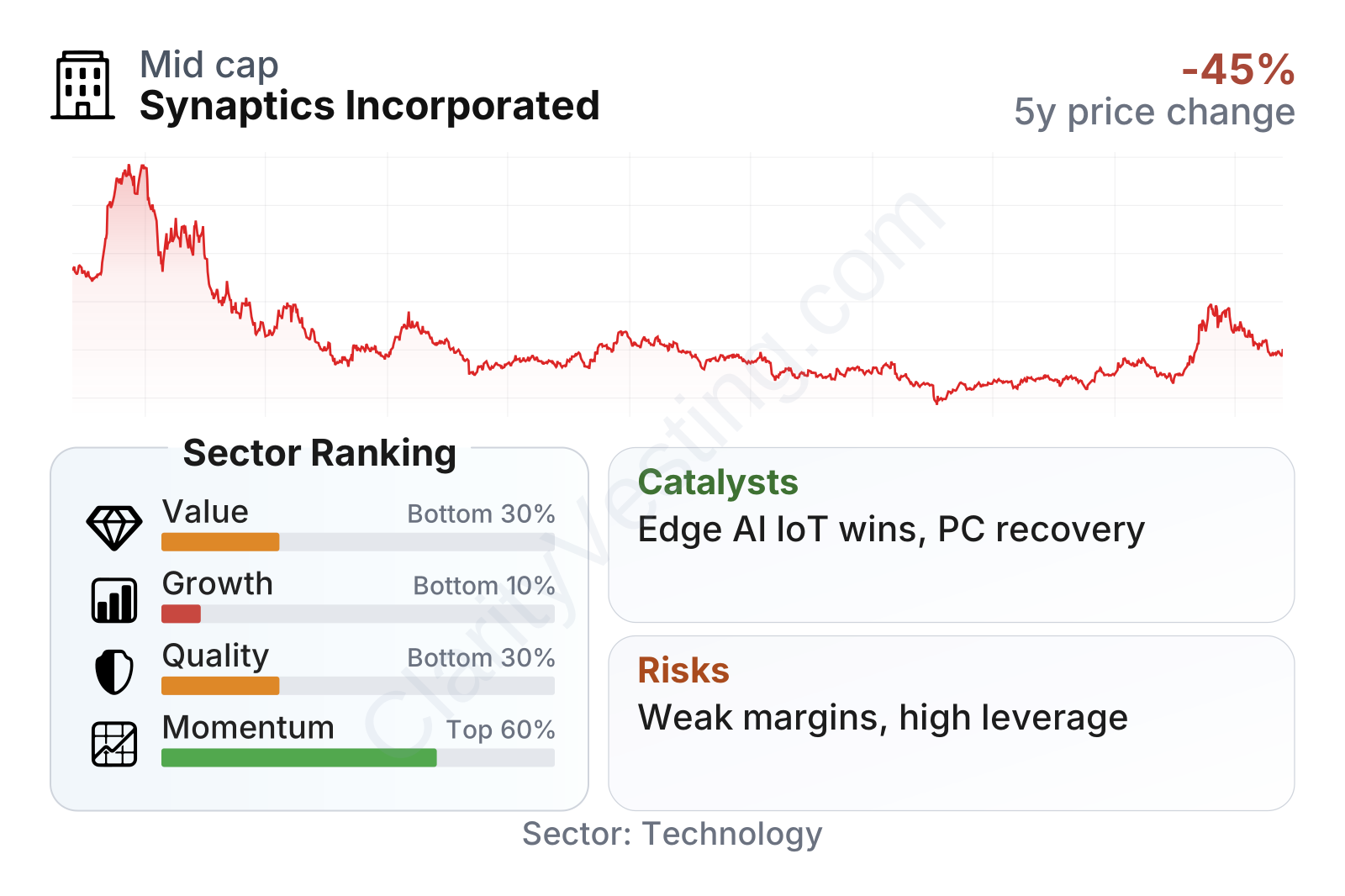
Synaptics is a mid-sized semiconductor company with a stock that has been notably volatile, as shown by its beta near 2. The factor profile is mixed: recent share-price momentum has been stronger than much of the sector, but value, quality, and growth rankings remain weak versus semiconductor peers. Free cash flow is still positive, yet cash generation and profitability are below the sector median, which suggests the market is reacting more to improving expectations than to already strong operating results.
The stock-price history also reflects that tension. After a very strong period in 2021, the shares went through a deep reset during the industry downturn and only recently recovered sharply. That pattern is common in semiconductors, but in Synaptics’ case it also shows how sensitive the valuation is to changing views on demand recovery and execution in newer product areas.
Growth
Synaptics operates in parts of the semiconductor market that should remain relevant for years: connected devices, edge AI, wireless connectivity, human-machine interfaces, and embedded processing. Those are attractive long-term themes because more devices are gaining screens, cameras, sensors, voice control, and local intelligence. In simple terms, more everyday products are becoming smart and connected, and that creates demand for the kinds of chips Synaptics makes.
The company’s strategy is broadly logical for that environment. It has been steering away from lower-growth and more volatile mobile exposure and putting more emphasis on IoT and embedded edge processing. That gives it access to markets where product life cycles can be longer and where customers often value integrated solutions combining hardware, software, and connectivity. This can make switching suppliers less convenient than in more commoditized chip categories.
Recent revenue trends indicate that the worst part of the prior downturn is over. Sales growth turned positive again after a severe contraction, and recent year-over-year increases have been in the high-single-digit to low-teens range. That is a real improvement, although still below the median pace seen across the broader semiconductor sector. So the growth picture is recovering, but not yet exceptional.
Cash generation tells a similar story. Free cash flow fell sharply during the downturn, almost disappearing at one point, then recovered back into positive territory. The latest level remains modest for a company of this size, but the return to positive cash generation is important because it shows the business still has financial flexibility while it invests in product development and works through uneven end-market demand.
A meaningful catalyst is Synaptics’ push into edge AI for IoT devices. The company has been emphasizing processors and connectivity solutions that allow AI tasks such as voice, vision, sensing, and contextual processing to happen on-device. If adoption broadens across consumer electronics, enterprise devices, and industrial equipment, Synaptics could benefit because it already sells several of the enabling pieces rather than relying on a single niche product.
Another favorable point is that its PC business can improve when notebook demand normalizes and when manufacturers refresh designs with higher-end input, biometrics, and display features. That is not as exciting as AI, but it can still provide support to the overall revenue base. Recent company communications have also pointed to design-win traction across IoT categories, which matters because semiconductor growth often starts with wins in future customer products before it shows up fully in reported revenue.
Risks
This article is for informational purposes only and does not constitute financial advice. Some content is AI-generated. See Disclaimer


