Stock Analysis · Skyworks Solutions Inc (SWKS)
Overview
Skyworks Solutions is a semiconductor company that designs analog and mixed-signal chips used to connect devices to wireless networks and manage radio signals, power, and timing. In simpler terms, its components help smartphones, routers, cars, industrial systems, and connected devices send and receive data reliably. The company is especially known for radio-frequency, or RF, components, which are essential in modern wireless communication.
Its business is concentrated in a few large end markets, with mobile devices still the biggest source of revenue. Based on the company’s latest fiscal 2025 annual report and 2026 quarterly filings, the revenue mix can be described approximately as follows:
- Mobile products: about 59% of revenue. This includes RF front-end modules, amplifiers, filters, and other connectivity chips used mainly in smartphones and other handheld wireless devices.
- Broad markets: about 41% of revenue. This category includes automotive, Wi‑Fi networking, infrastructure, defense, industrial, medical, smart home, and other connected-device applications.
- Customer concentration: one customer represented about 68% of fiscal 2025 revenue, showing that the company’s sales base is much more concentrated than its end-market list might suggest.
That mix matters because Skyworks is trying to reduce its dependence on smartphones by expanding further into automotive, Wi‑Fi 7, data-center connectivity, industrial systems, and other markets where product cycles can be longer and customer relationships stickier. Even so, mobile remains the earnings engine today, so any long-term view of the company still starts with handset demand and content per device.
The business flow also shows a clear pattern over the last several years: revenue and gross profit have declined from the 2022 peak, while research and development spending has remained elevated and even increased. That suggests management is protecting future product development during a weaker demand period, but it also means current profitability has been under pressure.
Key Figures
| Metric | Value | Sector ⓘ |
|---|---|---|
| Date | Sep 12, 2026 | |
| Context | ||
| Sector | Technology | |
| Industry | Semiconductors | |
| Market Cap ⓘ | $13.29B | |
| Beta ⓘ | 1.52 | |
Value (Cheapness) | ||
| P/E Ratio ⓘ | 45.78 | 29.51 |
| FCF Yield ⓘ | 1.48% | 4.25% |
| EBIT / EV ⓘ | 2.64% | 2.85% |
| PEG ⓘ | 11.90 | |
Growth (Business expansion) | ||
| Revenue Growth ⓘ | -3.10% | 15.40% |
| RPS Growth (5Y CAGR) ⓘ | -3.66% | 8.56% |
| EPS Growth (5Y CAGR) ⓘ | -27.13% | -11.88% |
| Margin Growth (5Y Trend) ⓘ | -18.00% | 0.46% |
| FCF Growth (5Y CAGR) ⓘ | -0.32% | 9.80% |
Quality (Business durability) | ||
| ROIC (Latest) ⓘ | 4.46% | 9.44% |
| ROIC (5Y Median) ⓘ | 47.22% | 8.30% |
| Net Debt / EBIT (Latest) ⓘ | -0.33 | 0.54 |
| Net Debt / EBIT (5Y Median) ⓘ | 0.69 | 0.44 |
| Operating Margin (Latest) ⓘ | 8.24% | 9.58% |
| Operating Margin (5Y Median) ⓘ | 23.95% | 8.25% |
| Debt to Equity (Latest) ⓘ | 11.87% | 33.33% |
| Profit Margin (Latest) ⓘ | 7.23% | 7.14% |
| Free Cash Flow (Latest) ⓘ | $196.30M | |
Momentum (Price trend) | ||
| 3Y Return ⓘ | +0.44% | +45.48% |
| 12M Return (excl. last month) ⓘ | +1.27% | +23.48% |
| 6M Return ⓘ | +61.43% | +20.93% |
| Price vs. 200-Day MA ⓘ | +38.66% | +7.43% |
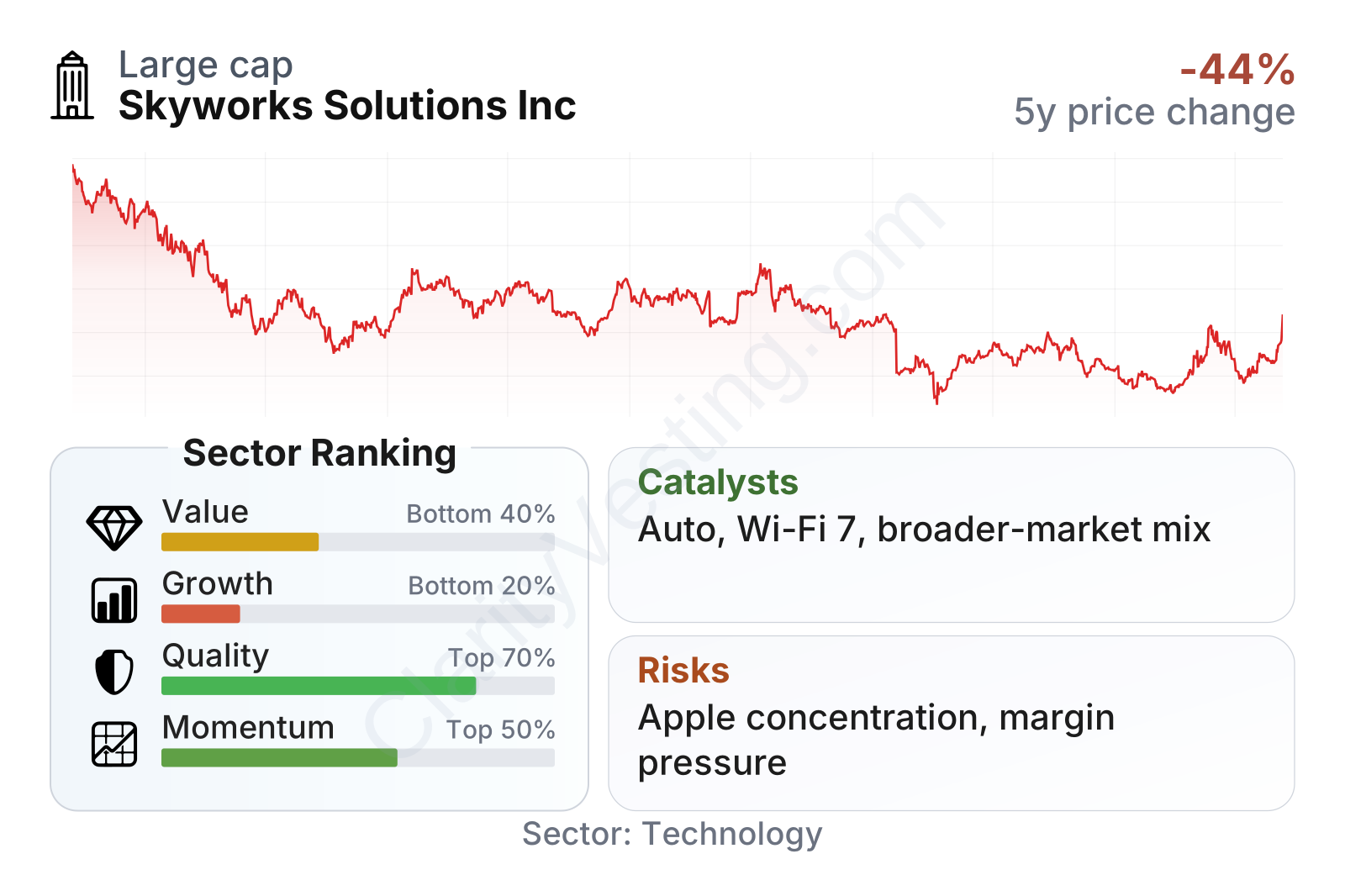
Skyworks is a mid-sized semiconductor company with above-average share-price volatility, as shown by a beta around 1.5. The quality profile remains supported by a very strong long-term return on invested capital history and a balance sheet that is cleaner than most peers, with debt to equity near 12% and net cash on an earnings basis. The weaker side is growth: revenue, earnings, and free cash flow trends have all cooled materially versus the sector over recent years. On valuation, the stock is not obviously cheap on earnings and looks less compelling on cash flow yield than many semiconductor peers, even though operating earnings relative to enterprise value remain somewhat better than the sector median.
Growth
Skyworks operates in a sector with durable long-term demand drivers. Wireless connectivity keeps expanding across phones, vehicles, factories, homes, defense systems, and connected infrastructure. That broad direction is favorable because more devices need more radio management, power efficiency, and signal processing. In that sense, the company is still positioned in a growth industry, but its own recent growth has lagged the sector because it has been exposed to a mature smartphone market and customer-specific headwinds.
The recent revenue trend shows a business that moved from strong post-pandemic growth into a long correction. Year-over-year growth turned negative through much of 2023 and 2024, improved briefly in parts of 2025, and then slipped slightly negative again in early 2026. That pattern points to stabilization rather than a clean return to sustained expansion. Compared with the broader technology sector, Skyworks has been growing more slowly and more unevenly.
Management’s strategy for future growth is logical on paper. The company is pushing deeper into broad markets, where it can apply similar analog and RF know-how beyond premium smartphones. Automotive is one of the more important opportunities because modern vehicles use more wireless connectivity, infotainment, advanced driver-assistance systems, and increasingly complex power architectures. Wi‑Fi 6E and Wi‑Fi 7 are another potential tailwind, since better networking standards can raise chip content in routers, gateways, and connected devices.
There is also a product-cycle angle. Skyworks has highlighted advanced mobile platforms, next-generation Wi‑Fi solutions, timing products, and power management as areas of focus. If handset makers adopt more complex RF content or if connected-device demand accelerates, Skyworks could benefit without needing dramatic unit growth. In semiconductors, increasing content per device can matter just as much as shipment volume.
Cash generation, however, shows why the growth case still needs proof. Free cash flow was very strong in 2022 through 2025 but dropped sharply into 2026. The company remains cash generative, which gives it flexibility for dividends, buybacks, and internal investment, but the direction has weakened. For long-term analysis, that matters because future upside would look more convincing if revenue recovery and cash generation start moving upward together.
A notable recent development is the company’s continued emphasis on diversifying away from its largest mobile customer and broadening customer engagement in automotive and infrastructure-related applications. That is more a multi-year opportunity than a single headline catalyst, but it is one of the most important things to watch because even modest success there could make the business less cyclical and less customer-dependent over time.
Risks
This article is for informational purposes only and does not constitute financial advice. Some content is AI-generated. See Disclaimer


