Stock Analysis · Swatch Group AG (SWGAY)
Overview
Swatch Group AG is a Swiss watchmaking and jewelry company best known for owning a wide range of brands that cover many price points, from mass-market names such as Swatch and Tissot to prestige labels such as Omega, Longines, Breguet, Blancpain, and Harry Winston. The group also makes movements, components, and other parts used in watch production, which gives it an unusually high level of vertical integration for the industry. In simple terms, it is not just a brand owner; it is also a manufacturer with deep control over design, production, and distribution.
The business is mainly driven by watch and jewelry sales, while a much smaller share comes from electronic systems. Swatch Group’s annual reporting typically presents revenue in two operating segments, with watches and jewelry overwhelmingly dominant.
- Watches & Jewelry: roughly 95% to 97% of sales in recent years. This includes the group’s portfolio of watch brands, jewelry activities, and retail distribution.
- Electronic Systems: roughly 3% to 5% of sales. This segment includes specialized components and timing-related technologies.
Within the core watch business, the strongest earnings power usually comes from mid-range and luxury Swiss watches, especially brands with global recognition and pricing power. Geographically, demand has historically been broad, but performance is heavily influenced by Asia, tourism flows, and the health of luxury spending in China.
The business model has two appealing traits for long-term analysis: a portfolio of established brands that would be difficult to recreate, and a manufacturing base that supports quality control and product differentiation. At the same time, recent results show that brand strength alone has not fully protected the company from a sharp slowdown in demand and weaker profitability.
The long-term pattern shows a company that used to convert a large share of revenue into gross profit, but whose recent operating and net profit have compressed sharply. Sales have moved down from the post-pandemic peak, while the final profit left after expenses has fallen much faster, showing how sensitive the model can be when volumes soften.
Key Figures
| Metric | Value | Sector ⓘ |
|---|---|---|
| Date | Sep 12, 2026 | |
| Context | ||
| Sector | Consumer Cyclical | |
| Industry | Luxury Goods | |
| Market Cap ⓘ | $11.45B | |
| Beta ⓘ | 0.82 | |
Value (Cheapness) | ||
| P/E Ratio ⓘ | N/A | 17.10 |
| FCF Yield ⓘ | 1.71% | 8.53% |
| EBIT / EV ⓘ | N/A | 6.46% |
| PEG ⓘ | 0.07 | |
Growth (Business expansion) | ||
| Revenue Growth ⓘ | 2.00% | 5.75% |
| RPS Growth (5Y CAGR) ⓘ | -3.78% | 9.14% |
| EPS Growth (5Y CAGR) ⓘ | N/A | -18.21% |
| Margin Growth (5Y Trend) ⓘ | -11.74% | -0.23% |
| FCF Growth (5Y CAGR) ⓘ | -44.09% | 4.91% |
Quality (Business durability) | ||
| ROIC (Latest) ⓘ | 0.94% | 12.61% |
| ROIC (5Y Median) ⓘ | 4.34% | 10.72% |
| Net Debt / EBIT (Latest) ⓘ | -2.89 | 2.10 |
| Net Debt / EBIT (5Y Median) ⓘ | -2.54 | 2.32 |
| Operating Margin (Latest) ⓘ | 2.42% | 9.25% |
| Operating Margin (5Y Median) ⓘ | 13.89% | 9.64% |
| Debt to Equity (Latest) ⓘ | 2.07% | 75.78% |
| Profit Margin (Latest) ⓘ | 0.14% | 5.33% |
| Free Cash Flow (Latest) ⓘ | $195.29M | |
Momentum (Price trend) | ||
| 3Y Return ⓘ | -13.09% | +14.53% |
| 12M Return (excl. last month) ⓘ | +40.72% | +3.08% |
| 6M Return ⓘ | +2.73% | +0.55% |
| Price vs. 200-Day MA ⓘ | -4.56% | -0.54% |
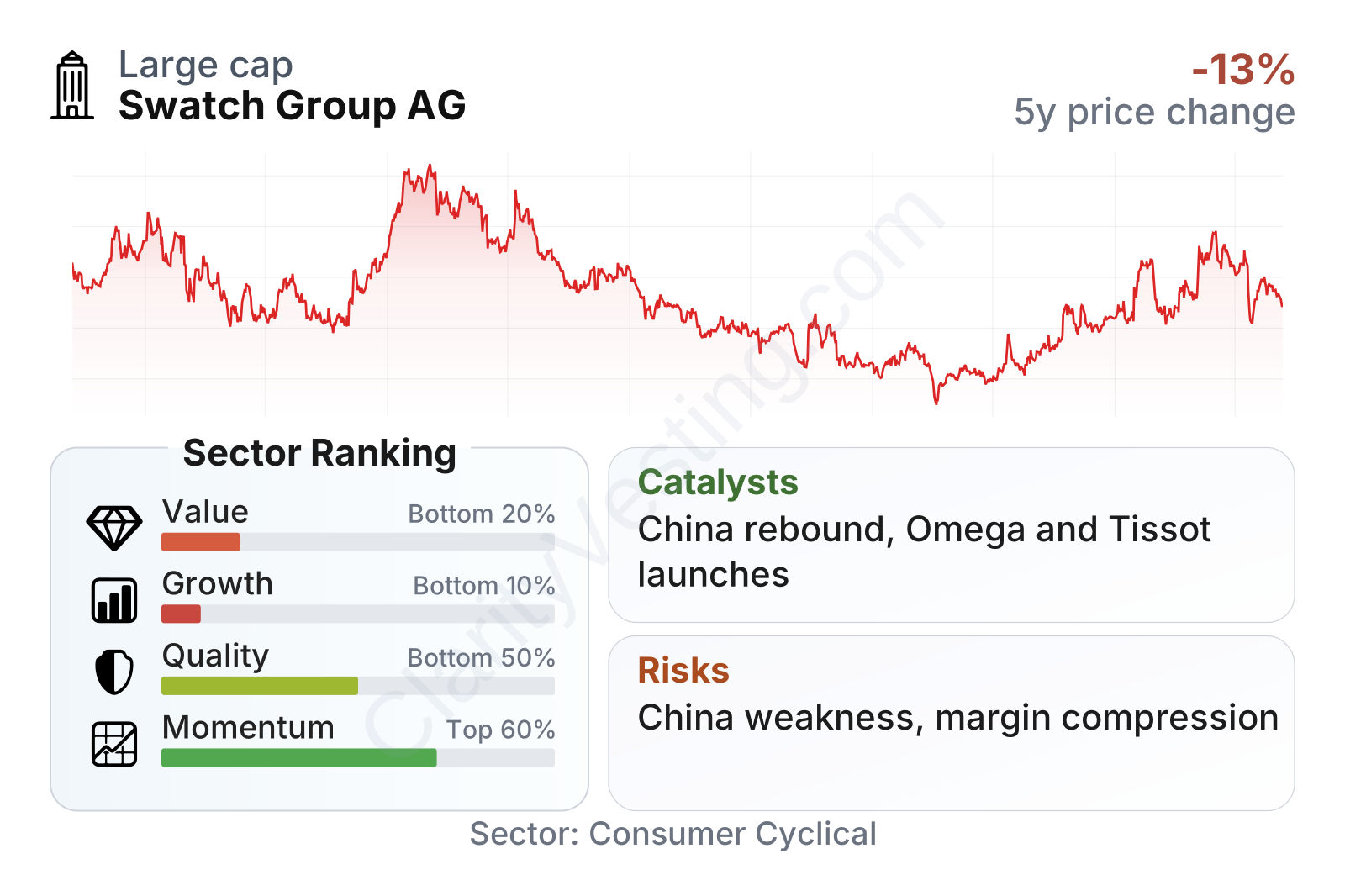
Swatch Group’s market value is around the mid-teens in billions of dollars, placing it well below the very largest global luxury houses but still among the more meaningful listed names in Swiss watches. The share price has been volatile over the past few years, with a deep decline through 2024 followed by a partial rebound more recently.
The overall factor picture is mixed. Balance-sheet strength stands out clearly: debt is close to negligible, and net debt relative to earnings is better than most of the sector. By contrast, growth, profitability, and cash generation have weakened materially, which explains why the company ranks poorly on value and growth measures despite the low headline earnings multiple shown over much of the past two years. That low multiple reflects depressed earnings and market skepticism rather than clear operating strength.
Growth
The luxury watch market remains attractive over long periods because it combines brand value, scarcity, gifting demand, and international appeal. Swiss-made mechanical watches also benefit from heritage and status in a way that is difficult for lower-cost competitors to replicate. That said, the sector is not a smooth growth market. It tends to move in cycles tied to consumer confidence, wealth effects, travel, and especially demand from China and other Asian markets.
Swatch Group’s strategy still makes sense in principle. It owns brands across the entry, mid, and high-end segments, controls a large share of its own manufacturing, and continues to invest in product development and distribution. This setup can become powerful again when demand improves because the company does not need to rebuild brand awareness or production know-how. It already has the assets. The main question is not whether the brands exist, but how quickly volumes and margins can recover from the current weak phase.
Recent revenue momentum has clearly been under pressure. After strong recovery growth in the post-pandemic period, sales trends turned negative and remained weaker than the broader sector. That matters because luxury businesses tend to rely on operating leverage: when sales slow, profitability can deteriorate faster than revenue.
Cash generation has also become a pressure point. Free cash flow moved from clearly positive territory to negative territory, which suggests that weaker earnings, inventory needs, or working-capital demands have weighed on financial flexibility. This does not look like a balance-sheet emergency given the company’s low debt, but it does reduce the margin for error if the slowdown lasts longer than expected.
The most important catalyst for future growth is a normalization in Chinese and broader Asian demand for Swiss watches. Another potential support is product-led momentum from well-known brands such as Omega, Longines, Tissot, and Swatch, especially if new launches reconnect with younger buyers and tourism spending improves. The group’s broad brand ladder is useful here: it can participate in both accessible luxury and high-end collecting demand. If that demand recovery arrives, the company has enough manufacturing depth to scale into it.
Recent company communications and annual reporting have continued to emphasize production capacity, brand investment, and long-term positioning rather than short-term financial engineering. That is consistent with a family-influenced industrial group that thinks in multi-year cycles. For long-term analysis, that can be a constructive trait, although the near-term recovery still depends heavily on external demand conditions.
Risks
This article is for informational purposes only and does not constitute financial advice. Some content is AI-generated. See Disclaimer


