Stock Analysis · Smurfit WestRock plc (SW)
Overview
Smurfit WestRock plc is one of the world’s largest paper-based packaging companies. It was created through the combination of Smurfit Kappa and WestRock, bringing together containerboard mills, box plants, paper converting operations, and a broad network serving customers in consumer goods, food and beverage, e-commerce, industrial products, and retail. In simple terms, the company makes the paper and cardboard materials used to protect, transport, and display products.
The business is built around corrugated packaging, which includes shipping boxes and other paper-based transport packaging. It also sells consumer packaging such as folding cartons, bag-in-box systems, and displays used in stores. Because packaging is needed across many everyday industries, the company benefits from recurring demand, although volumes and prices can still move with the economy and with raw material cycles.
Based on company reporting following the merger, revenue is centered on a few major categories, with corrugated and containerboard activities clearly dominating the group. A practical way to think about the revenue mix is:
- Corrugated packaging and box solutions: roughly the majority of group revenue, likely around 55% to 65%.
- Paper and containerboard sales: a large secondary contributor, roughly 15% to 25%.
- Consumer packaging such as folding cartons, displays, and specialty formats: roughly 10% to 20%.
- Bag-in-box, specialty packaging, and other products/services: a smaller share, generally below 10%.
Geographically, the group is broadly diversified across North America, Europe, and Latin America, with additional exposure to other regions through sales and operating sites. That wide footprint matters because large multinational customers often prefer packaging suppliers that can serve them in several markets at once.
The business model is fairly straightforward: produce paper-based packaging at scale, integrate raw material production with converting plants, and use design, logistics, and customer relationships to win recurring orders. The recent revenue step-up visible over the last two years reflects the merger more than pure underlying organic growth, while the earnings flow shows that turning size into stronger profitability is still a work in progress.
The long-term pattern is clear: revenue has expanded sharply after the combination, but a meaningful share of that increase has been absorbed by operating costs, selling expenses, and higher interest expense. That points to a company with far greater scale than before, but not yet with the full earnings efficiency that investors usually want to see from a global packaging leader.
Key Figures
| Metric | Value | Sector ⓘ |
|---|---|---|
| Date | Jul 18, 2026 | |
| Context | ||
| Sector | Consumer Cyclical | |
| Industry | Packaging & Containers | |
| Market Cap ⓘ | $23.48B | |
| Beta ⓘ | 0.94 | |
Value (Cheapness) | ||
| P/E Ratio ⓘ | 60.50 | 18.58 |
| FCF Yield ⓘ | 4.35% | 7.99% |
| EBIT / EV ⓘ | 4.07% | 5.91% |
| PEG ⓘ | 0.28 | |
Growth (Business expansion) | ||
| Revenue Growth ⓘ | 0.70% | 5.50% |
| RPS Growth (5Y CAGR) ⓘ | 10.11% | 9.20% |
| EPS Growth (5Y CAGR) ⓘ | N/A | -26.43% |
| Margin Growth (5Y Trend) ⓘ | -4.57% | -0.18% |
| FCF Growth (5Y CAGR) ⓘ | 26.54% | 5.02% |
Quality (Business durability) | ||
| ROIC (Latest) ⓘ | 2.18% | 12.03% |
| ROIC (5Y Median) ⓘ | 4.16% | 10.82% |
| Net Debt / EBIT (Latest) ⓘ | 0.21 | 2.12 |
| Net Debt / EBIT (5Y Median) ⓘ | 2.67 | 2.25 |
| Operating Margin (Latest) ⓘ | 4.91% | 9.28% |
| Operating Margin (5Y Median) ⓘ | 10.34% | 9.64% |
| Debt to Equity (Latest) ⓘ | 78.94% | 75.23% |
| Profit Margin (Latest) ⓘ | 1.22% | 5.28% |
| Free Cash Flow (Latest) ⓘ | $1.02B | |
Momentum (Price trend) | ||
| 3Y Return ⓘ | +30.00% | +10.68% |
| 12M Return (excl. last month) ⓘ | +5.87% | +5.26% |
| 6M Return ⓘ | +4.32% | -2.41% |
| Price vs. 200-Day MA ⓘ | +9.68% | +1.55% |
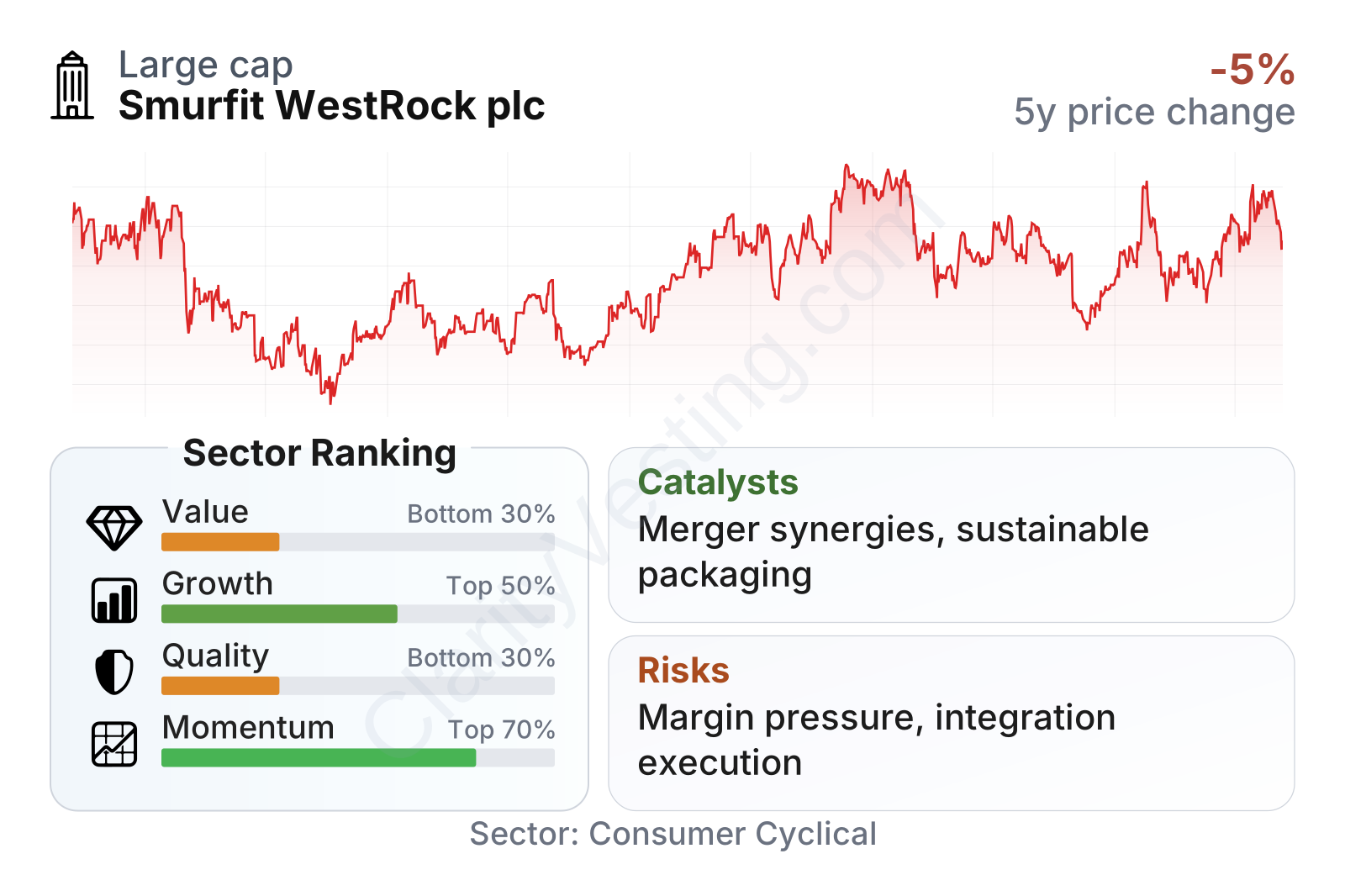
Smurfit WestRock stands at a market value of roughly $23 billion, making it a major player in global packaging rather than a niche operator. Share price volatility is close to the broader market, which fits a business tied to industrial demand and consumer goods volumes rather than a highly speculative profile.
The most notable takeaway from the metrics table is the mixed picture. Growth characteristics are around the middle of the sector, supported by strong multiyear expansion in revenue per share and especially free cash flow, but recent year-over-year sales growth has been weak once merger effects are set aside. Quality measures are less flattering: returns on invested capital and current margins sit well below sector norms, suggesting that the enlarged group has not yet converted its size into superior profitability.
Balance sheet indicators are more reassuring than profit metrics. Debt relative to equity is not dramatically out of line for the industry, and net debt relative to EBIT appears manageable at the latest reading. That said, the valuation profile looks demanding on earnings-based measures, while cash-flow-based value metrics also do not look especially cheap compared with the broader sector.
Growth
The packaging industry is not a fast-growth field in the way software or semiconductors can be, but it remains structurally relevant. Goods still need to be moved, protected, and displayed, and paper-based packaging continues to benefit from the push to replace some plastic formats with more recyclable materials. E-commerce, food delivery, shelf-ready retail packaging, and sustainability targets from major consumer brands all support long-term demand for corrugated and paper-based solutions.
For Smurfit WestRock, the core growth case is less about explosive end-market expansion and more about scale, integration, and optimization. The merger created a broader mill and converting network, deeper customer coverage, and larger procurement and logistics opportunities. If management executes well, the combined company should be able to improve plant utilization, reduce overlapping costs, and cross-sell more packaging formats to multinational clients.
The recent revenue pattern needs context. Reported growth surged after the merger, then normalized and turned weaker in the latest period. That does not necessarily mean the business is shrinking in strategic importance; it means headline comparisons are now tougher and that demand and pricing remain cyclical. What matters more for long-term analysis is whether the company can translate its larger scale into steadier organic growth and better margins over time.
Cash generation is one of the more encouraging recent developments. Free cash flow was pressured during the integration period, even turning negative at one point, but it has rebounded strongly to more than $1 billion on a trailing basis. For a capital-intensive manufacturer, that recovery is important because it can support debt service, reinvestment, restructuring, and potentially shareholder distributions without relying as heavily on external financing.
A key catalyst is the ongoing integration of Smurfit Kappa and WestRock. Public company communications around the merger emphasized synergy capture, network optimization, and a stronger global offering for customers. If those initiatives begin to show up more clearly in operating margin and return on capital, the company’s current profile could look materially different over the next few years.
Another favorable element is the company’s position in sustainable packaging. Large customers increasingly want recyclable, fiber-based solutions, and Smurfit WestRock has design, paper sourcing, and manufacturing capabilities that can help them shift formats. That is not a short-term demand spike, but it is a durable strategic tailwind.
Risks
The biggest risk is that this remains a low-margin, cyclical manufacturing business. Packaging demand is widespread, but not immune to economic slowdowns. Industrial production, consumer spending, box volumes, and paper pricing can all weaken at the same time. When that happens, fixed costs weigh heavily on profits.
Leverage is not the company’s weakest point, but it still deserves attention because the merger increased the scale and complexity of the balance sheet. Debt to equity has generally tracked around the sector range and is currently a bit below the industry median, which is a decent sign. Even so, interest expense has become much more noticeable in the earnings flow, so the business needs continued cash generation and disciplined integration to keep leverage from becoming a larger concern.
Profitability is the clearest area of weakness. Net profit margin has fallen sharply from earlier levels and now sits well below the sector median, near the low single digits. That matters because even modest disruptions in input costs, pricing, or volumes can have an outsized effect when margins are already thin. The latest operating margin is also notably below the industry norm, reinforcing the view that merger benefits have not yet fully offset cost pressure and integration friction.
Competition is intense. The company operates against other major packaging groups such as International Paper, Packaging Corporation of America, Mondi, DS Smith, and Oji-related packaging businesses in various regions, alongside many smaller local converters. Smurfit WestRock is unquestionably one of the largest players globally, and that scale is a real competitive advantage. It supports procurement, mill integration, customer reach, and design capabilities. However, it does not make the company immune to price competition, regional oversupply, or execution mistakes.
The company’s main advantages are its integrated system, broad geographic reach, long-standing customer relationships, and the sheer breadth of its packaging portfolio. Those strengths are meaningful, especially for multinational customers that value supply security and design support. The challenge is that packaging is still a business where scale must be turned into efficiency. At the moment, the size advantage is evident, but the superior returns usually associated with strong competitive moats are less visible in the financial results.
Recent company developments do not point to a major scandal or unusual governance event from the public materials typically reviewed for this type of analysis. The more practical risk is execution: integration delays, weaker-than-expected synergy capture, mill downtime, inflation in energy or fiber costs, and slower customer demand could all postpone the margin recovery that many market participants are watching for.
Valuation
Smurfit WestRock’s valuation is one of the more complicated parts of the picture. On a simple earnings multiple, the shares screen as expensive, with the latest price-to-earnings ratio far above the sector median. That headline number, however, is being influenced by depressed profit margins. When earnings are temporarily weak, the P/E ratio can look unusually high even if the market is really pricing in a recovery rather than rich current profitability.
The historical pattern supports that interpretation. For much of the earlier period, the company traded at lower earnings multiples, often below the sector median, but the multiple expanded sharply as profits came under pressure. In other words, the valuation looks elevated not because the market is assigning a classic premium-growth rating, but because current net income is relatively thin compared with the company’s scale.
That makes valuation highly dependent on whether margins improve. If integration benefits, better utilization, and cost actions lift earnings meaningfully, today’s multiple could look less stretched in hindsight. If margins stay subdued, then the current valuation leaves less room for disappointment. Cash flow offers some support to the broader valuation picture, especially after the recent rebound, but even on cash-flow-based measures the shares do not look obviously discounted versus the sector.
Overall, the current price appears to reflect a business with strong strategic assets and credible recovery potential, rather than a company already demonstrating best-in-class economics. That distinction is important: the valuation is easier to justify on future normalization than on present-day profitability.
Conclusion
Smurfit WestRock is easy to understand at a high level: it is a global packaging heavyweight supplying the boxes, paper, and related formats that move everyday commerce. The company has real industrial substance, broad geographic reach, and a strategic position in fiber-based packaging at a time when sustainability and e-commerce continue to support long-term demand.
The central issue is not relevance, but execution. The merger has created much greater scale and opened the door to meaningful synergies, yet the current financial profile still shows weak margins and low returns on capital compared with the wider sector. That leaves the company in an in-between position: stronger and more strategically important than before, but not yet operating with the efficiency expected from a top-tier global leader.
From a long-term perspective, the most constructive interpretation is that Smurfit WestRock has a credible path to becoming a more profitable and cash-generative packaging group as integration progresses. The more cautious interpretation is that the market is already giving some credit for that outcome while present earnings remain underwhelming. Taken together, the company looks more like a large-scale transformation case with solid industry positioning than a fully proven compounder at this stage.
Sources:
- Smurfit WestRock plc — Annual Report 2025
- Smurfit WestRock plc — Quarterly Report 2026
- Smurfit WestRock plc — Current Reports on Form 8-K filed in 2026
- SEC EDGAR — Smurfit WestRock plc filings
- Smurfit WestRock Investor Relations — merger and earnings press releases published in 2026
- Smurfit WestRock Investor Relations — company-hosted presentations and webcast materials
- Wikipedia — Smurfit WestRock plc
This article is for informational purposes only and does not constitute financial advice. Some content is AI-generated. See Disclaimer