Stock Analysis · Savers Value Village Inc (SVV)
Overview
Savers Value Village Inc. operates thrift stores that sell secondhand clothing, accessories, home goods, books, and other household items. The company runs a for-profit resale model in the United States, Canada, and Australia under banners including Savers, Value Village, Village des Valeurs, Unique, and 2nd Ave. Its model is built around buying donated goods from nonprofit partners and from other sources, processing those items centrally and in stores, and then selling them at value-oriented price points. That gives the business exposure to two durable consumer themes at once: low-price retail and reuse.
The company’s revenue is primarily generated by merchandise sales in its stores. Based on recent annual filings, revenue is heavily concentrated in retail sales, while the business is also meaningfully diversified by geography.
- Retail merchandise sales: about 98% to 99% of revenue. This includes sales of secondhand apparel, shoes, accessories, housewares, textiles, books, and other donated or sourced items sold through the company’s store base.
- Other revenue: about 1% to 2%. This mainly includes ancillary activities tied to the operating model, such as supply-chain related items and other miscellaneous income.
Geographically, Canada has historically represented the largest share of sales, followed by the United States, with Australia still much smaller. Exact shares can move over time, but Canada and the U.S. together account for the overwhelming majority of revenue.
A notable feature of the business is that inventory is not purchased in the same way as a traditional retailer that orders finished goods from brands or factories. Instead, Savers acquires donated goods in bulk, often through long-term nonprofit relationships, then sorts and prices those goods for resale. That structure can support attractive gross margins, but it also makes execution, labor productivity, and store traffic especially important.
The long-term financial picture shows a business that has continued to expand revenue, while more of that revenue has been absorbed by operating costs and interest expense in recent years. Sales rose from a little over $1.2 billion in 2021 to roughly $1.68 billion in 2025, but net income did not follow the same path, indicating that growth has been easier to achieve than profit expansion.
The flow of revenue and costs points to a business with resilient gross profit generation, but weaker conversion into bottom-line earnings. Selling, general, and administrative costs remain a large use of revenue, and interest expense has also been meaningful, which helps explain why earnings have been much more volatile than sales.
Key Figures
| Metric | Value | Sector ⓘ |
|---|---|---|
| Date | Sep 12, 2026 | |
| Context | ||
| Sector | Consumer Cyclical | |
| Industry | Specialty Retail | |
| Market Cap ⓘ | $1.49B | |
| Beta ⓘ | 1.22 | |
Value (Cheapness) | ||
| P/E Ratio ⓘ | 65.00 | 17.10 |
| FCF Yield ⓘ | 5.48% | 8.53% |
| EBIT / EV ⓘ | 3.96% | 6.46% |
| PEG ⓘ | N/A | |
Growth (Business expansion) | ||
| Revenue Growth ⓘ | 7.40% | 5.75% |
| RPS Growth (5Y CAGR) ⓘ | 8.28% | 9.14% |
| EPS Growth (5Y CAGR) ⓘ | -39.65% | -18.21% |
| Margin Growth (5Y Trend) ⓘ | -4.30% | -0.23% |
| FCF Growth (5Y CAGR) ⓘ | -22.56% | 4.91% |
Quality (Business durability) | ||
| ROIC (Latest) ⓘ | 6.74% | 12.61% |
| ROIC (5Y Median) ⓘ | 5.92% | 10.72% |
| Net Debt / EBIT (Latest) ⓘ | 12.05 | 2.10 |
| Net Debt / EBIT (5Y Median) ⓘ | 7.55 | 2.32 |
| Operating Margin (Latest) ⓘ | 6.41% | 9.25% |
| Operating Margin (5Y Median) ⓘ | 9.78% | 9.64% |
| Debt to Equity (Latest) ⓘ | 323.46% | 75.78% |
| Profit Margin (Latest) ⓘ | 1.42% | 5.33% |
| Free Cash Flow (Latest) ⓘ | $81.81M | |
Momentum (Price trend) | ||
| 3Y Return ⓘ | -56.04% | +14.53% |
| 12M Return (excl. last month) ⓘ | -4.97% | +3.08% |
| 6M Return ⓘ | +25.00% | +0.55% |
| Price vs. 200-Day MA ⓘ | +3.44% | -0.54% |
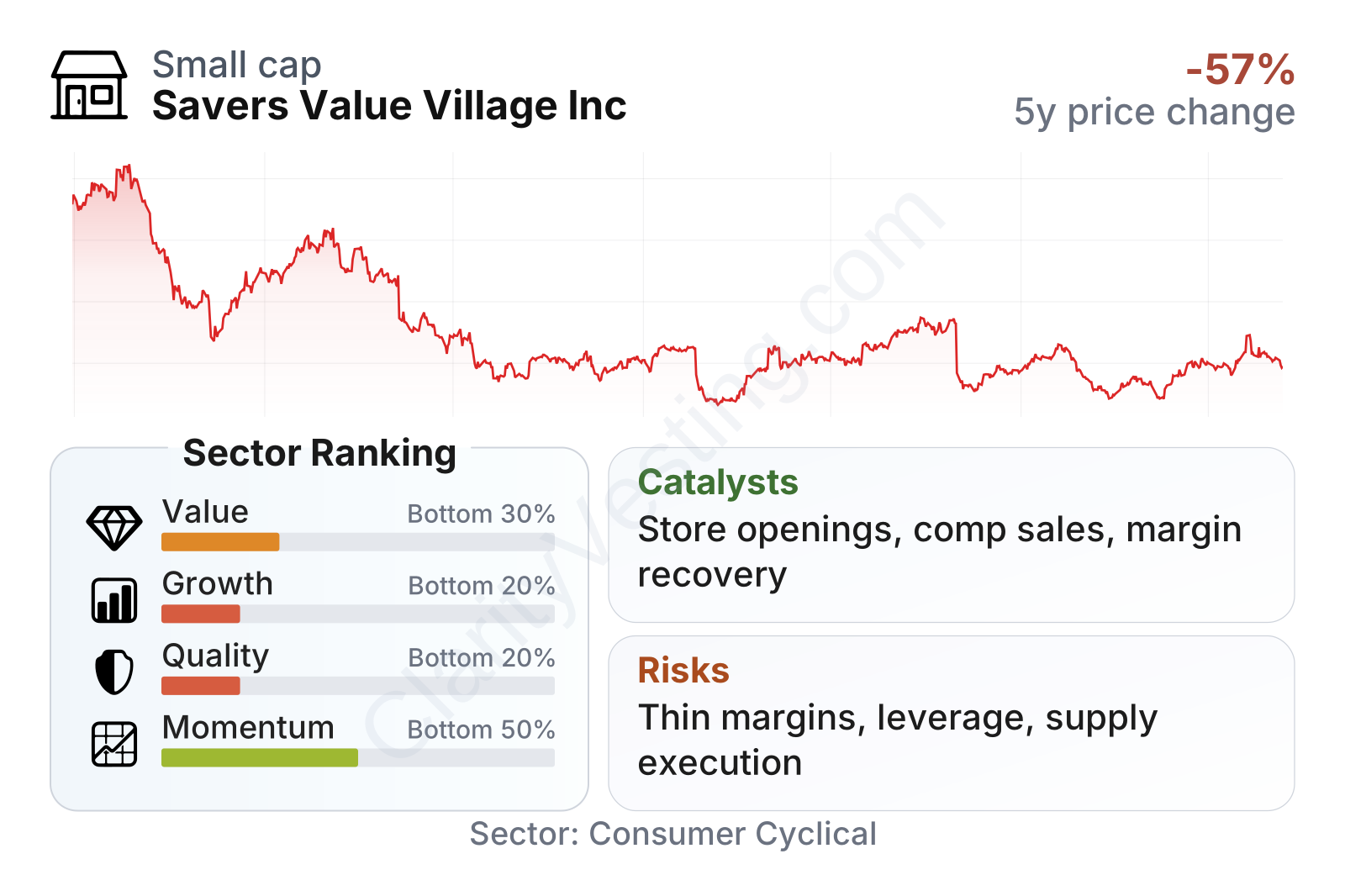
Savers is a mid-sized public retailer with above-average share price volatility, reflected in a beta above 1. The current factor profile is weak relative to much of the consumer discretionary sector: value ranks in the bottom 30%, while growth and quality both sit in the bottom 20%. Revenue growth has recently been decent, but profitability, returns on capital, and balance-sheet strength are less impressive. Momentum is mixed: the stock remains far below its 2023 level over a multi-year view, but shorter-term trading has improved.
Growth
The company operates in a part of retail that has favorable long-term industry characteristics. Secondhand retail has benefited from consumer demand for lower prices, growing acceptance of resale, and broader interest in reuse and sustainability. These are useful tailwinds because they are not tied to a single fashion trend or product cycle. In a weaker consumer environment, thrift can also attract shoppers looking to trade down on price.
Savers’ strategy for growth is straightforward and generally logical. It is centered on opening more stores, increasing comparable sales in existing locations, improving supply availability through nonprofit and other sourcing relationships, and using scale to process goods more efficiently. The store base still leaves room for expansion, especially because thrift remains fragmented and many local competitors do not have the same processing infrastructure or brand recognition.
Recent revenue growth has been positive and, lately, somewhat stronger than the sector median. Year-over-year sales growth moved from low single digits in 2024 to high single digits for much of 2025 and the first half of 2026. That suggests demand and store expansion are still supporting the top line even though earnings have remained pressured.
Cash generation is a more mixed picture. Free cash flow remains positive, which matters for a retailer with expansion plans and leverage, but the trend has been uneven over the last few years. There was a sharp drop during 2025 followed by some recovery. That indicates the business still converts sales into cash, but not with the consistency that would make the growth profile look especially strong.
One of the clearest catalysts is continued store growth combined with better operating execution. If the company can keep adding locations while lifting productivity in sorting, pricing, labor scheduling, and inventory flow, even modest margin improvement could have a meaningful effect on earnings because the current profit base is relatively thin. Another possible support is the ongoing consumer search for value, which tends to benefit off-price and secondhand formats.
Recent company updates have also emphasized new store openings, stronger comparable sales trends, and initiatives around customer experience and sourcing. None of these changes transform the business overnight, but together they point to a realistic path for gradual expansion if execution remains steady.
Risks
This article is for informational purposes only and does not constitute financial advice. Some content is AI-generated. See Disclaimer


