Stock Analysis · Sun Art Retail Group Limited (SURRF)
Overview
Sun Art Retail Group Limited is one of China’s large food and general merchandise retail operators. The company runs hypermarkets, supermarkets, and membership-based warehouse formats, selling everyday necessities such as fresh food, packaged groceries, household items, personal care products, apparel, and some consumer electronics. Its best-known banners include RT-Mart and Auchan, and in recent years the group has also pushed harder into online fulfillment, home delivery, and store-based digital integration.
For a long-term reader, the easiest way to understand Sun Art is to see it as a traditional big-box retailer trying to adapt to a Chinese consumer market that has shifted toward convenience, lower prices, and online ordering. The business still depends heavily on physical stores, but those stores increasingly act as both shopping destinations and local distribution hubs.
Revenue is mainly generated from merchandise sales, with a much smaller contribution from services linked to operating retail space and related activities. Based on the company’s business model and disclosures, the mix is broadly concentrated as follows:
- Direct sales of goods in stores and online: by far the largest source, roughly well above 90% of total revenue.
- Fresh food and grocery categories: the core traffic drivers within merchandise sales, typically the largest product family.
- General merchandise: household goods, apparel, electronics, and seasonal items, a secondary but meaningful contributor.
- Rental, service, and other operating income: a small share, likely in the low single digits.
What stands out in the recent business flow is that sales have been shrinking from earlier peaks, while gross profit remains substantial but leaves only a thin cushion after operating costs. That pattern is important: Sun Art still handles very large volumes, but turning those volumes into stable profit has become more difficult.
Key Figures
| Metric | Value | Sector ⓘ |
|---|---|---|
| Date | Sep 12, 2026 | |
| Context | ||
| Sector | Consumer Cyclical | |
| Industry | Department Stores | |
| Market Cap ⓘ | $2.95B | |
| Beta ⓘ | 1.30 | |
Value (Cheapness) | ||
| P/E Ratio ⓘ | N/A | 17.10 |
| FCF Yield ⓘ | 91.48% | 8.53% |
| EBIT / EV ⓘ | 57.44% | 6.46% |
| PEG ⓘ | 1.37 | |
Growth (Business expansion) | ||
| Revenue Growth ⓘ | -10.60% | 5.75% |
| RPS Growth (5Y CAGR) ⓘ | -9.91% | 9.14% |
| EPS Growth (5Y CAGR) ⓘ | -68.77% | -18.21% |
| Margin Growth (5Y Trend) ⓘ | N/A | -0.23% |
| FCF Growth (5Y CAGR) ⓘ | -58.13% | 4.91% |
Quality (Business durability) | ||
| ROIC (Latest) ⓘ | N/A | 12.61% |
| ROIC (5Y Median) ⓘ | 0.53% | 10.72% |
| Net Debt / EBIT (Latest) ⓘ | -4.50 | 2.10 |
| Net Debt / EBIT (5Y Median) ⓘ | N/A | 2.32 |
| Operating Margin (Latest) ⓘ | 0.62% | 9.25% |
| Operating Margin (5Y Median) ⓘ | -0.78% | 9.64% |
| Debt to Equity (Latest) ⓘ | 43.41% | 75.78% |
| Profit Margin (Latest) ⓘ | -0.50% | 5.33% |
| Free Cash Flow (Latest) ⓘ | $2.70B | |
Momentum (Price trend) | ||
| 3Y Return ⓘ | -56.06% | +14.53% |
| 12M Return (excl. last month) ⓘ | -17.99% | +3.08% |
| 6M Return ⓘ | -44.54% | +0.55% |
| Price vs. 200-Day MA ⓘ | -46.47% | -0.54% |
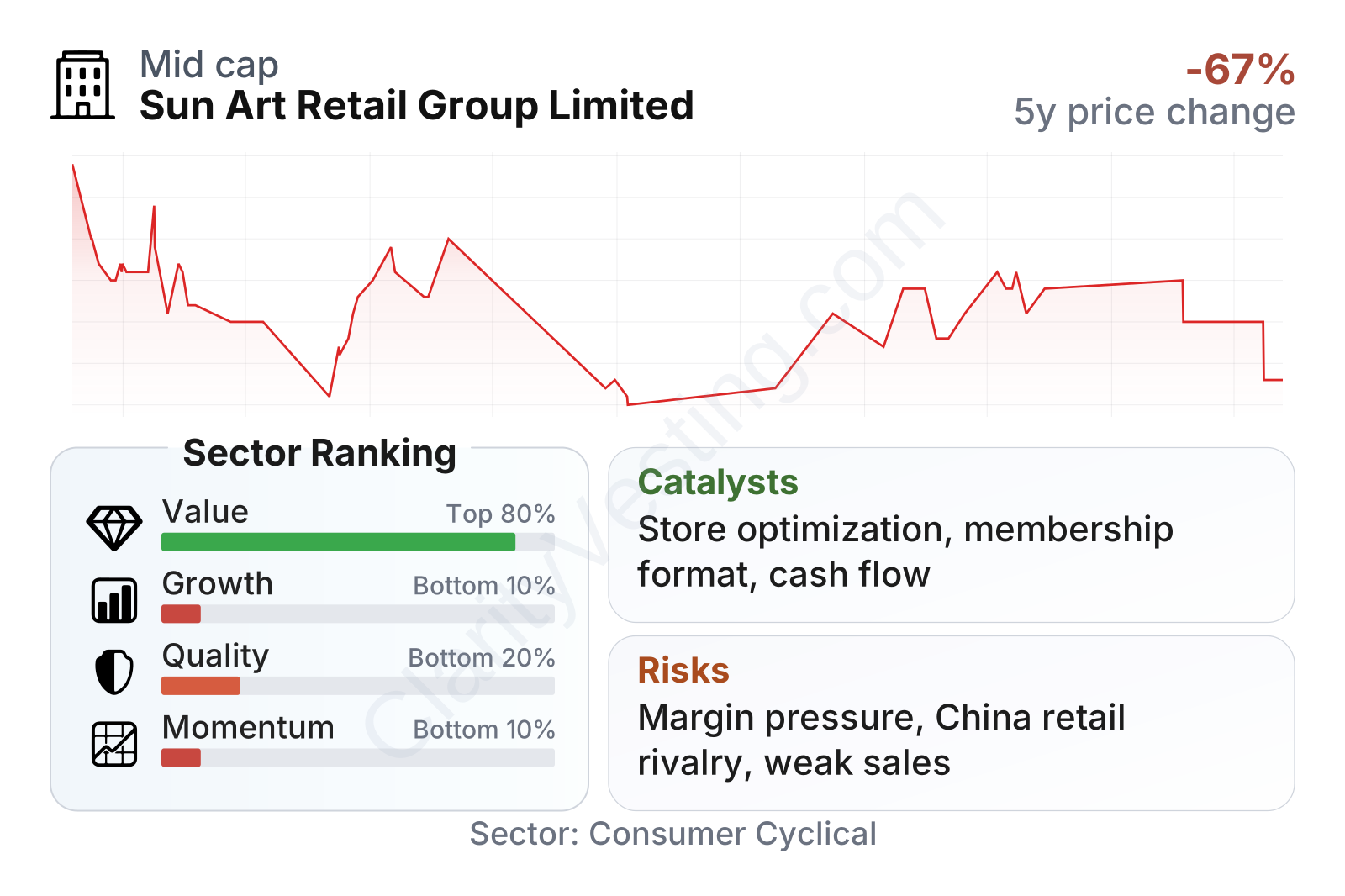
Sun Art sits in an unusual position. On headline valuation measures, it appears very cheap relative to much of the consumer retail sector, and its balance sheet is not heavily burdened by debt. Free cash flow also looks unusually strong on a trailing basis. However, those positives are offset by very weak growth and low operating quality metrics. In simple terms, the market is not assigning a high multiple because the business has struggled to convert scale into consistent earnings growth.
The stock’s longer-term share price trend has also been weak despite some shorter bursts of resilience. That matches the broader picture: the company is still relevant and sizable, but confidence has been limited by declining sales, inconsistent profitability, and a difficult retail environment.
Growth
Sun Art operates in a sector that is still important, but not structurally easy. Food retail and household essentials remain durable categories because people continue to spend on them in almost any economic environment. The problem is that growth in China’s retail market has shifted toward more efficient formats, stronger private-label offerings, discount-driven competition, faster delivery, and ecosystems built around digital platforms. That means the sector itself is not disappearing, but legacy hypermarket operators have to evolve quickly to capture future demand.
Sun Art’s strategy broadly makes sense in that context. The company has focused on store optimization, supply chain improvements, membership-store development, and closer integration between offline stores and online fulfillment. Those are sensible responses because they target the areas where consumer behavior has changed most: convenience, value, and speed. The challenge is execution. The company’s recent record shows that strategic adaptation has not yet translated into sustained top-line growth.
Recent revenue direction remains a weak point. Year-over-year sales have been negative, and the multi-year trend is also below the sector norm. That suggests Sun Art is still in a transition phase rather than in a clean recovery. For long-term analysis, this matters more than one isolated quarter because retailers with shrinking revenue often face pressure on purchasing power, store productivity, and vendor terms.
Cash generation is a more constructive area. Even with weak profit margins, the business has recently produced strong free cash flow, which can help support store revamps, logistics upgrades, and operational restructuring. For a retailer, that flexibility is valuable because turnarounds usually require both time and investment. If management can protect cash while stabilizing comparable sales, that would be a meaningful operational catalyst.
A further potential catalyst comes from format evolution. Membership stores and digitally enabled neighborhood fulfillment are among the more promising areas in Chinese retail. If Sun Art can leverage its national footprint and supply chain to make those formats more productive, it could improve traffic quality rather than simply chase volume. The company’s scale remains an asset, even if it has not recently shown up in growth metrics.
Risks
This article is for informational purposes only and does not constitute financial advice. Some content is AI-generated. See Disclaimer


