Stock Analysis · Seagate Technology PLC (STX)
Overview
Seagate Technology is a data storage company best known for hard disk drives, or HDDs. These are the devices used to store large amounts of data in cloud data centers, enterprise systems, personal computers, video and image archives, and external storage products. The company also sells storage systems and a smaller range of solid-state storage offerings, but Seagate remains primarily an HDD business. In simple terms, Seagate helps large organizations and consumers keep, move, and manage very large volumes of digital information.
Its revenue base is concentrated in mass-capacity storage, especially products sold to cloud service providers and enterprise customers. Based on recent company disclosures, the business can be understood roughly as follows:
- Mass-capacity HDDs for cloud and enterprise customers: about 75% to 85%. This includes high-capacity nearline drives used in data centers, AI infrastructure, and large-scale storage environments.
- Legacy and non-mass-capacity HDD products: about 10% to 20%. This covers desktop, notebook, video/image applications, and other lower-capacity or older categories that have been shrinking over time.
- Systems, SSDs, and other storage-related products and services: less than 10%. This is a smaller part of the business and not the main earnings driver.
Geographically, Seagate sells worldwide, but demand is driven less by consumer regions and more by a limited number of very large technology and cloud customers. That customer mix makes the company more exposed to big swings in data center spending than many diversified hardware businesses.
The business mix has improved in recent years. A larger share now comes from higher-capacity drives, which usually support better pricing and stronger margins than older product lines. The operating picture also shows a sharp recovery from the 2023 downturn, with revenue, gross profit, and net income rebounding strongly by fiscal 2026.
Key Figures
| Metric | Value | Sector ⓘ |
|---|---|---|
| Date | Sep 12, 2026 | |
| Context | ||
| Sector | Technology | |
| Industry | Computer Hardware | |
| Market Cap ⓘ | $196.09B | |
| Beta ⓘ | 2.09 | |
Value (Cheapness) | ||
| P/E Ratio ⓘ | 63.69 | 29.51 |
| FCF Yield ⓘ | 1.70% | 4.25% |
| EBIT / EV ⓘ | 1.95% | 2.85% |
| PEG ⓘ | 0.51 | |
Growth (Business expansion) | ||
| Revenue Growth ⓘ | 48.50% | 15.40% |
| RPS Growth (5Y CAGR) ⓘ | 0.57% | 8.56% |
| EPS Growth (5Y CAGR) ⓘ | 17.02% | -11.88% |
| Margin Growth (5Y Trend) ⓘ | 16.05% | 0.46% |
| FCF Growth (5Y CAGR) ⓘ | 24.90% | 9.80% |
Quality (Business durability) | ||
| ROIC (Latest) ⓘ | 66.68% | 9.44% |
| ROIC (5Y Median) ⓘ | 33.26% | 8.30% |
| Net Debt / EBIT (Latest) ⓘ | 0.54 | 0.54 |
| Net Debt / EBIT (5Y Median) ⓘ | 2.44 | 0.44 |
| Operating Margin (Latest) ⓘ | 32.59% | 9.58% |
| Operating Margin (5Y Median) ⓘ | 16.53% | 8.25% |
| Debt to Equity (Latest) ⓘ | 178.03% | 33.33% |
| Profit Margin (Latest) ⓘ | 26.11% | 7.14% |
| Free Cash Flow (Latest) ⓘ | $3.33B | |
Momentum (Price trend) | ||
| 3Y Return ⓘ | +1319.31% | +45.48% |
| 12M Return (excl. last month) ⓘ | +469.10% | +23.48% |
| 6M Return ⓘ | +122.53% | +20.93% |
| Price vs. 200-Day MA ⓘ | +37.15% | +7.43% |
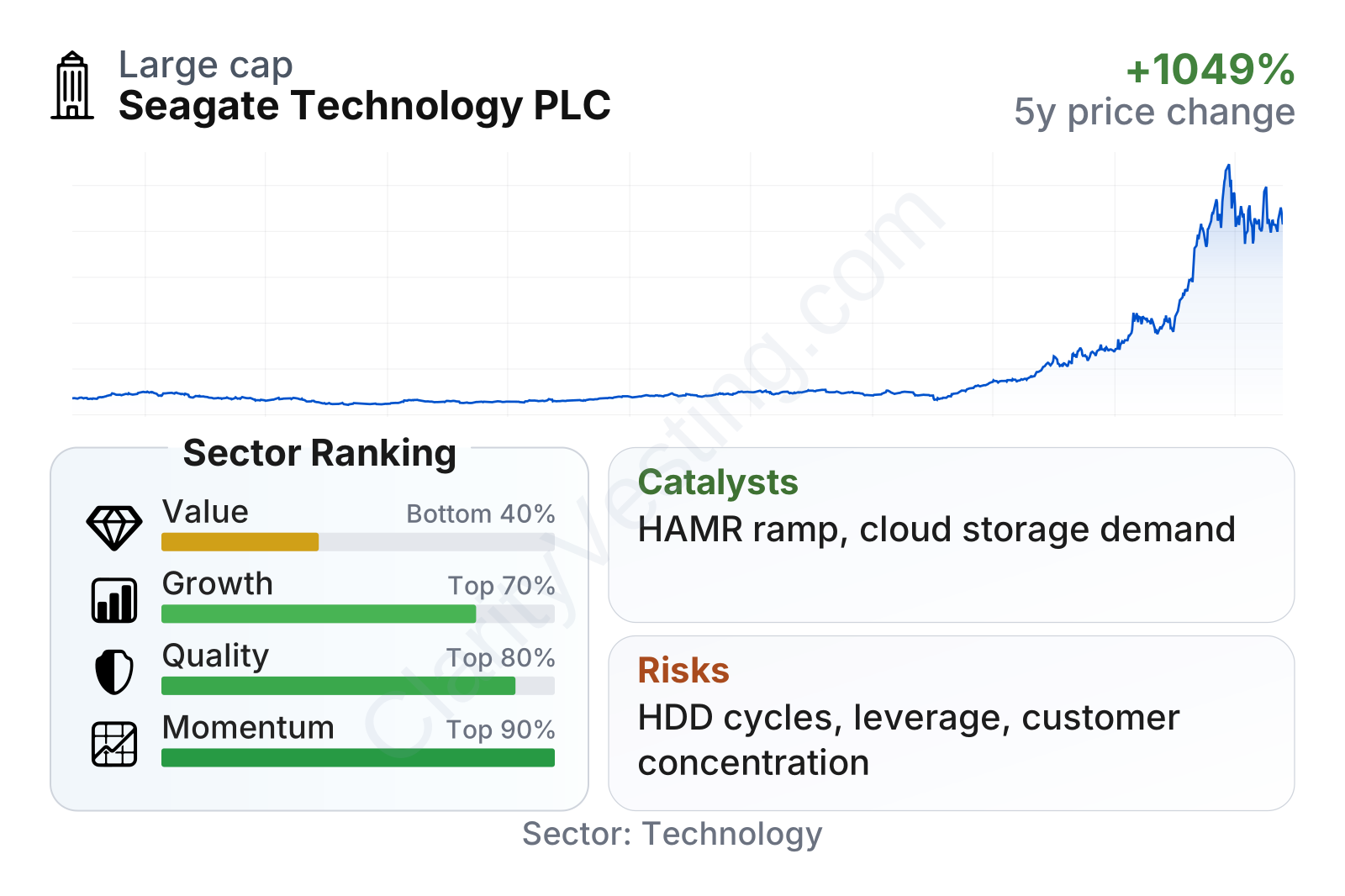
Seagate currently combines very strong profitability, strong recent growth, and powerful stock momentum, but its valuation is no longer cheap on simple earnings and cash flow measures. The quality profile stands out: operating margin, profit margin, and return on invested capital are well above sector medians. Growth indicators are mixed depending on the time frame, with a strong short-term rebound but a much less impressive multi-year revenue record. The balance sheet also deserves attention, because leverage remains meaningfully above the sector norm and the shares have historically been volatile, as reflected in a beta above 2.
Growth
Seagate operates in a sector with an important long-term tailwind: the world keeps creating more data. Cloud computing, AI model training, AI inference, video content, surveillance, enterprise backups, and digital archives all require huge amounts of storage. Not all of that demand goes to HDDs, but high-capacity hard drives remain one of the cheapest ways to store massive volumes of data. That cost advantage is central to Seagate’s long-term relevance.
The company’s strategy is built around this idea. Rather than trying to compete everywhere, Seagate has focused on high-capacity drives for cloud and enterprise customers, where storage economics matter most. One of the biggest product catalysts is the transition to heat-assisted magnetic recording, or HAMR, which is designed to push drive capacities higher over time. If Seagate executes well, larger-capacity products can raise revenue per drive, deepen ties with large cloud buyers, and support margins.
The recent operating rebound has been significant. Revenue growth turned deeply negative during the inventory correction in 2022 and 2023, then moved back into strong positive territory. The latest year-over-year growth rate is close to 50%, clearly ahead of the broader sector median. That does not mean the business has become smooth or predictable, but it does show how powerfully Seagate can recover when cloud demand and pricing improve.
Cash generation has recovered as well. Trailing free cash flow rose from a depressed level in 2023 and 2024 to more than $2.5 billion by early 2026, and the latest metric table points to roughly $3.3 billion on a trailing basis. That is an important sign because this company’s long-term case depends not just on accounting profits, but on its ability to turn storage demand into real cash after capital spending.
A recent and meaningful opportunity is the company’s progress in shipping high-capacity HAMR-based drives to large customers. Public company communications in 2026 emphasized volume ramps in next-generation products and continuing cloud demand for mass-capacity storage. If these deployments continue, Seagate could benefit from both unit mix improvement and stronger pricing in the part of the market where it has the best position.
Risks
This article is for informational purposes only and does not constitute financial advice. Some content is AI-generated. See Disclaimer


