Stock Analysis · STMicroelectronics NV (STM)
Overview
STMicroelectronics is a large European semiconductor company that designs and manufactures chips used in industrial equipment, cars, personal electronics, communications devices, and connected objects. In simple terms, it makes many of the tiny components that allow modern machines to sense, process, control power, and communicate. Its products are especially important in areas where electronics meet the physical world, such as electric vehicles, factory automation, energy systems, and smart devices.
The business is broad, but its revenue is concentrated in a few important product families. Based on the company’s recent annual reporting, the largest sources of revenue are approximately:
- Automotive products — roughly 40% to 45% of revenue. This includes chips for electric vehicles, advanced driver assistance, power management, microcontrollers, and car electrification.
- Industrial products — roughly 25% to 30%. These chips serve factory automation, power and energy systems, smart infrastructure, and industrial control.
- Personal electronics — roughly 15% to 20%. This area includes components used in consumer devices and smart applications.
- Communication equipment and computer peripherals — roughly 10% or less.
- Other applications — a smaller residual share.
From a technology point of view, STMicroelectronics is strongest in microcontrollers, analog chips, sensors, and especially power semiconductors such as silicon carbide devices. That mix matters because these are the types of chips needed for electrification and automation, two themes likely to remain relevant for years.
The company’s financial profile also shows how cyclical semiconductors can be. Revenue and profit climbed sharply through 2022 and 2023, then weakened as demand softened and inventories adjusted. Even so, the business has continued to spend heavily on research and development, which suggests management is trying to protect its future product position instead of only defending short-term margins.
The longer picture is clear: sales expanded strongly from 2021 to 2023, but profitability compressed sharply in 2024 and 2025 as revenue fell and fixed costs weighed more heavily on results. Research and development remained high throughout the cycle, showing that innovation spending has been treated as a strategic priority rather than an expense to cut aggressively during the downturn.
Key Figures
| Metric | Value | Sector ⓘ |
|---|---|---|
| Date | Jul 18, 2026 | |
| Context | ||
| Sector | Technology | |
| Industry | Semiconductors | |
| Market Cap ⓘ | $56.01B | |
| Beta ⓘ | 1.56 | |
Value (Cheapness) | ||
| P/E Ratio ⓘ | 392.31 | 31.76 |
| FCF Yield ⓘ | 0.14% | 4.18% |
| EBIT / EV ⓘ | 0.68% | 2.56% |
| PEG ⓘ | 0.49 | |
Growth (Business expansion) | ||
| Revenue Growth ⓘ | 23.00% | 13.50% |
| RPS Growth (5Y CAGR) ⓘ | -1.85% | 8.57% |
| EPS Growth (5Y CAGR) ⓘ | -73.56% | -21.87% |
| Margin Growth (5Y Trend) ⓘ | -15.25% | 0.41% |
| FCF Growth (5Y CAGR) ⓘ | N/A | 9.76% |
Quality (Business durability) | ||
| ROIC (Latest) ⓘ | 0.89% | 8.54% |
| ROIC (5Y Median) ⓘ | 17.90% | 8.12% |
| Net Debt / EBIT (Latest) ⓘ | 1.73 | 0.38 |
| Net Debt / EBIT (5Y Median) ⓘ | -0.15 | 0.38 |
| Operating Margin (Latest) ⓘ | 3.17% | 9.58% |
| Operating Margin (5Y Median) ⓘ | 18.64% | 8.25% |
| Debt to Equity (Latest) ⓘ | 14.46% | 33.52% |
| Profit Margin (Latest) ⓘ | 1.19% | 6.96% |
| Free Cash Flow (Latest) ⓘ | $76.80M | |
Momentum (Price trend) | ||
| 3Y Return ⓘ | +20.72% | +30.91% |
| 12M Return (excl. last month) ⓘ | +157.93% | +28.90% |
| 6M Return ⓘ | +122.53% | +5.38% |
| Price vs. 200-Day MA ⓘ | +53.12% | +7.61% |
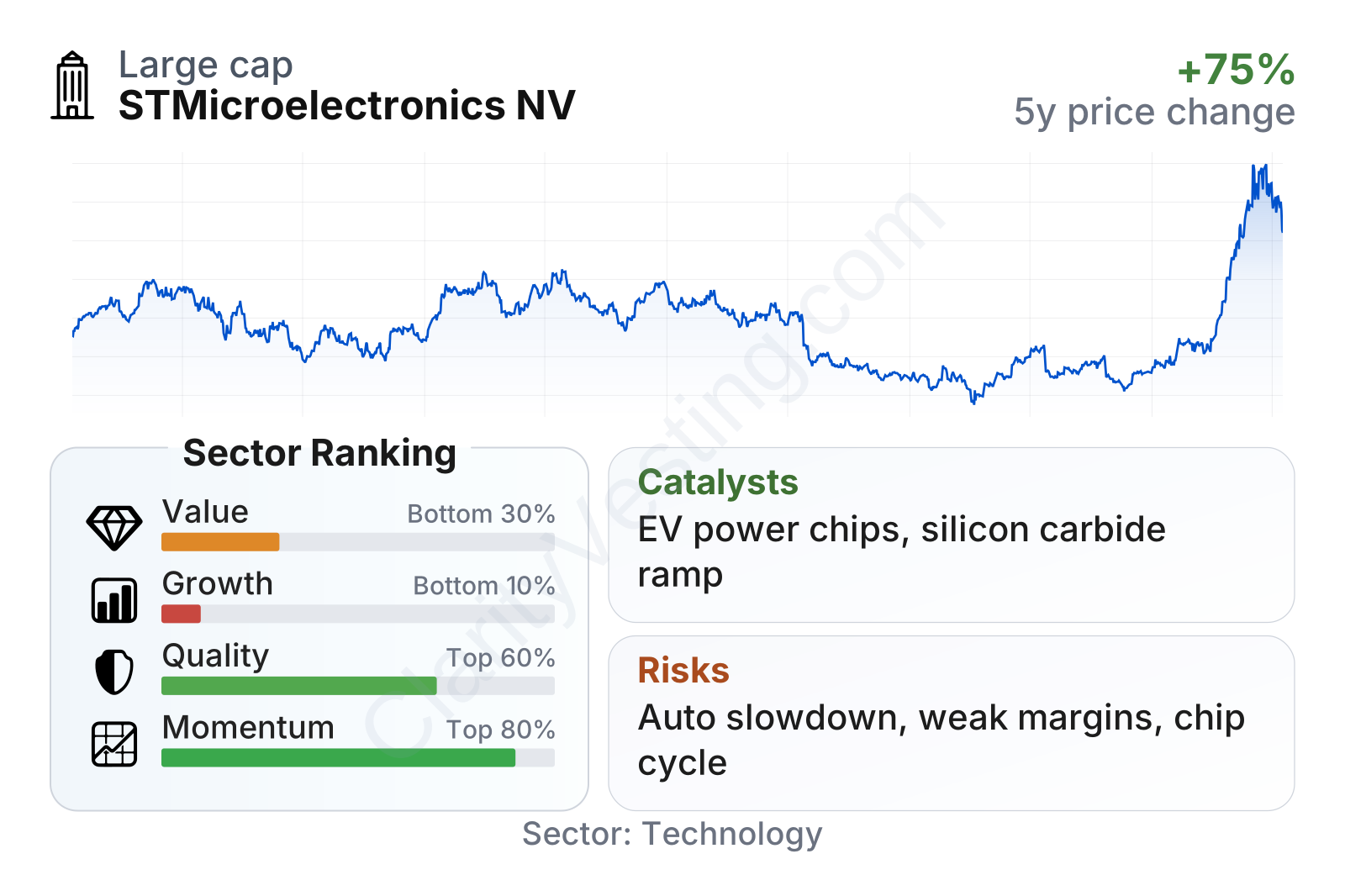
The market value places STMicroelectronics among the larger semiconductor companies, but the latest factor snapshot looks mixed. Quality remains decent on a longer view because historical returns on invested capital and margins were strong during the upcycle, while current growth and value readings are weaker because earnings and cash flow have fallen sharply from peak levels. Price momentum has been unusually strong recently, which suggests the market is already looking ahead to a recovery rather than focusing only on current profits.
Growth
STMicroelectronics operates in a sector with solid long-term demand drivers. Cars are becoming more electronic, factories are becoming more automated, and power systems are becoming more efficient and more connected. All of those trends require more semiconductors per device, especially the types of chips in which STMicroelectronics has established know-how. This does not remove the cycle, but it supports the idea that the end markets themselves are growing over time.
The company’s strategy is also coherent. It has leaned into automotive and industrial customers, where product lives are often longer and customer relationships can be stickier than in fast-changing consumer gadgets. It has also invested in silicon carbide, a material used in power electronics that can improve efficiency in electric vehicles and industrial energy systems. If that technology continues to gain adoption, STMicroelectronics is positioned in one of the more attractive parts of the semiconductor market.
Recent sales trends show a classic semiconductor pattern: a strong boom, a painful correction, and now signs of stabilization. Year-over-year revenue growth turned deeply negative through much of 2024 and 2025, but the latest period shows a return to positive growth. That does not prove a full recovery yet, though it does suggest the worst of the inventory adjustment may be passing.
Cash generation tells a similar story. Free cash flow was very strong during the upcycle, then dropped sharply as profits weakened and the company kept investing. A low recent cash figure is not ideal, but in this case it should be read alongside the company’s decision to continue funding capacity and technology rather than retreating completely. If demand improves, operating leverage could allow cash flow to recover faster than recent results imply.
One of the more important potential catalysts is the continued expansion of electric vehicles and industrial electrification. These markets need power chips, microcontrollers, and sensors in large volumes. Another is capacity development in advanced power semiconductors, especially silicon carbide, where customers increasingly want dependable supply from established partners. Recent company communications have also emphasized long-term partnerships and manufacturing investments aimed at supporting future demand rather than only near-term sales.
Risks
The biggest risk is cyclicality. Semiconductor demand rarely moves in a straight line, and STMicroelectronics is currently coming out of a weaker part of that cycle. A business tied to automotive and industrial customers can look resilient, but it is still exposed to inventory swings, production cuts, delayed orders, and weaker capital spending. When revenue falls, margins can compress quickly because chip manufacturing carries a high fixed-cost base.
Balance-sheet leverage is not the main concern here. Debt relative to equity has trended below the sector median for several years and remains fairly modest. That gives the company more room to absorb a downturn than peers that rely more heavily on debt. The more relevant issue is not solvency, but whether profits and cash flow recover enough to justify ongoing capital spending.
Margins highlight the pressure clearly. STMicroelectronics used to earn profit margins far above the sector median during the peak years, but that advantage has eroded dramatically. The latest margin is very thin, which means even a small operational disappointment can have a large effect on earnings. This is one reason the current valuation signals look distorted.
Competition is another important risk. STMicroelectronics is a major player, but it is not the overall leader across semiconductors. It competes with companies such as Infineon in automotive and power chips, NXP in automotive and industrial semiconductors, Texas Instruments in analog, ON Semiconductor in power and auto exposure, and Microchip in microcontrollers. STMicroelectronics compares well in power electronics and broad industrial-auto exposure, but it does not dominate every category. Its advantage is more about portfolio breadth, manufacturing capability, and customer relationships than pure market control.
The company does have real competitive strengths. It manufactures a meaningful share of its own products, has deep know-how in power and embedded processing, and serves customers that often value reliability and long qualification cycles. In automotive and industrial markets, switching suppliers is harder than in some consumer segments, which can help support durable business relationships. However, these strengths do not fully shield it when end-market demand weakens.
There is no widely visible public-domain sign of a major governance scandal or reputation event dominating the current story. The more important recent risk signal has been operational: the sharp fall in earnings, free cash flow, and profitability after the earlier boom. That creates pressure on execution, especially while the company continues to invest for future growth.
Valuation
At first glance, the current valuation can look expensive because the trailing price-to-earnings ratio has surged far above both its own history and the sector median. That does not necessarily mean the share price itself is extreme. In this case, the ratio has jumped mainly because earnings fell sharply, making the denominator unusually small. In earlier years, STMicroelectronics often traded at a much lower earnings multiple than the sector while delivering stronger margins.
That makes valuation harder than usual. On normalized earnings power, the company may look very different from what the current trailing multiple suggests. On near-term results, however, the stock does not screen as cheap: free cash flow yield is weak, operating profitability is compressed, and current earnings offer little support for a low-multiple argument. In other words, the market seems to be valuing recovery potential rather than present-day performance.
The recent share-price rebound also matters. Momentum has been much stronger than the sector average, which usually means some optimism about improving demand, margins, or both is already reflected. That does not invalidate the recovery case, but it reduces the margin for disappointment if the rebound takes longer than expected.
Conclusion
STMicroelectronics remains a substantial semiconductor company with attractive exposure to durable themes such as automotive electronics, industrial automation, and power efficiency. Its product mix is tied to real long-term demand, and its position in power semiconductors and embedded systems gives the business strategic relevance well beyond a single product cycle.
The challenge is that the company is being judged at a difficult point in the cycle. Revenue has only recently started to recover, profitability has fallen sharply from peak levels, and cash generation is still subdued. The balance sheet remains fairly solid, which reduces financial strain, but weak margins leave little room for execution mistakes in the short run.
Overall, the company looks more like a cyclical technology franchise with credible long-term industrial value than a consistently compounding semiconductor leader. The underlying business case is still meaningful, especially if electrification and silicon carbide continue to expand, but the current valuation context depends heavily on a recovery that has started to appear in revenue yet is not fully visible in earnings. That creates an interesting profile, though one that still rests more on future normalization than on present operating strength.
Sources:
- STMicroelectronics — 2025 Annual Report and Form 20-F
- STMicroelectronics — First Quarter 2026 Results Press Release
- STMicroelectronics — Investor Relations Presentations and Financial Reports
- SEC EDGAR — STMicroelectronics N.V. filings
- STMicroelectronics — Company profile and product portfolio information
- Wikipedia — STMicroelectronics
This article is for informational purposes only and does not constitute financial advice. Some content is AI-generated. See Disclaimer