Stock Analysis · Domino's Pizza Inc (DPZ)
Overview
Domino's Pizza is a global pizza delivery and carryout restaurant company built around a franchise-heavy model. It operates under the Domino’s brand and makes money not only from selling food in company-owned stores, but also from supplying ingredients and equipment to franchisees, collecting royalties, and earning fees tied to its digital ordering and store network. The business is present in the United States and in many international markets, with a system that depends heavily on scale, brand recognition, delivery logistics, and technology.
Its revenue base is more diversified than many casual readers might expect. Domino’s reported revenue primarily from the following sources, ranked from largest to smallest:
- U.S. supply chain revenue: about 60% to 65% of total revenue in recent years. This includes food, ingredients, packaging, and equipment sold to U.S. franchise stores.
- Company-owned stores: about 10% to 15%. This is direct restaurant sales from stores operated by Domino’s itself, mostly in the U.S.
- U.S. franchise royalties and fees: about 10% to 12%. This includes royalty income and related fees paid by domestic franchisees.
- International franchise royalties and fees: about 9% to 11%. This comes from overseas franchise partners and reflects the strength of the brand outside the U.S.
That mix matters because the supply chain business brings large revenue dollars, while franchise royalties tend to be higher-margin. Over the last several years, total revenue has moved steadily upward, and profits have generally expanded faster than sales, showing that the model benefits from scale.
The visual breakdown also shows a useful pattern: revenue has climbed from roughly $4.4 billion in 2021 to almost $4.9 billion in 2025, while operating income and net income have also improved. Interest expense has stayed meaningful, which is important for risk analysis, but the company has still translated more of its sales into profit over time.
Key Figures
| Metric | Value | Sector ⓘ |
|---|---|---|
| Date | Sep 12, 2026 | |
| Context | ||
| Sector | Consumer Cyclical | |
| Industry | Restaurants | |
| Market Cap ⓘ | $10.50B | |
| Beta ⓘ | 0.95 | |
Value (Cheapness) | ||
| P/E Ratio ⓘ | 18.21 | 17.10 |
| FCF Yield ⓘ | 6.23% | 8.53% |
| EBIT / EV ⓘ | 5.96% | 6.46% |
| PEG ⓘ | 1.46 | |
Growth (Business expansion) | ||
| Revenue Growth ⓘ | 4.30% | 5.75% |
| RPS Growth (5Y CAGR) ⓘ | 5.70% | 9.14% |
| EPS Growth (5Y CAGR) ⓘ | -10.49% | -18.21% |
| Margin Growth (5Y Trend) ⓘ | 0.80% | -0.23% |
| FCF Growth (5Y CAGR) ⓘ | 4.64% | 4.91% |
Quality (Business durability) | ||
| ROIC (Latest) ⓘ | 75.73% | 12.61% |
| ROIC (5Y Median) ⓘ | 78.89% | 10.72% |
| Net Debt / EBIT (Latest) ⓘ | 5.39 | 2.10 |
| Net Debt / EBIT (5Y Median) ⓘ | 6.00 | 2.32 |
| Operating Margin (Latest) ⓘ | 18.26% | 9.25% |
| Operating Margin (5Y Median) ⓘ | 18.95% | 9.64% |
| Debt to Equity (Latest) ⓘ | -128.64% | 75.78% |
| Profit Margin (Latest) ⓘ | 11.86% | 5.33% |
| Free Cash Flow (Latest) ⓘ | $653.47M | |
Momentum (Price trend) | ||
| 3Y Return ⓘ | -17.08% | +14.53% |
| 12M Return (excl. last month) ⓘ | -18.28% | +3.08% |
| 6M Return ⓘ | -20.42% | +0.55% |
| Price vs. 200-Day MA ⓘ | -13.58% | -0.54% |
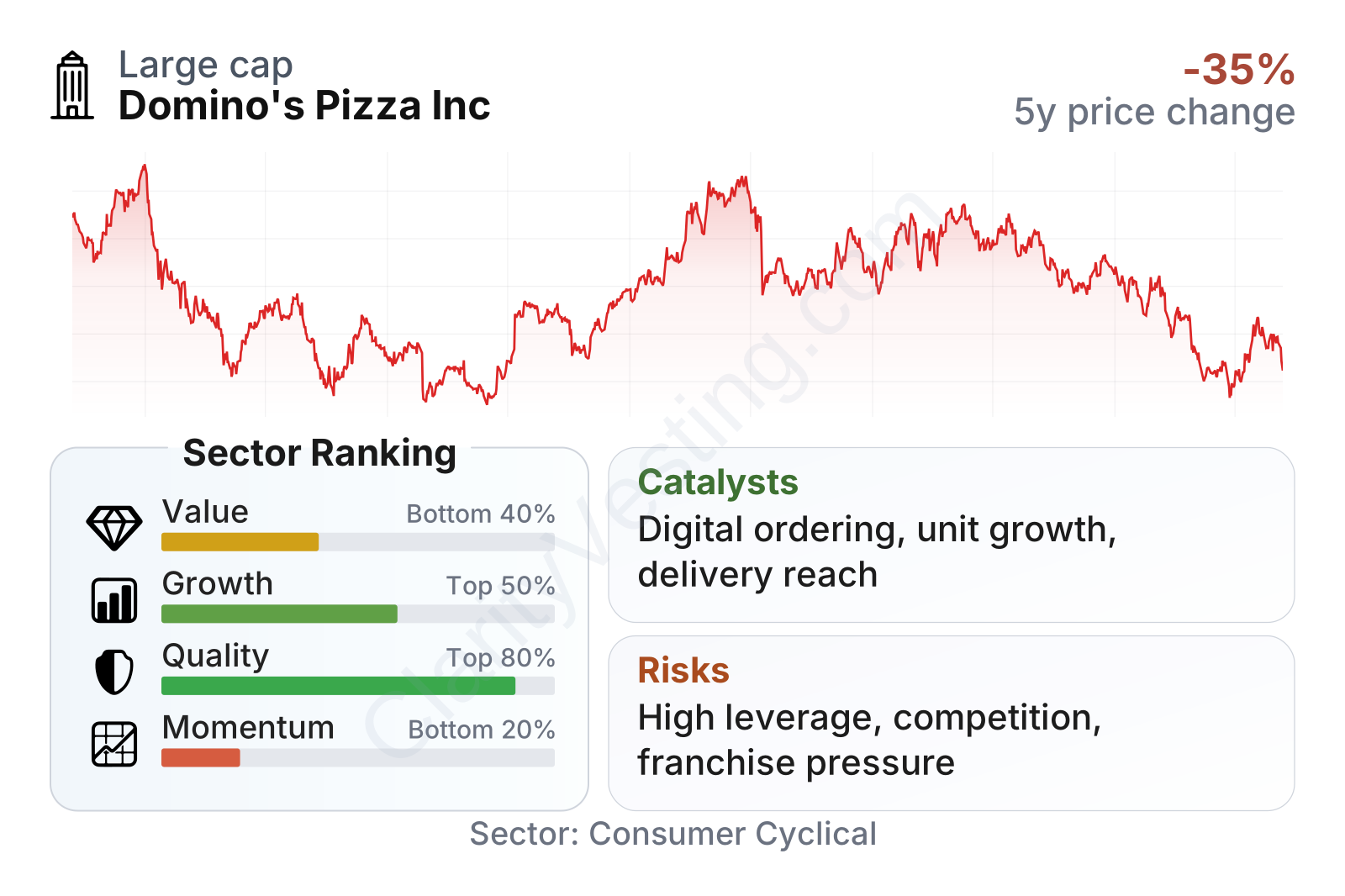
Domino’s is a large restaurant company with a market value around $10 billion to $11 billion and a beta close to 1, meaning its stock has tended to move broadly in line with the market. The factor profile is mixed but interesting. Valuation metrics look close to the sector median on earnings, while cash flow yield is somewhat less generous. Growth is moderate rather than exceptional, but profitability stands out clearly. Operating margin is around 18%, roughly double the sector median, and profit margin is near 12%, also well above typical restaurant peers. Return on invested capital is unusually high, reflecting a business model that requires relatively little capital at the corporate level because franchisees fund most store expansion. The weakest area is recent stock momentum, with returns over the past year and multi-year period trailing the broader consumer discretionary group.
Growth
Domino’s operates in a mature but still resilient part of the food industry: quick-service restaurants, delivery, and carryout. This is not a high-growth sector in the way cloud software or artificial intelligence might be, but it has attractive long-term characteristics. Consumers continue to value convenience, affordability, and digital ordering, especially when budgets are tight. Pizza also travels well, which gives delivery-focused brands an operational advantage over many restaurant formats.
Domino’s strategy remains logical for future expansion because it combines several engines at once: new store openings, higher same-store sales, digital ordering improvements, loyalty, and international development. Its franchise model allows it to grow the store base without taking on all of the capital costs itself. In the U.S., its scale in delivery and carryout gives it leverage in advertising, technology, and supply chain purchasing. Internationally, growth depends on local franchise operators, which helps Domino’s extend the brand while limiting direct operating complexity.
Revenue growth has not been explosive, but it has been fairly steady. After some uneven quarters in 2023, growth reaccelerated and has recently been running in the low-single-digit to mid-single-digit range, with the latest year-over-year pace around 4%. That is slightly below the sector median, but it is respectable for a large, mature chain and more important when paired with strong margins.
Cash generation is one of the stronger parts of the investment case. Free cash flow has risen from just under $500 million a few years ago to roughly $650 million on a trailing basis. That suggests the business continues to convert earnings into cash effectively, giving management flexibility for debt service, reinvestment, and capital returns.
A notable catalyst has been Domino’s push to widen access through major delivery platforms while still strengthening its own digital ecosystem. The company has also continued focusing on loyalty, order frequency, and operational efficiency. Recent company updates have pointed to ongoing store development and product innovation, both of which can support traffic and ticket growth. For a brand of this size, incremental gains in transactions, delivery mix, and franchise unit growth can still have a meaningful effect on profit.
Risks
This article is for informational purposes only and does not constitute financial advice. Some content is AI-generated. See Disclaimer


