Stock Analysis · Stagwell Inc (STGW)
Overview
Stagwell Inc is a marketing and communications company that combines traditional agency services with digital media, technology, and data-driven advertising tools. In simple terms, it helps brands plan campaigns, create content, buy advertising space, measure results, and improve customer engagement across channels such as search, social media, television, connected TV, retail media, public relations, and experiential marketing.
The company presents itself as a challenger to the largest global advertising holding companies by focusing more heavily on digital transformation, performance marketing, and technology-enabled services. That matters because large clients increasingly want measurable returns from advertising spending rather than broad brand campaigns alone.
Stagwell reports its business through operating segments rather than a simple product breakdown, so exact revenue shares by activity are not disclosed in a single standardized list. Based on the company’s segment reporting and business descriptions, the main revenue sources are approximately:
- Integrated Agencies Network: about 45% to 50% of revenue. This includes creative, communications, public relations, and integrated agency services for brand strategy and campaign execution.
- Digital Transformation: about 20% to 25% of revenue. This covers digital experience, technology services, commerce, website and platform work, and customer transformation projects.
- Performance Media & Data: about 20% to 25% of revenue. This includes media planning and buying, search, social, programmatic advertising, analytics, and performance-focused campaigns.
- Communications / Other specialized marketing services: about 10% to 15% of revenue. This generally includes events, advocacy, research, and other specialized service lines depending on the reporting period and acquisitions.
One useful feature of the business model is that revenue is spread across many clients and service categories rather than depending on a single product. At the same time, like most agency groups, results are still tied to overall ad spending, client retention, and the company’s ability to integrate acquired businesses efficiently.
Sources of revenue are broadening faster than profits. Revenue has climbed meaningfully over the past several years, and gross profit has also expanded, but interest expense and operating costs have absorbed much of that progress. That gap between top-line growth and bottom-line conversion is one of the central points to watch.
Key Figures
| Metric | Value | Sector ⓘ |
|---|---|---|
| Date | Sep 12, 2026 | |
| Context | ||
| Sector | Communication Services | |
| Industry | Advertising Agencies | |
| Market Cap ⓘ | $2.10B | |
| Beta ⓘ | 1.22 | |
Value (Cheapness) | ||
| P/E Ratio ⓘ | 142.83 | 18.61 |
| FCF Yield ⓘ | 11.77% | 13.68% |
| EBIT / EV ⓘ | 3.94% | 4.54% |
| PEG ⓘ | 0.38 | |
Growth (Business expansion) | ||
| Revenue Growth ⓘ | 11.20% | 5.40% |
| RPS Growth (5Y CAGR) ⓘ | -9.30% | 4.62% |
| EPS Growth (5Y CAGR) ⓘ | -14.88% | -18.01% |
| Margin Growth (5Y Trend) ⓘ | -0.54% | 1.10% |
| FCF Growth (5Y CAGR) ⓘ | 13.70% | 5.88% |
Quality (Business durability) | ||
| ROIC (Latest) ⓘ | 3.94% | 8.38% |
| ROIC (5Y Median) ⓘ | 5.35% | 8.32% |
| Net Debt / EBIT (Latest) ⓘ | 11.00 | 1.99 |
| Net Debt / EBIT (5Y Median) ⓘ | 9.09 | 2.94 |
| Operating Margin (Latest) ⓘ | 4.77% | 14.89% |
| Operating Margin (5Y Median) ⓘ | 5.68% | 12.96% |
| Debt to Equity (Latest) ⓘ | 254.81% | 59.59% |
| Profit Margin (Latest) ⓘ | 0.53% | 8.77% |
| Free Cash Flow (Latest) ⓘ | $246.69M | |
Momentum (Price trend) | ||
| 3Y Return ⓘ | +57.51% | +46.64% |
| 12M Return (excl. last month) ⓘ | +68.77% | +2.16% |
| 6M Return ⓘ | +37.16% | +5.05% |
| Price vs. 200-Day MA ⓘ | +30.65% | +2.88% |
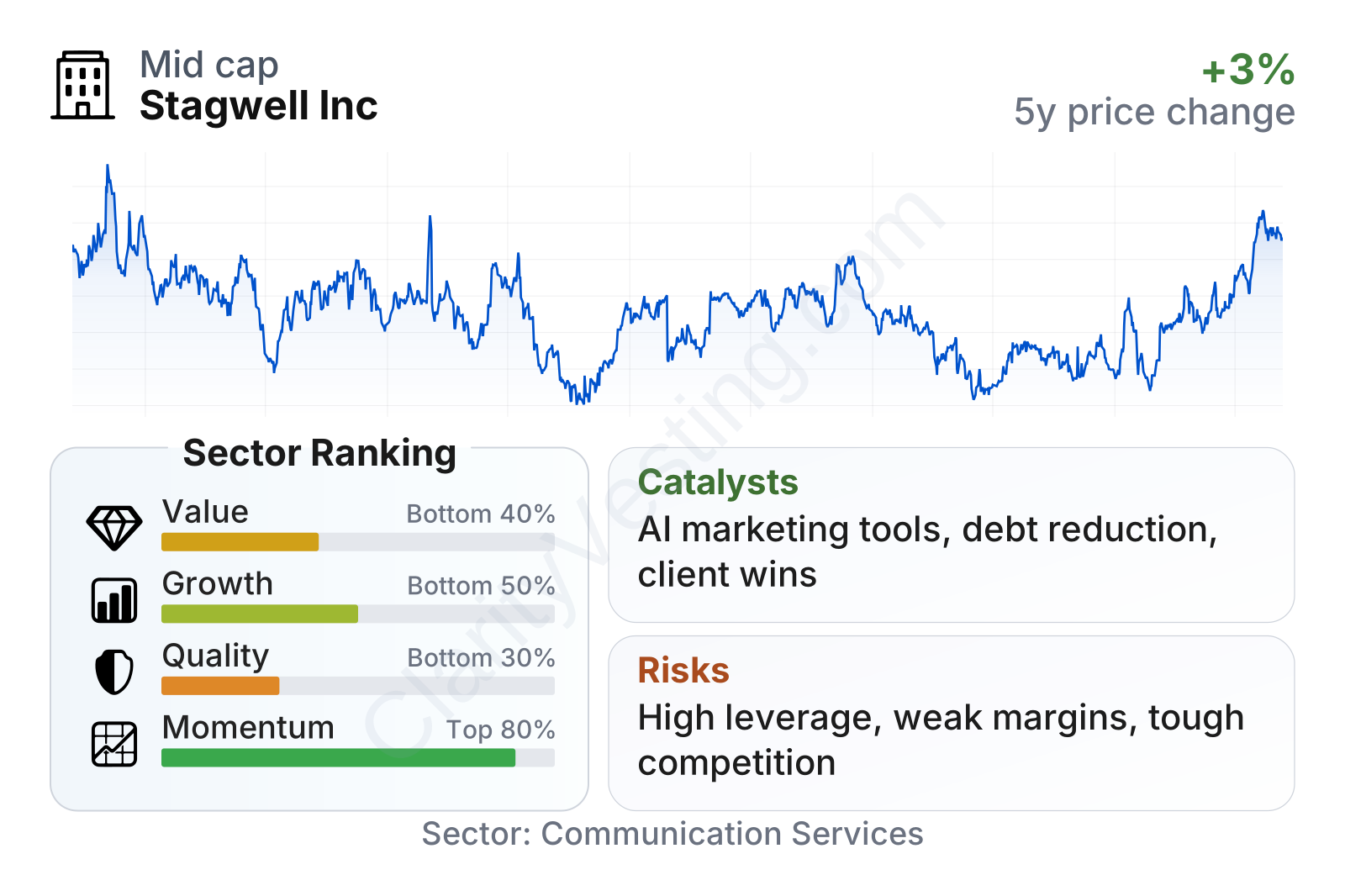
Stagwell is a mid-sized company in the communications sector, and its recent market behavior has been much stronger than the sector median over the last several months. The stock has shown clear momentum, but the underlying factor profile is more mixed. Growth metrics are uneven, quality metrics are relatively weak versus peers, and valuation signals conflict because free cash flow looks solid while earnings-based multiples look inflated. In short, the market has recently rewarded improving business trends, but the financial profile still shows important areas that need improvement.
Growth
Advertising and marketing remain attractive long-term sectors, but the most important shift is not simply that companies keep spending on ads. The real opportunity is that budgets continue moving toward digital channels, measurable performance campaigns, commerce media, and technology-enabled customer engagement. Stagwell is positioned directly in that part of the market, which gives it a more future-oriented profile than a traditional agency group built mainly around legacy media and brand advertising.
The company’s strategy is broadly coherent for this environment. It has built a portfolio around digital media, data, creative execution, and marketing technology, while also using acquisitions to deepen capabilities. That can work well if management keeps integrating agencies effectively and turns scale into better margins. The strategic logic is clear: large clients want fewer vendors, stronger analytics, and campaign results that can be measured more precisely.
Recent revenue growth has returned to positive territory and is running above the sector median. That is encouraging because it suggests demand has stabilized after a softer period in 2023. Even so, the longer-term picture is less clean. Revenue per share over five years has declined, which means past growth has been diluted by capital structure changes, acquisitions, or both. So the company has shown it can expand, but not all of that expansion has translated neatly into per-share progress.
Free cash flow is one of the stronger parts of the case. It has been volatile, but the latest trailing period shows a sharp rebound to one of the better levels in the company’s recent history. That matters because cash generation can support debt reduction, acquisitions, and investment in technology. It also suggests that accounting earnings alone do not fully capture the company’s underlying cash-producing ability.
A meaningful catalyst is Stagwell’s push into AI-enabled marketing tools, data products, and performance-focused media services. In the current industry environment, clients are looking for automation, personalized campaigns, and measurable returns, and those trends align with Stagwell’s positioning. Another potential tailwind is new business wins and a larger presence in fast-growing areas such as retail media, connected TV, and commerce-led marketing. If those areas continue to gain share, Stagwell could grow faster than slower-moving agency peers.
Recent company updates have also emphasized simplification, stronger collaboration across agencies, and ongoing use of technology platforms to deepen client relationships. Those are not guaranteed breakthroughs, but they do fit the direction of the market and support the idea that Stagwell is trying to compete on relevance rather than size alone.
Risks
This article is for informational purposes only and does not constitute financial advice. Some content is AI-generated. See Disclaimer