Stock Analysis · Sensata Technologies Holding NV (ST)
Overview
Sensata Technologies Holding NV designs and manufactures sensors, electrical protection components, and other mission-critical parts that help machines monitor temperature, pressure, position, speed, current, and power. In simple terms, its products act like the “nervous system” inside vehicles, industrial equipment, aircraft, and energy systems. They are usually small parts compared with the final product, but they are essential because they help improve safety, efficiency, emissions control, and reliability.
The company serves a broad mix of end markets, but transportation remains the core of the business. Sensata has historically generated most of its sales from automotive and heavy vehicle applications, while the rest comes from industrial, aerospace, and newer electrification-related uses such as battery management, high-voltage contactors, and power conversion. Based on recent company reporting, revenue is broadly concentrated as follows:
- Performance Sensing: roughly two-thirds of revenue. This includes pressure, thermal, position, and speed sensors used mainly in cars, trucks, off-road vehicles, and industrial equipment.
- Sensing Solutions: roughly one-fifth of revenue. This covers more specialized sensor and control products for automotive, aerospace, and industrial applications.
- Electrical Protection: around one-tenth of revenue. These products protect electrical systems and are used in vehicles, industrial equipment, and energy applications.
- Insights / Other: a smaller share. This includes software, monitoring, and connected solutions tied to fleet and asset management.
What stands out is that Sensata sells deeply embedded components rather than consumer-facing products. That tends to create sticky customer relationships, because switching suppliers in safety-critical systems can be costly, slow, and heavily regulated. At the same time, it also means the company is exposed to the production cycles of its customers, especially global auto manufacturers and industrial equipment makers.
The business mix also shows a clear transition. Traditional combustion-engine and vehicle sensor products still provide the bulk of current revenue and cash flow, while electrification and high-voltage products are expected to be important sources of future growth. Over the last several years, revenue has been fairly stable around the $3.7 billion to $4.1 billion range, but profitability has been much more volatile, suggesting that execution and margin management matter at least as much as top-line growth.
The operating picture shows a company that still produces substantial gross profit, but with more pressure below that line than in earlier years. Revenue has eased from its recent peak, while operating income and net income have been less consistent. Interest costs have remained meaningful, which is important because it limits how much of the gross profit ultimately reaches shareholders.
Key Figures
| Metric | Value | Sector ⓘ |
|---|---|---|
| Date | Jul 18, 2026 | |
| Context | ||
| Sector | Technology | |
| Industry | Scientific & Technical Instruments | |
| Market Cap ⓘ | $6.55B | |
| Beta ⓘ | 1.26 | |
Value (Cheapness) | ||
| P/E Ratio ⓘ | 136.52 | 31.76 |
| FCF Yield ⓘ | 7.76% | 4.18% |
| EBIT / EV ⓘ | 6.04% | 2.56% |
| PEG ⓘ | 0.27 | |
Growth (Business expansion) | ||
| Revenue Growth ⓘ | 2.60% | 13.50% |
| RPS Growth (5Y CAGR) ⓘ | 1.30% | 8.57% |
| EPS Growth (5Y CAGR) ⓘ | -32.62% | -21.87% |
| Margin Growth (5Y Trend) ⓘ | -8.21% | 0.41% |
| FCF Growth (5Y CAGR) ⓘ | 4.59% | 9.76% |
Quality (Business durability) | ||
| ROIC (Latest) ⓘ | 6.66% | 8.54% |
| ROIC (5Y Median) ⓘ | 1.81% | 8.12% |
| Net Debt / EBIT (Latest) ⓘ | 4.22 | 0.38 |
| Net Debt / EBIT (5Y Median) ⓘ | 8.63 | 0.38 |
| Operating Margin (Latest) ⓘ | 14.07% | 9.58% |
| Operating Margin (5Y Median) ⓘ | 7.35% | 8.25% |
| Debt to Equity (Latest) ⓘ | 99.81% | 33.52% |
| Profit Margin (Latest) ⓘ | 1.30% | 6.96% |
| Free Cash Flow (Latest) ⓘ | $508.28M | |
Momentum (Price trend) | ||
| 3Y Return ⓘ | -0.34% | +30.91% |
| 12M Return (excl. last month) ⓘ | +80.30% | +28.90% |
| 6M Return ⓘ | +28.68% | +5.38% |
| Price vs. 200-Day MA ⓘ | +19.32% | +7.61% |
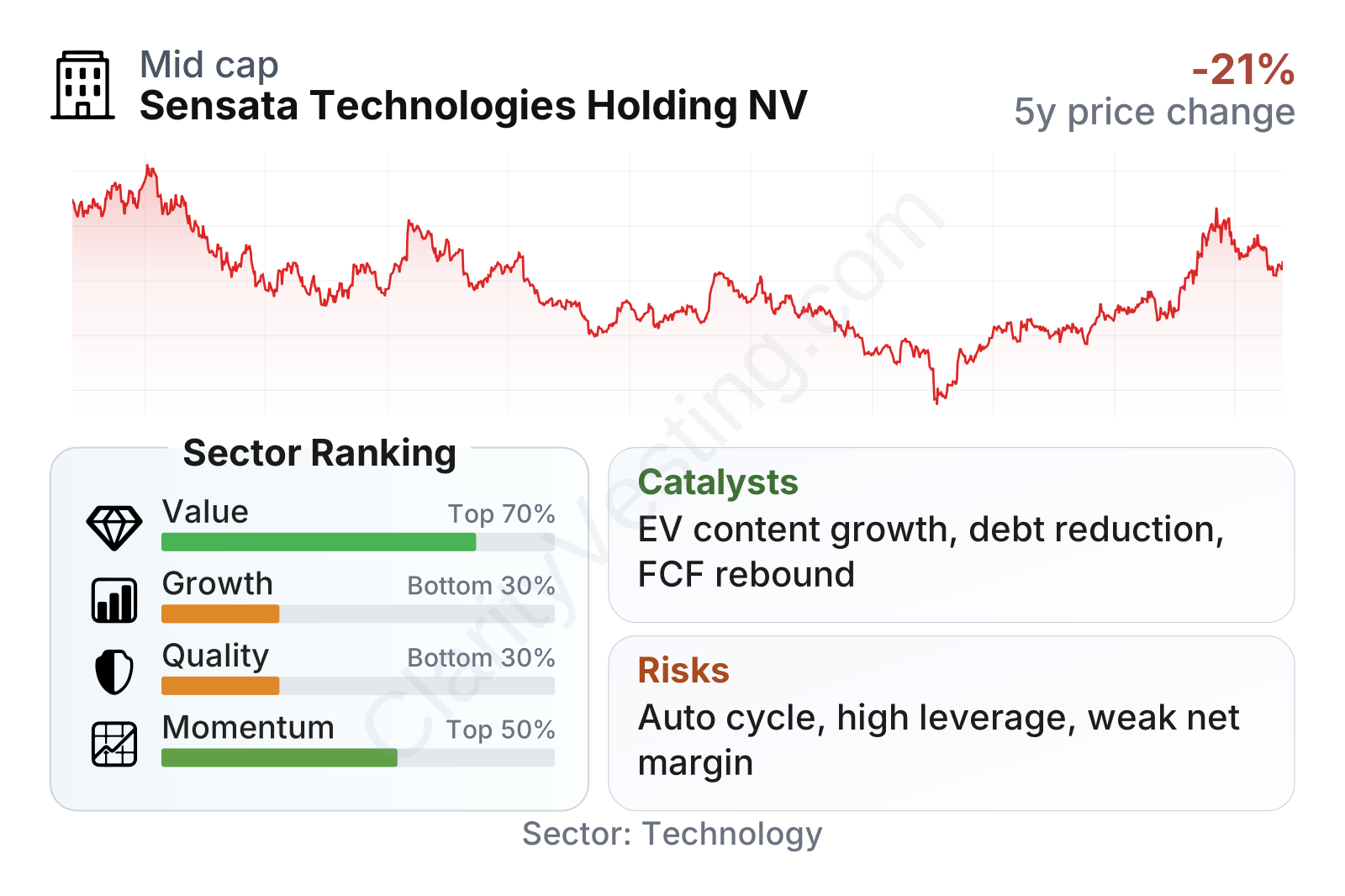
Sensata currently sits in a mixed position. Its market value is in the mid-single-digit billions, making it a meaningful but not dominant player in its sector. The table suggests relatively attractive cash-flow-based valuation measures, with free cash flow yield and EBIT relative to enterprise value comparing better than many peers. However, growth and quality indicators are weaker. Revenue growth has lagged the sector, returns on invested capital are below the industry median, and leverage remains elevated. Momentum has improved sharply in the more recent period, which helps explain the stock’s recovery from its late-2024 and early-2025 lows, but the longer-term picture is still less impressive than the sector as a whole.
The stock price history reflects this uneven path. Shares were much higher in 2021, then trended downward through 2022 and remained under pressure for much of 2024 and early 2025 before rebounding. That pattern usually signals a company where the market has moved from pricing in stable industrial growth to focusing more closely on cyclical demand, margins, and debt.
Growth
Sensata operates in several areas that should remain relevant for years: vehicle safety, industrial automation, electrification, power management, and energy efficiency. These are attractive markets in principle because more machines are becoming connected, more vehicles are being electrified, and tighter regulation usually increases the amount of sensing and control hardware needed per system. In that sense, the company is positioned in a sector with durable long-term demand drivers.
The more difficult question is not whether the end markets are attractive, but whether Sensata can convert those tailwinds into faster company-level growth. Recent performance shows only modest improvement after a period of contraction. Revenue has returned to low single-digit year-over-year growth, which is better than the declines seen through much of 2024 and 2025, but still well below the pace seen across many technology and instrumentation peers.
The revenue trend suggests stabilization rather than breakout growth. That is still meaningful, because it may indicate that the company is moving past a cyclical trough in automotive and industrial demand. For a business like Sensata, even modest revenue growth can matter if it comes with better factory utilization and improved mix toward higher-value electrification products.
Its strategy for future expansion is sensible on paper. Management has been emphasizing products tied to electric vehicles, battery systems, contactors, power conversion, and industrial electrification. These categories fit the company’s existing engineering strengths and customer relationships. Sensata does not need to reinvent itself completely; it is trying to extend its position from traditional sensing into newer high-voltage and energy-management components.
One encouraging sign is cash generation. Even with uneven earnings, free cash flow has been trending upward over the past few years, reaching a materially stronger level recently. That matters because cash can be used to reduce debt, fund research and development, and support acquisitions or shareholder returns without relying entirely on accounting profits.
The improvement in free cash flow is one of the clearest positives in the current profile. It suggests that the underlying business still throws off meaningful cash despite margin volatility and slower top-line expansion. For a mature industrial technology company, this can be an important bridge while newer growth categories scale up.
As for catalysts, the most important ones appear to be a normalization in global automotive production, broader adoption of electrified powertrains and high-voltage systems, and continued conversion of revenue into free cash flow. Public company communications in 2025 and early 2026 also point to a stronger focus on portfolio discipline and profitability, which could become significant if it leads to cleaner execution and better margins rather than just cost cutting.
Risks
The biggest risk is that Sensata is caught between two business realities. Its legacy products tied to combustion vehicles and mature industrial applications still generate much of the current earnings base, but those areas do not offer strong structural growth. Meanwhile, the newer electrification categories are strategically attractive but not yet large enough to fully offset weakness elsewhere. If the transition takes longer than expected, the company could remain stuck in a low-growth, margin-pressured middle ground.
Another major concern is leverage. Debt levels have improved from earlier periods, but they are still high relative to much of the sector. Debt to equity remains close to 100%, versus a much lower sector median, and net debt relative to EBIT is also elevated. This reduces flexibility during downturns and makes interest expense a recurring drag on profits.
The leverage trend is moving in the right direction, but only gradually. That is positive, yet it still leaves Sensata more financially stretched than many comparable technology and industrial component companies. For long-term analysis, that means balance-sheet repair remains an important part of the investment case, not just a background detail.
Profitability is another weak point. Operating margins are respectable and currently above the sector median, which shows that the core business still has some pricing power and cost discipline. But net profit margins have compressed sharply over time and remain well below the sector norm. In other words, the company is still earning decent money before interest and other below-the-line items, but much less is left at the bottom line.
The margin pattern highlights why Sensata can look stronger on a cash-flow or operating basis than on a net-income basis. That gap is not necessarily permanent, but it does raise the standard for execution. If gross margins weaken or interest costs stay elevated, net profitability can remain thin even when revenue stabilizes.
Competition is serious but manageable. Sensata is not the largest industrial technology company in the field, yet it is a well-established specialist with meaningful scale in sensors and electrical protection. Its competitive advantages include long customer relationships, qualification barriers, engineering know-how, broad manufacturing capability, and products that are embedded in regulated or safety-critical applications. Those are real strengths, but the company is not unchallenged.
Main competitors vary by niche and include companies such as TE Connectivity, Amphenol, Honeywell, Littelfuse, Aptiv, and Bosch in certain categories. Compared with those groups, Sensata is more specialized in sensing and protection components, but generally has less diversification and a weaker balance sheet than some of the largest rivals. That makes execution more important: larger competitors can often absorb downturns more easily or invest more aggressively in growth segments.
There does not appear to be a major public scandal defining the recent period, but the operational record itself is a risk factor. The combination of slow growth, margin pressure, and leverage means management has less room for error. For this company, the main reputation risk is not controversy; it is the possibility of failing to deliver a convincing transition from mature products toward higher-growth electrification and industrial opportunities.
Valuation
Valuation is where Sensata becomes more nuanced. On traditional earnings multiples, the stock can look expensive, with the current P/E ratio far above both its own historical range and the sector median. On the surface, that would usually suggest a richly valued business. But in this case, the elevated P/E is heavily distorted by very low recent earnings, so it is not the best standalone measure of what the market is paying for the business.
The P/E history shows a company that previously traded closer to the broader sector range, but has recently moved to a much higher multiple because earnings have been compressed. That makes the current reading less a sign of market enthusiasm and more a sign of weak net income. In practical terms, the stock does not screen cheaply on earnings because the denominator has shrunk.
Cash-flow-based measures tell a friendlier story. Free cash flow yield is above the sector median, and EBIT relative to enterprise value also compares well. That suggests the market is not placing an aggressive valuation on the company’s operating cash generation. So the stock looks expensive on one lens and more moderate on another. The key question is whether current cash flow is sustainable and whether earnings can recover closer to operating profit over time.
Given the backdrop, the current price seems to reflect a business with real industrial value but limited confidence from the market in its growth quality. The rebound in the share price suggests sentiment has improved, yet the underlying fundamentals still point to a company in repair mode rather than one receiving a premium for consistent execution. That makes the present valuation context easier to justify through cash generation than through growth or net-profit strength.
Conclusion
Sensata Technologies remains a credible industrial technology company with products that matter in vehicles, industrial systems, and electrification. Its niche is understandable, its customer relationships are sticky, and its cash generation has improved in a way that gives the business real substance. Those are meaningful positives for a long-term view.
At the same time, the company’s profile is not that of a clean high-quality compounder right now. Growth has been slow, margins have been uneven, and leverage is still high enough to weigh on the overall picture. The business appears better described as a solid but pressured operator trying to turn stable engineering franchises into a stronger next chapter driven by electrification and disciplined execution.
The most convincing part of the case is the combination of embedded products, recovering cash flow, and exposure to long-term trends that should increase the amount of sensing and power-control content in vehicles and equipment. The least convincing part is that the financial results have not yet consistently translated those advantages into stronger returns, lower debt burden, and clear sector-leading growth. Overall, Sensata looks more like a company with credible long-term industrial relevance and improving internal footing than one already firing on all cylinders.
Sources:
- Sensata Technologies Holding plc — Annual Report 2025
- Sensata Technologies Holding plc — Quarterly Report on Form 10-Q for the quarter ended March 31, 2026
- Sensata Technologies Holding plc — Investor Relations materials and earnings presentations
- SEC EDGAR — Sensata Technologies Holding plc filings
- Wikipedia — Sensata Technologies
This article is for informational purposes only and does not constitute financial advice. Some content is AI-generated. See Disclaimer


