Stock Analysis · SPS Commerce Inc (SPSC)
Overview
SPS Commerce is a cloud software company focused on retail supply chain connections. In simple terms, it helps retailers, suppliers, distributors, grocers, and logistics partners exchange business documents and data electronically. That includes purchase orders, invoices, inventory updates, shipping notices, and product information. Its platform is designed to make those connections easier to set up and maintain, especially for businesses that need to work with many trading partners at once.
The company’s business is largely built around recurring subscription-based services delivered through its cloud platform. Public filings describe revenue in three main categories.
- Recurring revenue from cloud services and recurring support: approximately 95%+ of total revenue in recent years. This includes ongoing access to the company’s platform, transaction processing, partner connectivity, analytics, and related managed services.
- One-time setup and professional services: approximately 3% to 5% of total revenue. This usually covers implementation, onboarding, integration work, and initial project services for new customers or new trading partner connections.
- Other minor revenue items: a very small remainder, if any, depending on reporting period and classification.
SPS Commerce has also expanded through acquisitions, adding capabilities in analytics, product information, and complementary retail network services. The broader financial picture remains attractive: revenue has risen from about $385 million in 2021 to about $752 million in 2025, while gross profit has remained strong and operating income has expanded. That suggests the company is scaling without losing the economics that make software businesses attractive.
The business mix shows a model with high gross profit and steadily rising operating earnings. Costs have increased as SPS Commerce invests in product development and sales, but revenue and profit dollars have also climbed meaningfully over the last several years.
Key Figures
| Metric | Value | Sector ⓘ |
|---|---|---|
| Date | Sep 12, 2026 | |
| Context | ||
| Sector | Technology | |
| Industry | Software - Application | |
| Market Cap ⓘ | $2.98B | |
| Beta ⓘ | 0.51 | |
Value (Cheapness) | ||
| P/E Ratio ⓘ | 39.75 | 29.51 |
| FCF Yield ⓘ | 6.68% | 4.25% |
| EBIT / EV ⓘ | 4.68% | 2.85% |
| PEG ⓘ | 4.71 | |
Growth (Business expansion) | ||
| Revenue Growth ⓘ | 5.60% | 15.40% |
| RPS Growth (5Y CAGR) ⓘ | 17.37% | 8.56% |
| EPS Growth (5Y CAGR) ⓘ | -4.80% | -11.88% |
| Margin Growth (5Y Trend) ⓘ | 1.85% | 0.46% |
| FCF Growth (5Y CAGR) ⓘ | 13.02% | 9.80% |
Quality (Business durability) | ||
| ROIC (Latest) ⓘ | 9.30% | 9.44% |
| ROIC (5Y Median) ⓘ | 9.87% | 8.30% |
| Net Debt / EBIT (Latest) ⓘ | -1.36 | 0.54 |
| Net Debt / EBIT (5Y Median) ⓘ | -2.30 | 0.44 |
| Operating Margin (Latest) ⓘ | 15.83% | 9.58% |
| Operating Margin (5Y Median) ⓘ | 15.60% | 8.25% |
| Debt to Equity (Latest) ⓘ | 0.67% | 33.33% |
| Profit Margin (Latest) ⓘ | 10.10% | 7.14% |
| Free Cash Flow (Latest) ⓘ | $198.70M | |
Momentum (Price trend) | ||
| 3Y Return ⓘ | -53.93% | +45.48% |
| 12M Return (excl. last month) ⓘ | -29.56% | +23.48% |
| 6M Return ⓘ | +36.19% | +20.93% |
| Price vs. 200-Day MA ⓘ | +20.17% | +7.43% |
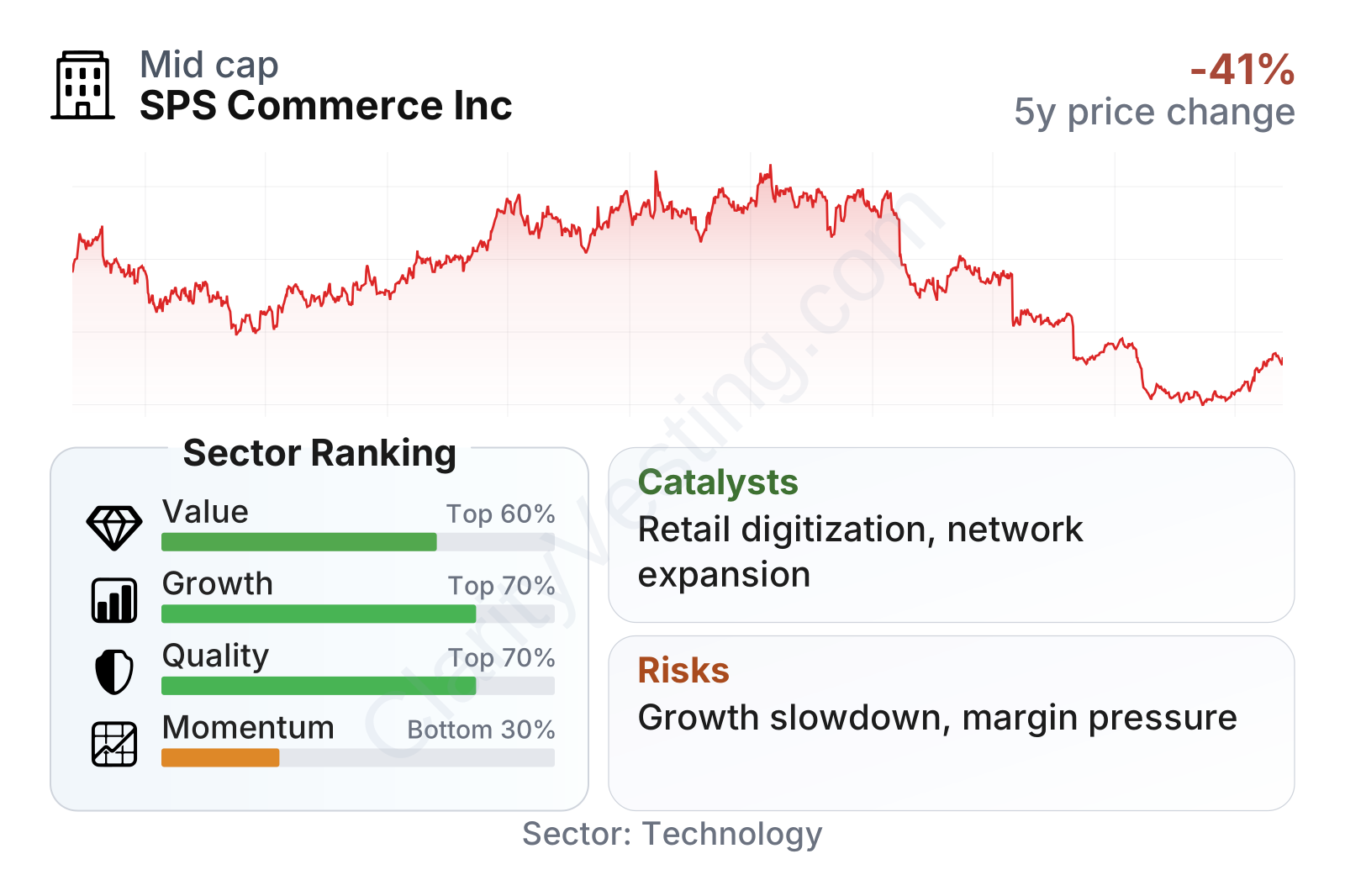
SPS Commerce is a mid-sized software company with unusually low share-price volatility for the sector, reflected in a beta of about 0.56. Its overall profile is mixed but understandable: valuation is not deeply discounted on earnings, growth has slowed sharply in the last year, quality remains strong, and recent stock momentum has been weak. On the positive side, cash generation looks solid relative to many software peers, margins remain above sector norms, and the balance sheet is exceptionally conservative with net cash and almost no debt.
Growth
SPS Commerce operates in a part of the software market that still has long-term room to expand. Retail and supply chain digitization is not a short-lived trend. Large retailers and brands increasingly want standardized, automated data exchange across ordering, fulfillment, invoicing, inventory, and product content. Smaller suppliers also need these connections because large retail customers often require them. This creates a network-driven market where once a platform is widely adopted, each additional participant can make the system more useful.
The company’s strategy is sensible for long-term expansion because it is not limited to basic electronic document exchange. It layers additional services around onboarding, analytics, fulfillment workflows, assortment visibility, and product data management. That approach can deepen customer relationships and raise switching costs over time. Acquisitions have also been part of the playbook, helping SPS Commerce broaden what it can offer inside retail-focused workflows.
There is, however, a clear change in near-term pace. Year-over-year revenue growth had been running around the high teens to low 20% range for several years, but more recently it has slowed to roughly 5% to 6%. That is a meaningful deceleration and an important point for long-term analysis. Even so, the longer view is still respectable: five-year revenue-per-share growth remains well above the sector median, which suggests the company built real scale before this slowdown appeared.
Free cash flow remains one of the most encouraging parts of the picture. Over the last several years, cash generation has moved steadily upward, and the latest trailing figure is close to $200 million. That matters because it shows the business is not depending on outside financing to support operations. It also gives management flexibility for product investment, acquisitions, or share repurchases if it chooses.
Recent company communications have continued to emphasize expanding the platform, broadening retail network participation, and cross-selling more services into existing accounts. The most important catalyst is probably the same one that built the company in the first place: every new retailer, supplier, or distribution partner added to the network can create more opportunities across the existing customer base. In a fragmented retail ecosystem, that network effect remains relevant.
Risks
This article is for informational purposes only and does not constitute financial advice. Some content is AI-generated. See Disclaimer


