Stock Analysis · Sphere Entertainment Co (SPHR)
Overview
Sphere Entertainment Co is an entertainment company built around two very different assets: the Sphere venue business and the long-established MSG Networks regional sports media business. The company is best known for Sphere in Las Vegas, an immersive venue designed for concerts, branded events, and its own original film experiences. MSG Networks, by contrast, generates revenue from television distribution and advertising tied mainly to local professional sports programming.
This mix matters for long-term analysis because Sphere is the growth engine and the strategic identity of the company, while MSG Networks contributes an established but structurally challenged media cash flow base. In recent company filings, management has increasingly emphasized Sphere as the platform with the biggest long-term upside through live entertainment, premium experiences, sponsorships, licensing, and the potential to expand the concept to other locations.
Based on recent segment reporting, the company’s main revenue sources are approximately:
- Sphere: about 60% to 70% of total revenue. This includes tickets for concerts and original shows, suite and premium hospitality sales, sponsorship and signage, venue-related services, and event rentals.
- MSG Networks: about 30% to 40% of total revenue. This mainly includes affiliate fees paid by cable and streaming distributors, plus advertising revenue around live sports content.
Within the Sphere business, the biggest revenue drivers appear to be event-related sales and the company’s original immersive productions, supported by high-value sponsorship arrangements. The media segment is more traditional: affiliate fees are usually the largest piece, while advertising is smaller and more cyclical.
The business model is unusual. Few public companies combine a high-profile new entertainment format with a mature regional sports network business. That makes Sphere Entertainment easier to understand as a collection of assets than as a standard entertainment company with a stable earnings pattern.
The recent financial flow shows a business that has moved from very heavy operating losses toward positive operating income, largely because revenue has scaled faster than fixed costs at the venue level. It also shows that selling, administrative, and interest costs still absorb a meaningful share of revenue, which helps explain why profitability remains volatile.
Key Figures
| Metric | Value | Sector ⓘ |
|---|---|---|
| Date | Sep 12, 2026 | |
| Context | ||
| Sector | Communication Services | |
| Industry | Entertainment | |
| Market Cap ⓘ | $5.15B | |
| Beta ⓘ | 1.61 | |
Value (Cheapness) | ||
| P/E Ratio ⓘ | 44.82 | 18.61 |
| FCF Yield ⓘ | 6.97% | 13.68% |
| EBIT / EV ⓘ | -2.66% | 4.54% |
| PEG ⓘ | N/A | |
Growth (Business expansion) | ||
| Revenue Growth ⓘ | 11.00% | 5.40% |
| RPS Growth (5Y CAGR) ⓘ | 10.90% | 4.62% |
| EPS Growth (5Y CAGR) ⓘ | -37.32% | -18.01% |
| Margin Growth (5Y Trend) ⓘ | N/A | 1.10% |
| FCF Growth (5Y CAGR) ⓘ | -19.63% | 5.88% |
Quality (Business durability) | ||
| ROIC (Latest) ⓘ | -1.54% | 8.38% |
| ROIC (5Y Median) ⓘ | -1.69% | 8.32% |
| Net Debt / EBIT (Latest) ⓘ | 3.45 | 1.99 |
| Net Debt / EBIT (5Y Median) ⓘ | N/A | 2.94 |
| Operating Margin (Latest) ⓘ | -10.69% | 14.89% |
| Operating Margin (5Y Median) ⓘ | -27.30% | 12.96% |
| Debt to Equity (Latest) ⓘ | 43.05% | 59.59% |
| Profit Margin (Latest) ⓘ | -5.66% | 8.77% |
| Free Cash Flow (Latest) ⓘ | $359.07M | |
Momentum (Price trend) | ||
| 3Y Return ⓘ | +298.39% | +46.64% |
| 12M Return (excl. last month) ⓘ | +351.73% | +2.16% |
| 6M Return ⓘ | +30.59% | +5.05% |
| Price vs. 200-Day MA ⓘ | +14.91% | +2.88% |
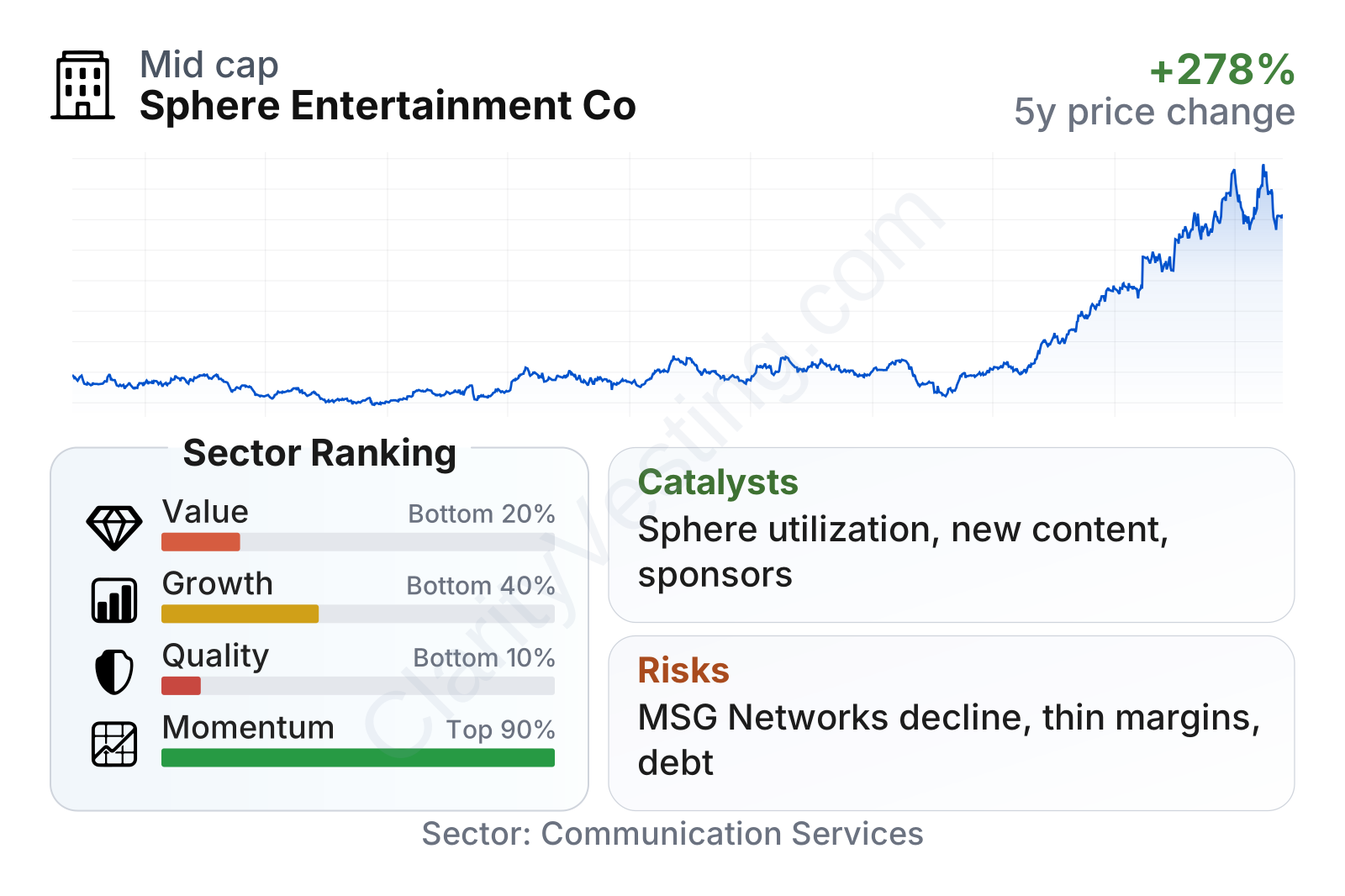
Sphere Entertainment currently looks like a mid-sized company with unusually strong share-price momentum, but weaker underlying quality and value metrics than much of the sector. Revenue growth has been solid, and free cash flow has turned positive, yet profitability and returns on capital still lag. The stock’s recent rerating suggests the market is focusing more on the operating ramp at Sphere than on the company’s still-fragile margins.
The stock price history highlights a dramatic revaluation since late 2025. That kind of move usually reflects a major shift in expectations, not just a small improvement in results. It also means the market is now assigning far more value to future execution than it did a few years ago.
Growth
Sphere Entertainment operates in parts of the entertainment industry that have attractive long-term demand drivers, especially live experiences that are hard to replicate at home. Premium events, immersive venues, destination entertainment, and branded physical experiences have all benefited from consumers spending more selectively on memorable outings rather than on generic mass entertainment. That trend supports the logic behind the Sphere concept.
The company’s strategy also makes sense from a growth perspective. Sphere is not just a venue; it is being positioned as a format. If management can keep the Las Vegas location highly utilized, produce successful proprietary content, and attract corporate partners willing to pay for exposure inside and outside the building, the economics could improve significantly. A future rollout to additional cities would be an even larger catalyst, although that would likely require major capital commitments and careful partner selection.
Revenue growth has been uneven, which is normal for a company digesting a new large-scale asset, but the more recent pattern is more encouraging. The latest year-over-year growth rate is above the sector median, and the longer five-year revenue-per-share trend is also ahead of the typical company in the sector. That indicates the top line is moving in the right direction even though earnings have not stabilized to the same extent.
One of the clearest improvements is cash generation. Free cash flow has moved from deeply negative levels during the investment phase to positive territory over the trailing twelve months. For a company that spent heavily to build and launch a one-of-a-kind venue, this shift is important because it suggests the business is becoming less dependent on external financing just to support operations.
Recent company communications have pointed to continued event activity at Sphere, expansion of the original content slate, and ongoing sponsorship opportunities. Those are meaningful catalysts because they can increase utilization of a largely fixed-cost asset. In simple terms, once the venue is built, each additional successful event or recurring production can have a larger impact on profitability than on revenue alone.
Another growth angle is scarcity value. There are many concert venues and media companies, but very few entertainment assets with the same visual scale and immersive technology profile as Sphere. That uniqueness can help the company attract marquee artists, corporate events, and tourist demand, especially in Las Vegas where traffic is already concentrated.
Risks
This article is for informational purposes only and does not constitute financial advice. Some content is AI-generated. See Disclaimer


