Stock Analysis · SoundHound AI Inc (SOUN)
Overview
SoundHound AI is a voice artificial intelligence software company. Its core business is helping other companies build conversational systems that let people speak naturally to cars, restaurants, devices, customer service systems, and business software. Instead of selling consumer hardware, SoundHound mainly provides the underlying technology: speech recognition, language understanding, voice assistants, and AI agents that can be embedded into another company’s products or services.
The company operates in a part of software that is benefiting from two large trends at once: broader AI adoption and the move toward voice-based interfaces. Its technology has historically been strong in automotive voice assistants, but management has been expanding into restaurants, contact centers, healthcare, financial services, and enterprise customer support through a wider conversational AI platform.
Based on recent company filings and investor materials, revenue is mainly generated from subscriptions and service arrangements tied to its AI platform, licensing, and usage-based or project-based deployments. Public filings do not always break every stream into a clean percentage split, but the business can be understood through these main buckets:
- Subscription and recurring platform revenue — the largest and increasingly important source. This includes access to SoundHound’s voice AI, conversational AI, and agentic AI services delivered over time to enterprise customers.
- Product royalties and usage-based revenue — tied to customer adoption, such as voice systems used in vehicles, restaurants, or devices where revenue can scale with deployments or transaction volume.
- Professional services — integration, customization, deployment support, and other implementation work. This is usually a smaller share and often supports the larger recurring relationships.
The broad financial pattern is clear: revenue has risen sharply over the last several years, while spending on research, product development, and commercial expansion has remained very high. Gross profit has grown, interest expense has fallen materially, and operating losses narrowed significantly in 2025 after an especially weak 2024.
The business mix shows a company that is becoming much larger in revenue terms, but still needs scale and operating discipline to convert that growth into durable profitability.
Key Figures
| Metric | Value | Sector ⓘ |
|---|---|---|
| Date | Sep 12, 2026 | |
| Context | ||
| Sector | Technology | |
| Industry | Software - Application | |
| Market Cap ⓘ | $2.79B | |
| Beta ⓘ | 2.83 | |
Value (Cheapness) | ||
| P/E Ratio ⓘ | N/A | 29.51 |
| FCF Yield ⓘ | -4.23% | 4.25% |
| EBIT / EV ⓘ | -5.13% | 2.85% |
| PEG ⓘ | N/A | |
Growth (Business expansion) | ||
| Revenue Growth ⓘ | 45.00% | 15.40% |
| RPS Growth (5Y CAGR) ⓘ | 40.82% | 8.56% |
| EPS Growth (5Y CAGR) ⓘ | -54.39% | -11.88% |
| Margin Growth (5Y Trend) ⓘ | N/A | 0.46% |
| FCF Growth (5Y CAGR) ⓘ | N/A | 9.80% |
Quality (Business durability) | ||
| ROIC (Latest) ⓘ | -22.07% | 9.44% |
| ROIC (5Y Median) ⓘ | -108.67% | 8.30% |
| Net Debt / EBIT (Latest) ⓘ | N/A | 0.54 |
| Net Debt / EBIT (5Y Median) ⓘ | N/A | 0.44 |
| Operating Margin (Latest) ⓘ | -67.64% | 9.58% |
| Operating Margin (5Y Median) ⓘ | -333.74% | 8.25% |
| Debt to Equity (Latest) ⓘ | 1.11% | 33.33% |
| Profit Margin (Latest) ⓘ | -67.45% | 7.14% |
| Free Cash Flow (Latest) ⓘ | -$118.04M | |
Momentum (Price trend) | ||
| 3Y Return ⓘ | +176.99% | +45.48% |
| 12M Return (excl. last month) ⓘ | -53.69% | +23.48% |
| 6M Return ⓘ | -16.20% | +20.93% |
| Price vs. 200-Day MA ⓘ | -24.02% | +7.43% |
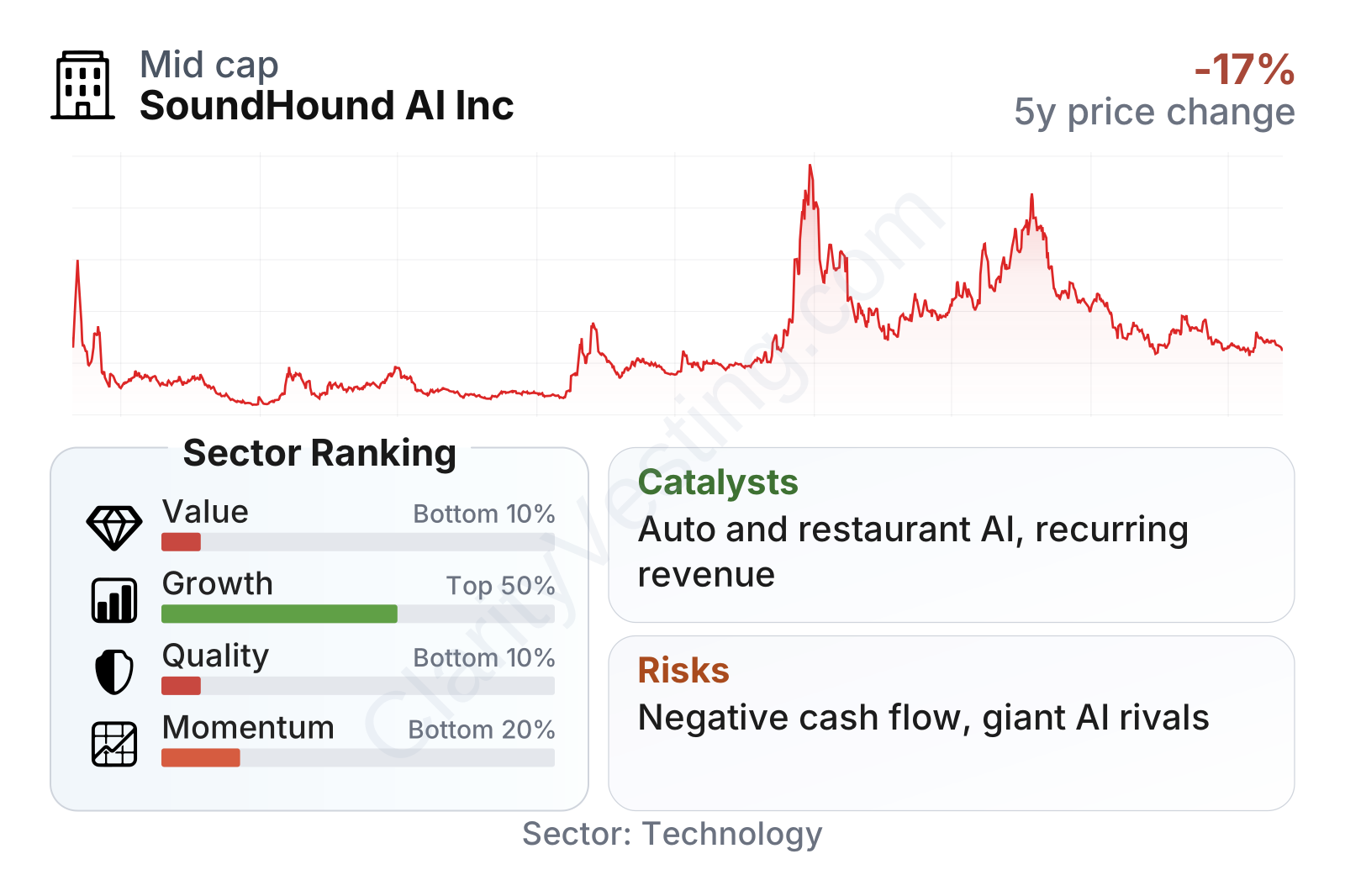
SoundHound sits in the mid-cap range, but its stock behavior is much more volatile than the typical software company, with a beta near 2.8. The factor profile is mixed: growth ranks around the middle of the sector and clearly beats the software median on recent sales expansion, while value and quality rank near the bottom of the group because the company is still loss-making and cash flow remains negative. Momentum has cooled after a very strong multiyear run, which helps explain why the share price has been swinging sharply even as the business continues to expand.
Growth
SoundHound operates in a growing segment of technology. Voice interfaces have existed for years, but large language models and better speech systems are making them more useful in real business settings. That matters because companies no longer want simple voice commands only; they want systems that can understand intent, answer questions, complete transactions, and support customers across multiple channels. This shift plays directly into SoundHound’s positioning.
The company’s strategy also makes sense from a long-term business perspective. Rather than relying on one narrow product, it is trying to become a voice and conversational AI infrastructure provider across several industries. Automotive remains important, but expansion into restaurants, contact centers, and enterprise AI agents broadens the addressable market and reduces dependence on any single customer category. Acquisitions and platform expansion have also helped it move closer to higher-value enterprise workflows.
Revenue growth has been very strong, including recent year-over-year gains around 45%, far above the sector median of roughly 16%. The longer pattern is even more striking: revenue has compounded at a much faster pace than most software peers over the past five years. Growth has moderated from the explosive rates seen in parts of 2025, but it still points to continued commercial traction rather than a one-quarter spike.
The weak point in the growth profile is that cash generation has not yet followed revenue higher. Free cash flow remains meaningfully negative, and recent trailing twelve-month readings are worse than they were several years ago. In practical terms, this means the company is still funding expansion ahead of profitability, so future growth needs to become more efficient over time.
Recent company updates have highlighted contract wins, broader deployment activity, and continued demand for AI agents and voice commerce solutions. Those developments matter because they suggest SoundHound is not just participating in AI enthusiasm at a high level; it is converting interest into commercial relationships. The strongest catalyst is simple: if the company can keep growing recurring revenue while lifting gross margins and controlling operating expenses, the path from promising technology vendor to more mature software platform becomes much clearer.
Risks
This article is for informational purposes only and does not constitute financial advice. Some content is AI-generated. See Disclaimer


