Stock Analysis · Sonos Inc (SONO)
Overview
Sonos is a consumer electronics company focused on home audio. It designs and sells wireless speakers, soundbars, subwoofers, portable speakers, headphones, and related audio components. The brand is best known for making products that work together as a connected sound system across different rooms, with software that lets users manage music, TV audio, and voice features in one ecosystem.
The business is still overwhelmingly driven by hardware sales. In its annual filings, Sonos groups revenue into a single broad category rather than giving a detailed breakdown by product family every quarter, so exact percentages by line are not consistently disclosed. Based on company disclosures, product mix, and the scale of its major categories, revenue sources can be understood in this order:
- Speakers and home theater products: approximately 85% to 90% — this includes core wireless speakers, premium speakers, soundbars, subwoofers, and portable audio devices sold under the Sonos brand.
- Partner and other revenue: approximately 10% to 15% — this includes architectural products developed with partners, accessories, software-related elements tied to the platform, and licensing or other smaller commercial arrangements.
Geographically, Sonos generates revenue across the Americas, Europe, and Asia-Pacific, with the United States remaining its largest single market. The company positions itself in the premium end of consumer audio rather than the mass-market, low-price segment. That matters because its results depend less on unit volume alone and more on brand strength, product launches, and customers upgrading within the ecosystem.
Over the last several years, revenue has trended down from earlier peaks, while research and development spending stayed elevated. That shows a company still investing heavily in future products even during a weaker demand period, but it also helps explain why earnings have been uneven.
The financial flow highlights a clear pattern: sales have moved lower since the 2022 peak, gross profit has narrowed, and Sonos has kept research and development spending relatively high. Selling costs have come down more meaningfully, but not enough to fully offset weaker revenue, which has pushed operating income into losses in recent years.
Key Figures
| Metric | Value | Sector ⓘ |
|---|---|---|
| Date | Sep 12, 2026 | |
| Context | ||
| Sector | Technology | |
| Industry | Consumer Electronics | |
| Market Cap ⓘ | $1.79B | |
| Beta ⓘ | 1.94 | |
Value (Cheapness) | ||
| P/E Ratio ⓘ | 32.17 | 29.51 |
| FCF Yield ⓘ | 7.00% | 4.25% |
| EBIT / EV ⓘ | 4.34% | 2.85% |
| PEG ⓘ | N/A | |
Growth (Business expansion) | ||
| Revenue Growth ⓘ | 8.80% | 15.40% |
| RPS Growth (5Y CAGR) ⓘ | -0.58% | 8.56% |
| EPS Growth (5Y CAGR) ⓘ | -2.40% | -11.88% |
| Margin Growth (5Y Trend) ⓘ | N/A | 0.46% |
| FCF Growth (5Y CAGR) ⓘ | -15.04% | 9.80% |
Quality (Business durability) | ||
| ROIC (Latest) ⓘ | 16.59% | 9.44% |
| ROIC (5Y Median) ⓘ | 8.90% | 8.30% |
| Net Debt / EBIT (Latest) ⓘ | -2.37 | 0.54 |
| Net Debt / EBIT (5Y Median) ⓘ | N/A | 0.44 |
| Operating Margin (Latest) ⓘ | 4.44% | 9.58% |
| Operating Margin (5Y Median) ⓘ | -1.24% | 8.25% |
| Debt to Equity (Latest) ⓘ | 12.44% | 33.33% |
| Profit Margin (Latest) ⓘ | 3.82% | 7.14% |
| Free Cash Flow (Latest) ⓘ | $125.15M | |
Momentum (Price trend) | ||
| 3Y Return ⓘ | +13.86% | +45.48% |
| 12M Return (excl. last month) ⓘ | +22.85% | +23.48% |
| 6M Return ⓘ | +9.80% | +20.93% |
| Price vs. 200-Day MA ⓘ | -1.87% | +7.43% |
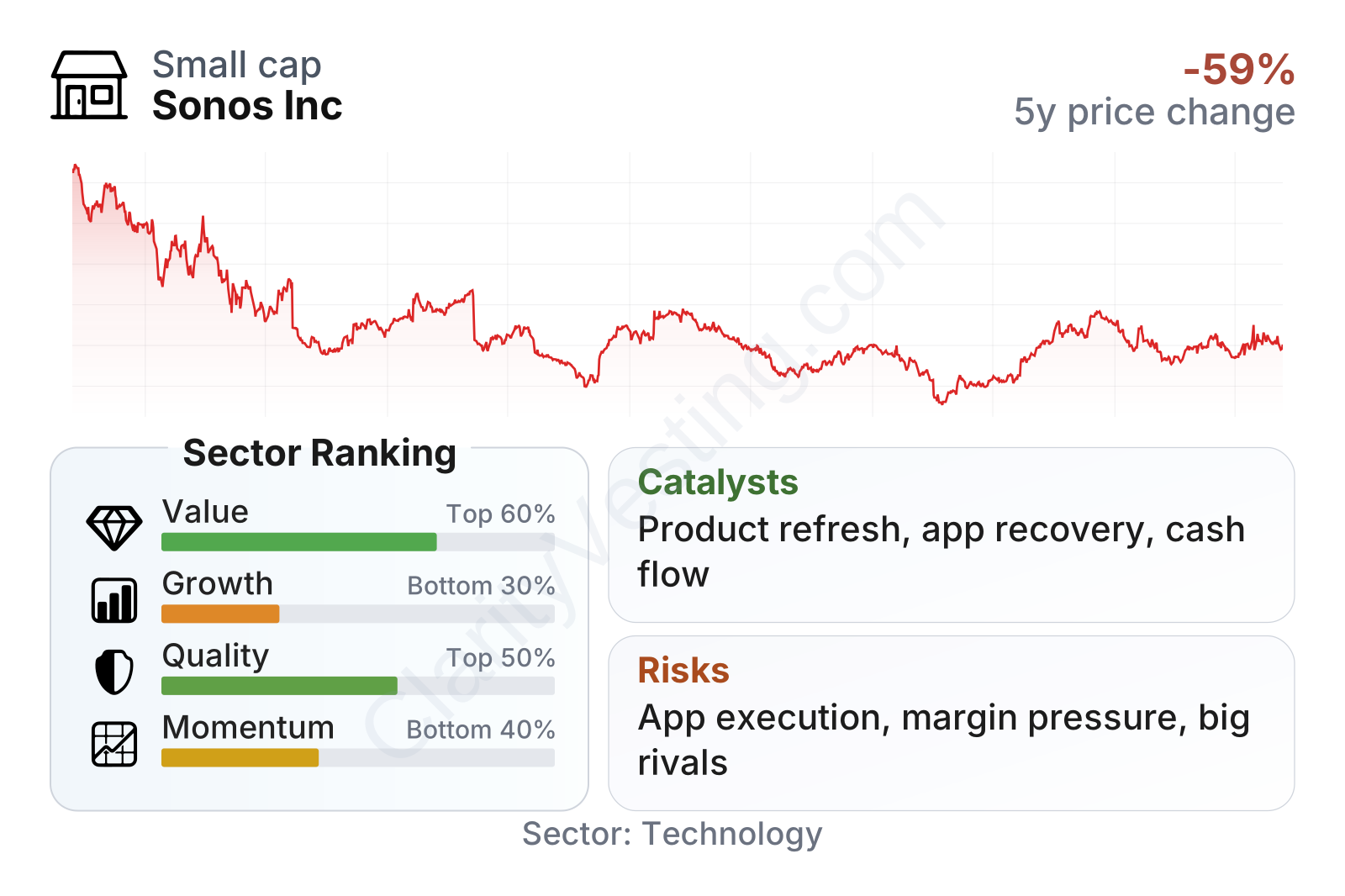
Sonos is a mid-sized consumer electronics company with a stock that has been volatile, reflected in a beta close to 2. The factor profile is mixed. On valuation, it screens slightly better than the sector median on cash-flow-based measures, which suggests the market is not assigning an aggressive price relative to the cash the business currently produces. Quality is around the middle to upper half of the sector, supported by solid returns on invested capital and a balance sheet with modest leverage. The weak point is growth: recent sales growth has improved, but the longer five-year record remains soft versus the broader technology sector. Price momentum also remains below average, showing that the market is still cautious despite periods of recovery.
Growth
Sonos operates in a market with long-term structural support. Home audio, streaming-based listening, premium entertainment setups, and smart-home adoption all create room for demand over time. The challenge is that this is not a straight-line growth market. Demand can be cyclical because many purchases are discretionary, and customers do not replace speakers as often as they replace phones or laptops.
Sonos’s strategy for future growth is logical on paper. It is built around expanding the number of products inside the home, increasing the value of the software ecosystem, and encouraging existing customers to add more devices over time. That ecosystem approach is important because a household that already owns one Sonos product is more likely to buy another if the experience is seamless. The company has also pushed into adjacent categories beyond its traditional speaker base, which broadens its addressable market even if execution has been uneven.
Recent revenue growth has turned positive again, with year-over-year increases in the high single digits in the latest periods. That is a real improvement from the sharp declines seen in 2023 and parts of 2024. Even so, the broader picture is still a recovery rather than a sustained high-growth phase, especially since Sonos remains below the growth pace of the median technology company.
Cash generation is one of the more constructive elements in the case. Free cash flow has recovered from a negative period in 2023 and is back above $100 million on a trailing basis. That matters because it gives Sonos room to keep funding product development, absorb industry swings, and maintain flexibility without relying heavily on debt. For a hardware company facing uneven demand, that financial resilience is more important than short-term earnings alone.
A meaningful catalyst is the company’s effort to refresh products and rebuild confidence in its software platform after prior app-related disruption. If management can stabilize the user experience, new launches could have a stronger effect because the installed base is already large and brand awareness is well established. Another opportunity comes from premium home theater and whole-home audio, where Sonos still occupies a distinctive space between mass-market devices and very high-end custom systems.
Risks
This article is for informational purposes only and does not constitute financial advice. Some content is AI-generated. See Disclaimer


