Stock Analysis · Sonoco Products Company (SON)
Overview
Sonoco Products Company is a packaging manufacturer with a long operating history and a broad industrial footprint. It makes packaging used to protect, contain, ship, and display products across food, beverage, household, healthcare, industrial, and consumer markets. In simple terms, Sonoco sells the containers, paper-based materials, and protective solutions that many other companies need to get their products to stores, factories, hospitals, and customers safely.
The business has become more focused on scaled packaging platforms rather than niche operations. Based on recent company reporting, revenue is mainly generated from consumer packaging, industrial paper and converted products, metal packaging, and protective packaging. The exact mix can shift after acquisitions and divestitures, but the revenue base is centered on the following activities:
- Consumer packaging: approximately 40% to 50% of revenue. This includes rigid paper containers, flexible packaging, thermoformed packaging, trays, and other packaging used in food, snacks, pet food, and household products.
- Industrial paper packaging: approximately 25% to 35% of revenue. This includes paperboard tubes, cores, and related converted paper products used in textiles, film, paper, and industrial supply chains.
- Metal packaging: approximately 10% to 20% of revenue. This includes aerosol cans, food cans, metal closures, and related packaging components.
- Protective and transit packaging: approximately 10% to 15% of revenue. This includes temperature-assurance packaging, molded solutions, and other protective systems used in shipping and industrial handling.
What stands out is that Sonoco is not dependent on one single customer market. A meaningful share of sales comes from products tied to everyday consumption and recurring industrial demand, which can make revenue less volatile than more cyclical manufacturing businesses. At the same time, the company still depends heavily on packaging volumes, raw material costs, and integration execution when it expands through acquisitions.
The business flow over recent years shows a familiar packaging pattern: large material and manufacturing costs, moderate but improving operating profitability, and sensitivity to interest expense because of debt. Revenue and operating income rebounded strongly in 2025 after a weaker 2024, but financing costs also moved higher.
Key Figures
| Metric | Value | Sector ⓘ |
|---|---|---|
| Date | Sep 12, 2026 | |
| Context | ||
| Sector | Consumer Cyclical | |
| Industry | Packaging & Containers | |
| Market Cap ⓘ | $4.73B | |
| Beta ⓘ | 0.35 | |
Value (Cheapness) | ||
| P/E Ratio ⓘ | 7.49 | 17.10 |
| FCF Yield ⓘ | 8.53% | 8.53% |
| EBIT / EV ⓘ | 11.03% | 6.46% |
| PEG ⓘ | 0.20 | |
Growth (Business expansion) | ||
| Revenue Growth ⓘ | -1.30% | 5.75% |
| RPS Growth (5Y CAGR) ⓘ | 7.70% | 9.14% |
| EPS Growth (5Y CAGR) ⓘ | -22.07% | -18.21% |
| Margin Growth (5Y Trend) ⓘ | 15.14% | -0.23% |
| FCF Growth (5Y CAGR) ⓘ | 57.76% | 4.91% |
Quality (Business durability) | ||
| ROIC (Latest) ⓘ | 10.02% | 12.61% |
| ROIC (5Y Median) ⓘ | 8.92% | 10.72% |
| Net Debt / EBIT (Latest) ⓘ | 4.41 | 2.10 |
| Net Debt / EBIT (5Y Median) ⓘ | 5.42 | 2.32 |
| Operating Margin (Latest) ⓘ | 13.80% | 9.25% |
| Operating Margin (5Y Median) ⓘ | 9.57% | 9.64% |
| Debt to Equity (Latest) ⓘ | 130.96% | 75.78% |
| Profit Margin (Latest) ⓘ | 8.41% | 5.33% |
| Free Cash Flow (Latest) ⓘ | $403.68M | |
Momentum (Price trend) | ||
| 3Y Return ⓘ | -0.27% | +14.53% |
| 12M Return (excl. last month) ⓘ | +33.59% | +3.08% |
| 6M Return ⓘ | -7.47% | +0.55% |
| Price vs. 200-Day MA ⓘ | -5.37% | -0.54% |
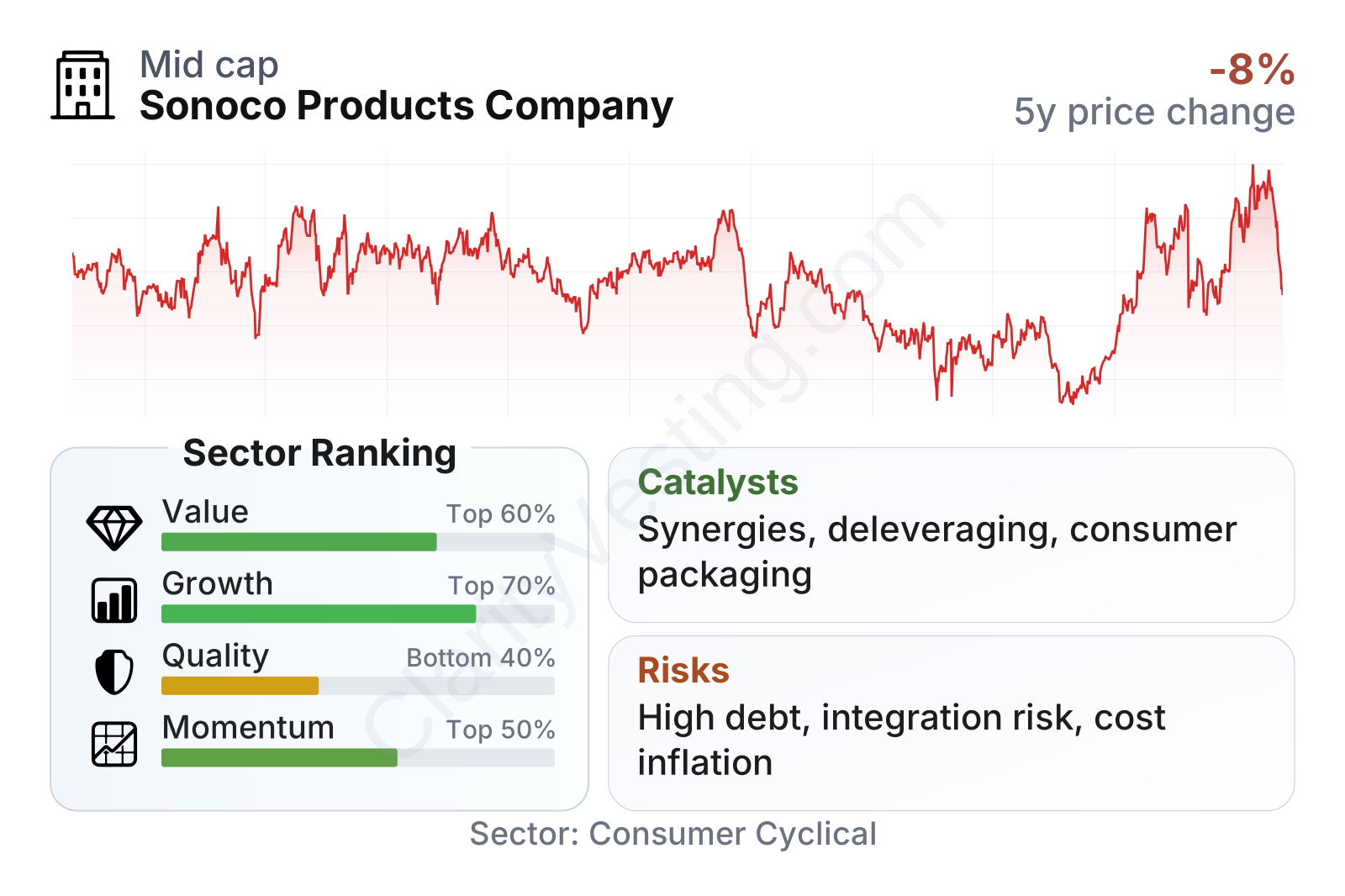
Sonoco is a mid-sized packaging company with a relatively low share-price volatility profile, reflected by a beta well below 1. In the factor view, the company looks strongest in momentum and reasonably solid in value, while quality is held back by leverage. Profitability is better than the sector median on operating margin and net margin, but returns on invested capital remain somewhat lower than many peers. Growth is mixed: long-term free cash flow expansion has been strong, yet recent revenue growth has been softer than the broader sector.
Growth
Packaging is usually not a high-excitement industry, but it is a durable one. Demand is supported by food consumption, e-commerce logistics, healthcare shipping, industrial production, and the constant need to protect and transport goods. That means Sonoco operates in a sector with long-term relevance, even if growth tends to come in steps rather than straight lines.
Its strategy for future growth is logical for this type of business. Management has been reshaping the portfolio toward larger packaging categories and using acquisitions to increase scale. For a packaging company, scale matters because it can improve plant utilization, purchasing power, customer reach, and pricing discipline. The main question is not whether the strategy makes sense in theory, but whether the company can integrate assets well enough to convert added revenue into durable earnings and cash flow.
Recent revenue trends show that Sonoco has gone through a volatile period rather than a smooth expansion phase. After strong growth in 2022, sales fell through much of 2023 and 2024, then rebounded sharply in parts of 2025, with the latest year-over-year comparisons turning slightly negative again in 2026. That pattern suggests a combination of acquisition effects, volume normalization, and portfolio changes rather than steady organic acceleration.
Cash generation is one of the more encouraging aspects. Free cash flow has been uneven from year to year, but the broader direction over the last several years has improved meaningfully. Even after a sharp drop from the 2024 peak, trailing free cash flow remains positive and substantial, which matters because packaging companies often need cash to fund capital spending, dividends, debt reduction, and integration costs.
A visible catalyst is the company’s portfolio transformation over the last two years, especially the push into larger consumer and metal packaging platforms. If integration proceeds well and volume demand stabilizes, Sonoco could emerge with a broader product offering and stronger positions in categories where customer relationships tend to be sticky. Another medium-term tailwind is the continued preference for packaging solutions that improve shelf appeal, product protection, and supply-chain efficiency. In several end markets, customers also continue to favor recyclable or fiber-based alternatives, which can support parts of Sonoco’s portfolio.
Recent company updates also point to ongoing efforts to capture synergies, simplify operations, and improve margins following strategic transactions. For a mature packaging manufacturer, these execution-driven gains can be more important than headline industry growth rates.
Risks
This article is for informational purposes only and does not constitute financial advice. Some content is AI-generated. See Disclaimer