Stock Analysis · Synnex Corporation (SNX)
Overview
SYNNEX Corporation, now operating under the TD SYNNEX name after the combination of legacy SYNNEX and Tech Data, is one of the world’s largest technology distributors and solutions aggregators. In simple terms, it sits between technology vendors and the businesses, resellers, and service providers that need hardware, software, cloud tools, and related services. The company helps move products from major brands to customers at very large scale, while also adding logistics, financing, integration support, and increasingly a broader set of software and cloud capabilities.
Its business is broad, but the model is straightforward: very high revenue volume, very thin margins, and strong dependence on efficient operations. That is typical for large distributors. The company works with major technology suppliers across PCs, servers, networking, cybersecurity, storage, cloud, and IT lifecycle services, which gives it exposure to many parts of the enterprise technology market rather than a single product niche.
The main sources of revenue are not broken out in a simple product-only percentage format in the same way as many software companies, but public filings indicate the business is largely driven by endpoint devices and advanced solutions sold through distribution channels, with services and recurring cloud activity adding support. A practical way to read the revenue mix is:
- Endpoint solutions — the largest contributor, including PCs, peripherals, mobile devices, printers, and related client hardware; roughly around half of sales.
- Advanced solutions — servers, storage, networking, hybrid infrastructure, security, and data-center-related products; roughly around one-third of sales.
- Cloud, software, and services — a smaller but strategically important share, including recurring software, cloud subscriptions, lifecycle services, and support offerings; roughly in the low-to-mid teens.
What stands out is that the company is not trying to invent the next consumer gadget. Its role is to be a large-scale enabler of IT spending across the ecosystem. That can make the business less exciting than a pure software name, but also more tied to the ongoing need for businesses to refresh infrastructure, adopt cloud tools, and manage increasingly complex technology stacks.
The flow of revenue to profit shows the usual distributor profile: most sales are absorbed by product costs, leaving a modest gross margin, but scale and disciplined expense control still produce meaningful operating income and cash generation. Revenue dipped after the post-merger surge, then recovered, while net income has continued to improve.
Key Figures
| Metric | Value | Sector ⓘ |
|---|---|---|
| Date | Sep 12, 2026 | |
| Context | ||
| Sector | Technology | |
| Industry | Electronics & Computer Distribution | |
| Market Cap ⓘ | $20.65B | |
| Beta ⓘ | 1.43 | |
Value (Cheapness) | ||
| P/E Ratio ⓘ | 19.30 | 29.51 |
| FCF Yield ⓘ | 1.81% | 4.25% |
| EBIT / EV ⓘ | 7.54% | 2.85% |
| PEG ⓘ | 0.75 | |
Growth (Business expansion) | ||
| Revenue Growth ⓘ | 31.00% | 15.40% |
| RPS Growth (5Y CAGR) ⓘ | 10.74% | 8.56% |
| EPS Growth (5Y CAGR) ⓘ | -6.08% | -11.88% |
| Margin Growth (5Y Trend) ⓘ | 0.42% | 0.46% |
| FCF Growth (5Y CAGR) ⓘ | 16.48% | 9.80% |
Quality (Business durability) | ||
| ROIC (Latest) ⓘ | 10.70% | 9.44% |
| ROIC (5Y Median) ⓘ | 7.86% | 8.30% |
| Net Debt / EBIT (Latest) ⓘ | 2.00 | 0.54 |
| Net Debt / EBIT (5Y Median) ⓘ | 2.83 | 0.44 |
| Operating Margin (Latest) ⓘ | 2.60% | 9.58% |
| Operating Margin (5Y Median) ⓘ | 1.87% | 8.25% |
| Debt to Equity (Latest) ⓘ | 52.73% | 33.33% |
| Profit Margin (Latest) ⓘ | 1.63% | 7.14% |
| Free Cash Flow (Latest) ⓘ | $374.56M | |
Momentum (Price trend) | ||
| 3Y Return ⓘ | +180.63% | +45.48% |
| 12M Return (excl. last month) ⓘ | +71.36% | +23.48% |
| 6M Return ⓘ | +76.24% | +20.93% |
| Price vs. 200-Day MA ⓘ | +30.40% | +7.43% |
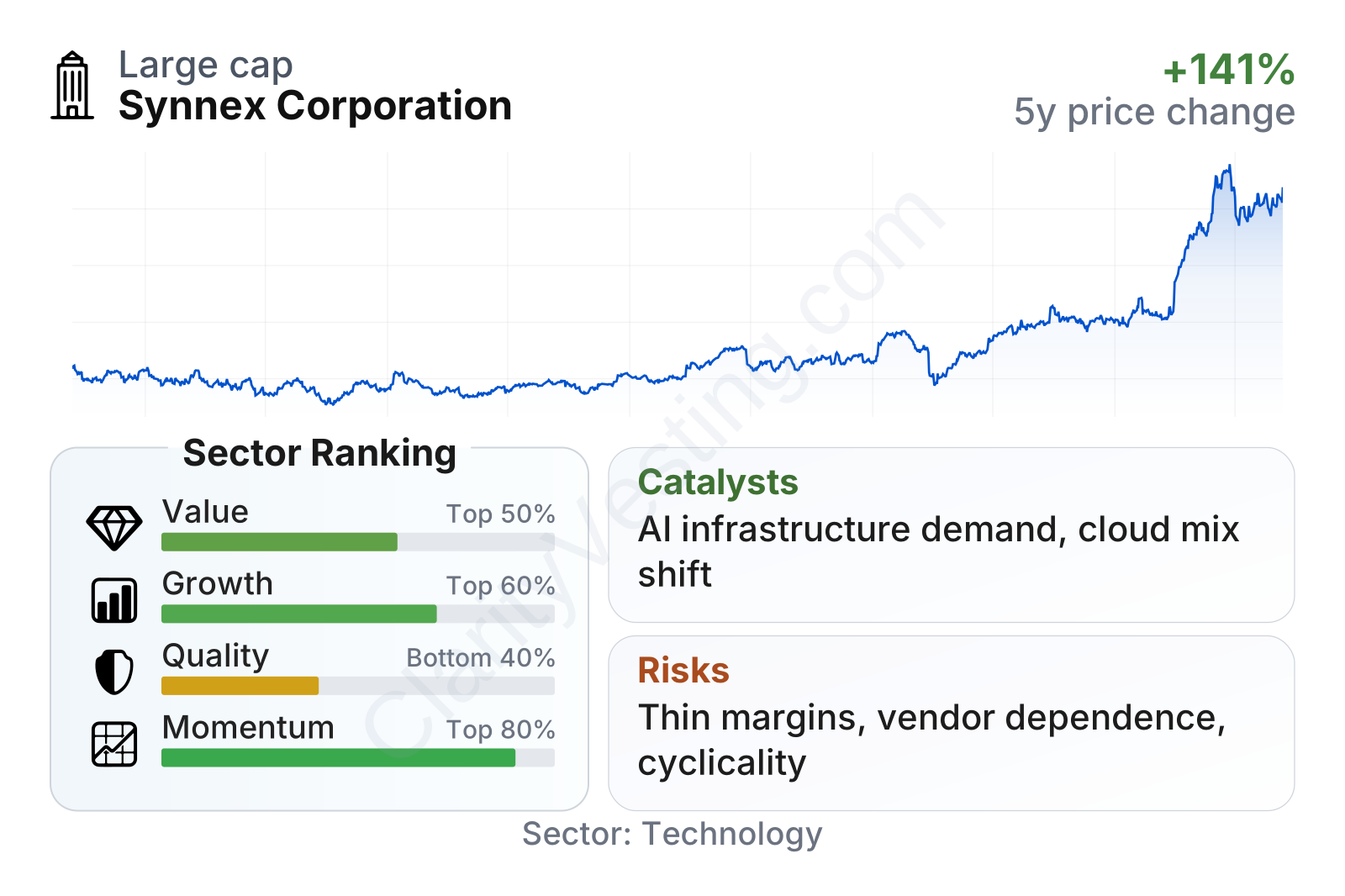
At roughly a $21 billion market value, TD SYNNEX is a large company rather than a niche distributor. The stock has shown strong momentum over the last few years, with gains well ahead of the broader technology sector median in the comparison set. On valuation, the earnings multiple remains below the sector median, which is notable given the recent share-price strength. Growth metrics are generally better than the middle of the sector, while quality metrics are mixed: returns on invested capital are respectable, balance-sheet leverage is currently light, but margins remain structurally low because of the nature of distribution.
The biggest takeaway from the current profile is that this is not a high-margin technology platform. It is a scale business. That means readers should focus less on raw profit margin and more on execution, cash conversion, debt discipline, and the company’s ability to capture recurring and higher-value revenue streams over time.
Growth
Technology distribution is not the fastest-growing corner of tech, but it remains tied to durable long-term demand. Companies still need devices, servers, networking gear, security products, software subscriptions, and cloud infrastructure. As IT purchasing becomes more complex, distributors that can bundle logistics, financing, vendor relationships, and technical enablement can keep an important role. That places TD SYNNEX in a sector with moderate but persistent structural relevance rather than explosive growth.
The strategy for future expansion is sensible. Management has been emphasizing higher-value areas such as cloud, software, security, data-center technologies, and vendor solutions that require more expertise than basic box-moving. That matters because these categories can deepen relationships and support somewhat better economics than plain hardware distribution. The company also benefits from its global footprint and broad vendor roster, which can make it a preferred channel partner when suppliers want reach without building every sales path themselves.
Recent revenue trends look stronger again after a softer period in 2023. Year-over-year growth moved back into positive territory and has accelerated meaningfully into the latest period, well above the sector median. Part of that reflects easier comparisons, but it also suggests that enterprise demand, product cycles, and execution have improved together. For a low-margin distributor, renewed top-line momentum is important because scale tends to support profitability.
Cash generation has also been uneven but improved sharply in the latest trailing period. That volatility is normal for distributors because working capital can swing with inventories, receivables, and vendor payment timing. Even so, the broader pattern over several years points to stronger free cash flow generation than earlier in the cycle, which helps support flexibility for debt reduction, acquisitions, and shareholder returns.
A meaningful catalyst is the company’s positioning around AI-related infrastructure demand. TD SYNNEX does not build AI chips or models, but it helps move the servers, networking equipment, storage, and enterprise technology that support AI deployments. If businesses continue investing in data-center refreshes and more complex IT environments, the company can participate as a key distribution and solutions intermediary. Another catalyst is the ongoing shift toward recurring cloud and software channels, which can gradually improve the business mix even if the company remains primarily a distributor.
Recent company communications have also highlighted vendor engagement, ecosystem expansion, and services capabilities rather than a one-time event. That is usually a healthier signal for a long-term business than dependence on a single headline catalyst.
Risks
This article is for informational purposes only and does not constitute financial advice. Some content is AI-generated. See Disclaimer


