Stock Analysis · Synopsys Inc (SNPS)
Overview
Synopsys is a software and semiconductor intellectual property company that helps other businesses design and test chips and complex electronic systems. In simple terms, it provides the digital tools used to create processors, memory, networking chips, automotive semiconductors, and many other components found in phones, data centers, cars, industrial equipment, and AI servers. It also sells interface and security-related chip building blocks, which customers can license instead of designing everything from scratch.
The company’s business is mainly built around recurring software and technology revenue. Based on recent company reporting, its revenue mix can be summarized approximately as follows:
- Design Automation: about 75% to 80% of revenue. This is the core business and includes electronic design automation software used for chip design, verification, simulation, testing, and manufacturing signoff.
- Design IP: about 20% to 25% of revenue. This includes pre-designed semiconductor building blocks such as interface IP, processor-related IP, and security technologies that customers embed into their chips.
Within those activities, a large share of sales comes from time-based software subscriptions, which tends to make revenue more predictable than a hardware-heavy business. Synopsys also benefits from the fact that its products are deeply embedded in customer workflows: once a chip program is built around a certain tool chain, changing vendors can be costly, slow, and risky.
The business model has shown a clear pattern in recent years: revenue has expanded steadily, gross profit has remained high, and the company continues to spend heavily on research and development to keep its tools competitive. That mix is typical of a strong software franchise serving a technically demanding market.
The broad trend is favorable: revenue and gross profit have climbed over time, while research and development remains the company’s largest operating expense. That is important because Synopsys competes in a market where staying technologically ahead matters more than cutting innovation spending.
Key Figures
| Metric | Value | Sector ⓘ |
|---|---|---|
| Date | Sep 12, 2026 | |
| Context | ||
| Sector | Technology | |
| Industry | Software - Infrastructure | |
| Market Cap ⓘ | $76.15B | |
| Beta ⓘ | 1.23 | |
Value (Cheapness) | ||
| P/E Ratio ⓘ | 69.47 | 29.51 |
| FCF Yield ⓘ | 3.66% | 4.25% |
| EBIT / EV ⓘ | 2.31% | 2.85% |
| PEG ⓘ | 2.13 | |
Growth (Business expansion) | ||
| Revenue Growth ⓘ | 42.40% | 15.40% |
| RPS Growth (5Y CAGR) ⓘ | 13.04% | 8.56% |
| EPS Growth (5Y CAGR) ⓘ | 3.04% | -11.88% |
| Margin Growth (5Y Trend) ⓘ | 6.84% | 0.46% |
| FCF Growth (5Y CAGR) ⓘ | -0.87% | 9.80% |
Quality (Business durability) | ||
| ROIC (Latest) ⓘ | 3.90% | 9.44% |
| ROIC (5Y Median) ⓘ | 17.67% | 8.30% |
| Net Debt / EBIT (Latest) ⓘ | 3.76 | 0.54 |
| Net Debt / EBIT (5Y Median) ⓘ | -0.69 | 0.44 |
| Operating Margin (Latest) ⓘ | 20.42% | 9.58% |
| Operating Margin (5Y Median) ⓘ | 24.60% | 8.25% |
| Debt to Equity (Latest) ⓘ | 34.80% | 33.33% |
| Profit Margin (Latest) ⓘ | 11.43% | 7.14% |
| Free Cash Flow (Latest) ⓘ | $2.79B | |
Momentum (Price trend) | ||
| 3Y Return ⓘ | -12.54% | +45.48% |
| 12M Return (excl. last month) ⓘ | -34.11% | +23.48% |
| 6M Return ⓘ | -5.10% | +20.93% |
| Price vs. 200-Day MA ⓘ | -11.17% | +7.43% |
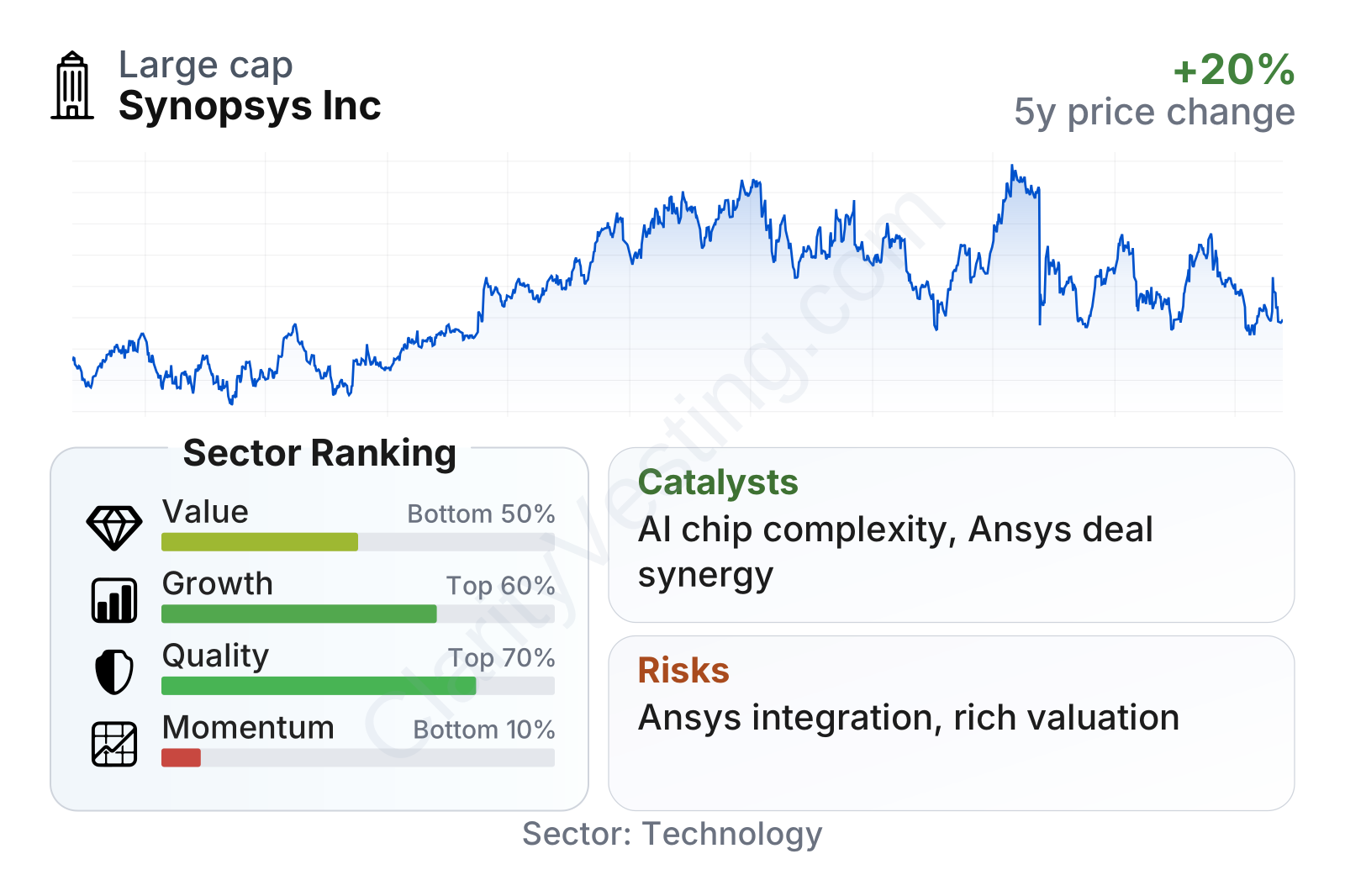
Synopsys is a very large technology company, and its recent factor profile is mixed in a way that long-term readers should notice. Growth and operating quality remain solid relative to much of the sector, but value metrics look stretched. Profitability is still above sector norms, while recent share-price momentum has been weak after a volatile period. In other words, the business fundamentals look stronger than the stock’s recent trading pattern.
Growth
Synopsys operates in a sector with long-term structural growth. Semiconductor complexity keeps rising, and that means chipmakers need more advanced software tools, more verification work, and more pre-built IP blocks. The spread of artificial intelligence, high-performance computing, advanced driver assistance, cloud infrastructure, and connected devices all increase design difficulty. That directly supports demand for Synopsys products because more complex chips require more simulation, validation, and manufacturing preparation.
The company’s strategy also fits that environment well. Synopsys is positioned across multiple steps of the chip design process rather than relying on one narrow product. That matters because customers often prefer integrated platforms that can handle design, verification, testing, and IP reuse together. It creates a broader relationship with each customer and raises switching costs over time.
Recent growth has accelerated sharply, with year-over-year revenue expansion running well above the sector median. Some of that reflects acquisition effects and some reflects strong end-market demand, but either way it shows that Synopsys is capturing a meaningful share of industry spending rather than merely moving with the market.
Cash generation also improved significantly after a softer stretch. Trailing free cash flow is now comfortably above prior levels, which suggests recent growth is not only appearing on the income statement but is also converting into cash. For a company that invests heavily in product development, that is a useful sign of underlying business strength.
A major recent opportunity is Synopsys’ planned acquisition of Ansys, a leader in engineering simulation software. If completed and integrated well, that combination could extend Synopsys beyond chip design into a broader “electronics plus physics-based simulation” platform. The industrial logic is straightforward: modern systems increasingly require co-design across silicon, packaging, thermals, power, and full-system behavior. Bringing those capabilities together could deepen customer relationships and expand the company’s addressable market.
Another catalyst is the growing need for AI-oriented chip development. AI accelerators, memory bandwidth demands, and advanced packaging all make design workflows more complicated. That trend tends to favor the largest tool vendors with the broadest capabilities, and Synopsys is one of the companies best placed to benefit.
Risks
This article is for informational purposes only and does not constitute financial advice. Some content is AI-generated. See Disclaimer