Stock Analysis · Snowflake Inc (SNOW)
Overview
Snowflake is a cloud software company focused on storing, organizing, sharing, and analyzing data. In simple terms, it helps businesses bring large amounts of information into one place so teams can run analytics, build applications, use artificial intelligence tools, and share information securely across departments, partners, and customers. Its platform runs across major public clouds, mainly Amazon Web Services, Microsoft Azure, and Google Cloud, which gives customers flexibility instead of locking them into one infrastructure provider.
The company’s business model is mostly consumption-based. Customers pay based on how much computing, storage, and related platform usage they consume rather than committing only to a fixed software seat count. That structure can support strong expansion when customers increase workloads, but it can also make growth more sensitive to IT spending discipline.
Snowflake reports revenue in two main categories. The mix is heavily concentrated in product revenue, while professional services remains a small supporting activity.
- Product revenue: about 94% to 95% of total revenue in the latest fiscal year. This includes use of the Data Cloud platform such as compute, storage, data engineering, analytics, collaboration, and newer AI-related capabilities.
- Professional services and other: about 5% to 6% of total revenue. This mainly covers consulting, training, implementation support, and related services that help customers deploy and expand usage.
That revenue mix matters because product revenue carries the core economics of the business. Over the last several years, total revenue has expanded rapidly from roughly $1.2 billion to about $4.7 billion, while gross profit also rose strongly. At the same time, Snowflake has continued to spend very heavily on research and development and on sales capacity, which explains why accounting profits remain negative even as scale has improved.
The business has become much larger, and gross profit has widened meaningfully, but operating expenses have also climbed fast. A notable feature is the company’s very large investment in product development, showing that management is prioritizing platform breadth and AI capabilities over near-term earnings.
Key Figures
| Metric | Value | Sector ⓘ |
|---|---|---|
| Date | Sep 12, 2026 | |
| Context | ||
| Sector | Technology | |
| Industry | Software - Application | |
| Market Cap ⓘ | $116.33B | |
| Beta ⓘ | 1.33 | |
Value (Cheapness) | ||
| P/E Ratio ⓘ | N/A | 29.51 |
| FCF Yield ⓘ | 1.03% | 4.25% |
| EBIT / EV ⓘ | -1.09% | 2.85% |
| PEG ⓘ | 8.33 | |
Growth (Business expansion) | ||
| Revenue Growth ⓘ | 35.10% | 15.40% |
| RPS Growth (5Y CAGR) ⓘ | 35.97% | 8.56% |
| EPS Growth (5Y CAGR) ⓘ | 13.56% | -11.88% |
| Margin Growth (5Y Trend) ⓘ | N/A | 0.46% |
| FCF Growth (5Y CAGR) ⓘ | 92.74% | 9.80% |
Quality (Business durability) | ||
| ROIC (Latest) ⓘ | -21.23% | 9.44% |
| ROIC (5Y Median) ⓘ | -12.45% | 8.30% |
| Net Debt / EBIT (Latest) ⓘ | N/A | 0.54 |
| Net Debt / EBIT (5Y Median) ⓘ | N/A | 0.44 |
| Operating Margin (Latest) ⓘ | -23.64% | 9.58% |
| Operating Margin (5Y Median) ⓘ | -35.36% | 8.25% |
| Debt to Equity (Latest) ⓘ | 128.57% | 33.33% |
| Profit Margin (Latest) ⓘ | -20.07% | 7.14% |
| Free Cash Flow (Latest) ⓘ | $1.20B | |
Momentum (Price trend) | ||
| 3Y Return ⓘ | +97.20% | +45.48% |
| 12M Return (excl. last month) ⓘ | +72.10% | +23.48% |
| 6M Return ⓘ | +85.61% | +20.93% |
| Price vs. 200-Day MA ⓘ | +49.10% | +7.43% |
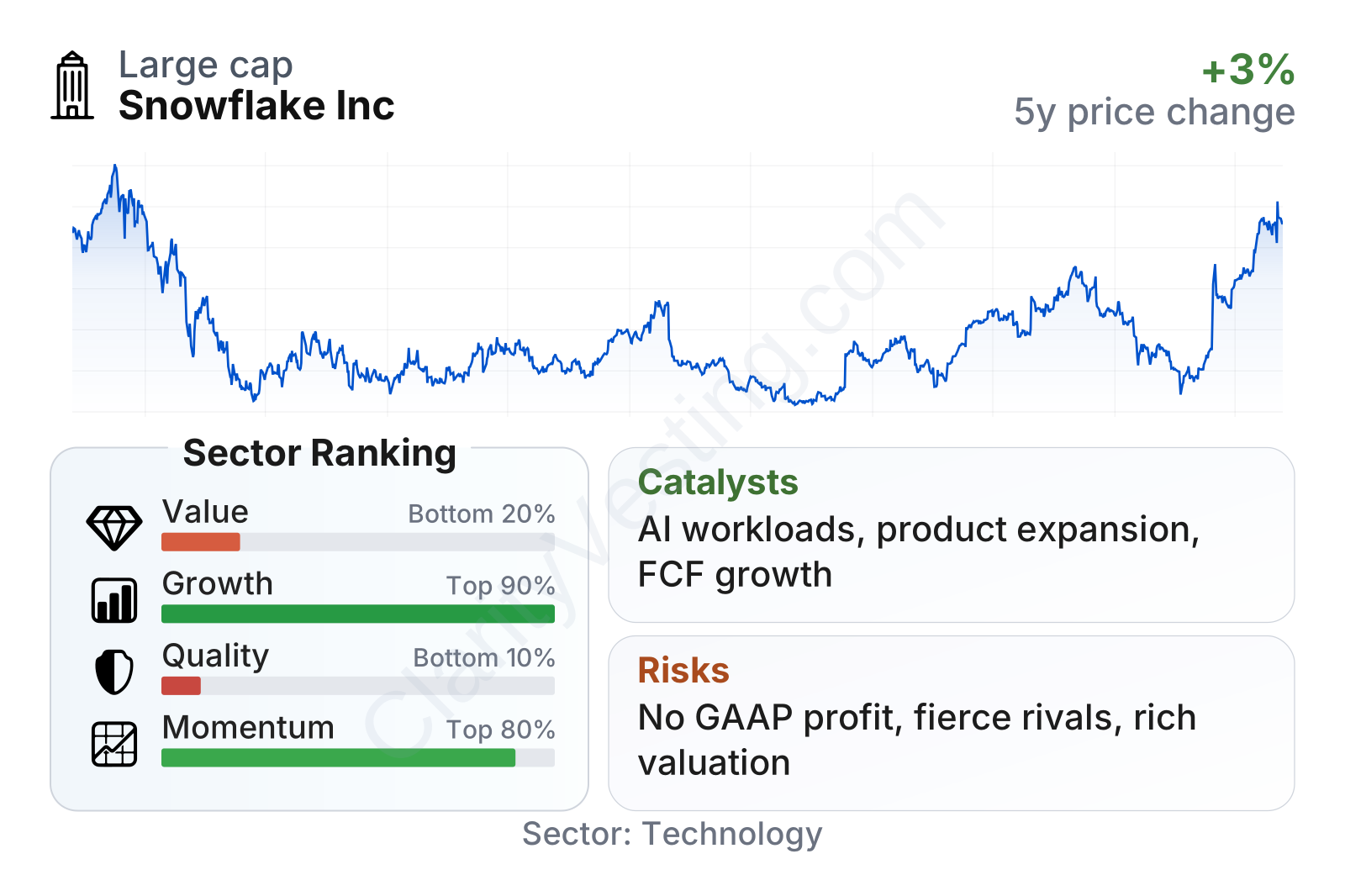
Snowflake is now a very large software company by market value, but its financial profile is unusual: growth and market momentum are strong, while valuation and profitability metrics remain weak compared with much of the software sector. The stock has been volatile over the last several years, including a major decline after the 2021 peak and a sharp recovery more recently. That pattern is typical of companies where the market is constantly reassessing the balance between long-term expansion and near-term profitability.
Growth
Snowflake operates in one of the most attractive parts of enterprise software: cloud data infrastructure, analytics, and AI-enabled data workloads. This remains a growing sector because companies continue moving information from older on-premise systems into the cloud, while also trying to make that information usable for real-time decisions, automation, and machine learning. The rise of generative AI has made clean, accessible, and well-governed business information more valuable, which directly supports Snowflake’s positioning.
The company’s strategy is coherent for long-range expansion. Instead of offering just a database, Snowflake has been broadening its platform into data engineering, application development, collaboration, governance, cybersecurity-related data use cases, and AI features. Its acquisitions and product launches have aimed to make the platform more useful for building complete data workflows, not just running queries. That broadening matters because it can raise usage per customer and make the service harder to replace once embedded deeply across teams.
Revenue growth has slowed from the extremely high rates seen earlier in the company’s public life, which is normal as scale increases. Even so, the latest annual growth rate is still around the mid-30% range, well above the software sector median of roughly 15%. The more important point is that recent periods show reacceleration from the high-20% range back toward the mid-30% area, suggesting demand has remained resilient despite a tougher spending environment.
Cash generation is another positive signal. Free cash flow has increased from under $100 million a few years ago to more than $1.1 billion on a trailing basis. That tells a different story from net income: even though accounting earnings are still negative, the underlying business is already generating meaningful cash. For software companies, this often reflects upfront customer commitments, efficient gross margins, and non-cash expenses such as stock-based compensation.
Recent company updates have also highlighted areas that could become important catalysts. Snowflake has continued pushing deeper into AI through tools that help customers build applications and use large language models on enterprise information without moving everything outside its platform. The company has also emphasized a larger partner ecosystem and closer ties with cloud providers and software vendors. If AI adoption drives more data processing and governance needs, Snowflake is in a credible position to benefit because those workloads depend on trusted, organized information.
Risks
This article is for informational purposes only and does not constitute financial advice. Some content is AI-generated. See Disclaimer


