Stock Analysis · Spin Master Corp (SNMSF)
Overview
Spin Master Corp is a global children’s entertainment company best known for designing and selling toys, but its business is broader than that. The company operates across three connected activities: toys, digital games, and entertainment content. Its brands include well-known franchises such as PAW Patrol, Rubik’s Cube, Melissa & Doug, Bakugan, Hatchimals, and Gund, and it sells products through major retailers, specialty stores, and e-commerce channels in many countries.
For long-term analysis, the key point is that Spin Master is not only a traditional toy manufacturer. Management has built a portfolio that tries to turn characters and brands into products across multiple formats. That matters because successful children’s brands can generate revenue more than once: first through media exposure, then through toys, games, licensing, and sometimes digital extensions.
The company’s main revenue sources are organized by operating segment. Based on recent annual reporting, the mix is approximately:
- Toys: about 75% to 80% of revenue. This includes activities, games and puzzles, dolls and interactive products, infant and preschool toys, outdoor products, plush, action figures, and craft-related items. This is the core of the company.
- Digital Games: about 10% to 15% of revenue. This includes mobile and other interactive game titles, helped by acquisitions that expanded Spin Master beyond physical toys.
- Entertainment: about 8% to 12% of revenue. This includes children’s content creation, production, and licensing tied to owned intellectual property such as PAW Patrol and other franchises.
Geographically, North America remains the largest market, with Europe also important, while the rest of the world adds diversification. The business is seasonal, with a large share of sales typically concentrated in the second half of the year, especially around the holiday season.
The business model has attractive features when it works well: owned brands can support pricing, successful content can boost toy demand, and acquisitions can broaden the catalog. At the same time, it remains a hit-driven consumer business where product cycles and retailer demand can change quickly.
The longer-term picture shows a company that has kept gross profit above the $1 billion level in recent years, even as operating income and net income became more volatile. Revenue stepped up sharply in 2024, but the conversion from sales into bottom-line profit weakened because operating costs and interest expense rose.
Key Figures
| Metric | Value | Sector ⓘ |
|---|---|---|
| Date | Sep 12, 2026 | |
| Context | ||
| Sector | Consumer Cyclical | |
| Industry | Leisure | |
| Market Cap ⓘ | $1.41B | |
| Beta ⓘ | 0.56 | |
Value (Cheapness) | ||
| P/E Ratio ⓘ | N/A | 17.10 |
| FCF Yield ⓘ | 24.82% | 8.53% |
| EBIT / EV ⓘ | 12.03% | 6.46% |
| PEG ⓘ | 0.46 | |
Growth (Business expansion) | ||
| Revenue Growth ⓘ | 8.90% | 5.75% |
| RPS Growth (5Y CAGR) ⓘ | 2.25% | 9.14% |
| EPS Growth (5Y CAGR) ⓘ | N/A | -18.21% |
| Margin Growth (5Y Trend) ⓘ | -4.56% | -0.23% |
| FCF Growth (5Y CAGR) ⓘ | -8.41% | 4.91% |
Quality (Business durability) | ||
| ROIC (Latest) ⓘ | N/A | 12.61% |
| ROIC (5Y Median) ⓘ | 11.66% | 10.72% |
| Net Debt / EBIT (Latest) ⓘ | 1.52 | 2.10 |
| Net Debt / EBIT (5Y Median) ⓘ | -1.69 | 2.32 |
| Operating Margin (Latest) ⓘ | 9.79% | 9.25% |
| Operating Margin (5Y Median) ⓘ | 10.83% | 9.64% |
| Debt to Equity (Latest) ⓘ | 30.48% | 75.78% |
| Profit Margin (Latest) ⓘ | -3.77% | 5.33% |
| Free Cash Flow (Latest) ⓘ | $349.27M | |
Momentum (Price trend) | ||
| 3Y Return ⓘ | -43.37% | +14.53% |
| 12M Return (excl. last month) ⓘ | -4.84% | +3.08% |
| 6M Return ⓘ | +1.57% | +0.55% |
| Price vs. 200-Day MA ⓘ | -0.39% | -0.54% |
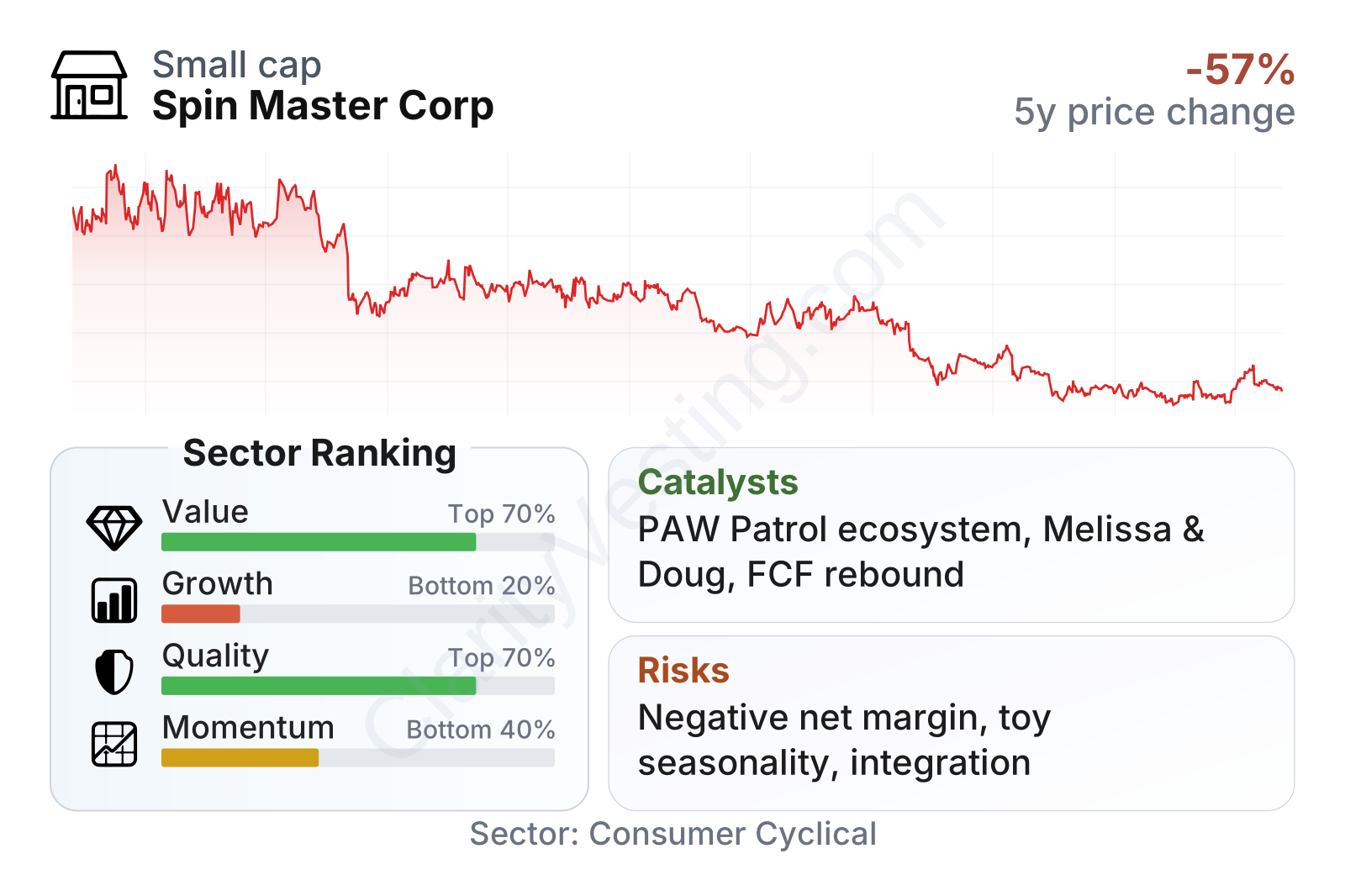
Spin Master is a mid-sized consumer company with a relatively low beta, meaning its share price has historically moved less sharply than the broader market. On valuation and cash generation, the profile looks stronger than many peers: free cash flow yield and EBIT relative to enterprise value are well above sector medians. Quality is more mixed but still decent overall, supported by moderate operating margins and balance-sheet leverage that remains lower than most companies in the sector. The weaker areas are growth and share-price momentum, reflecting uneven multi-year expansion, softer margin trends, and a stock that is still far below its levels from several years ago.
The stock-price history shows a long decline from 2021 highs, followed by a more modest stabilization in 2026. That backdrop suggests the market has become much more cautious about the company’s earnings durability than it was a few years ago.
Growth
Spin Master operates in a sector that is mature overall, but not stagnant. The global toy market usually grows at a low-to-mid single-digit pace over time, with faster pockets in collectibles, preschool products, digital play, licensed properties, and educational or craft-oriented categories. What makes Spin Master more interesting than a plain toy maker is its attempt to grow through intellectual property, cross-platform franchises, and acquisitions that can expand both category reach and distribution.
Its strategy is logical for future growth. The company combines owned entertainment brands with product development and has also added businesses that broaden its portfolio, such as Melissa & Doug in educational and pretend play and digital gaming assets that add exposure outside physical retail shelves. This can help reduce dependence on any single toy line and gives the company more ways to monetize a successful brand.
Recent revenue growth has been uneven rather than steady. After strong gains in 2021 and the first half of 2022, sales turned negative during the inventory correction that affected much of the toy industry. Growth later recovered, especially through parts of 2024, but became weaker again into late 2025 and early 2026. That pattern shows the company can still generate rebounds, but it also highlights how exposed it remains to retailer ordering cycles and franchise timing.
Cash generation is an encouraging counterpoint. Free cash flow has recovered meaningfully from the lower levels seen in 2024 and has moved back toward the upper end of its recent range. For a company in a cyclical consumer category, that matters because cash flow supports debt management, product investment, content development, and flexibility for future acquisitions or shareholder returns.
Several catalysts could shape the next phase. First, continued integration and cross-selling of acquired brands can lift scale and improve category depth with retailers. Second, a successful content release tied to a major franchise can create a halo effect on toy demand. Third, digital games offer a different revenue stream with potentially better recurring economics if engagement remains healthy. The company has also continued launching new products around established brands, which is important in a market where shelf space depends on constant refresh.
A meaningful recent development is the company’s effort to lean more heavily on evergreen properties and broader brand ecosystems rather than relying only on one-off toy launches. That approach does not remove volatility, but it can make sales less dependent on a single seasonal hit.
Risks
This article is for informational purposes only and does not constitute financial advice. Some content is AI-generated. See Disclaimer


