Stock Analysis · Snap Inc (SNAP)
Overview
Snap Inc. is the company behind Snapchat, a social media and communications platform centered on photo and video messaging, Stories, Spotlight short-form video, augmented reality lenses, maps, and creator content. The business is built around keeping users engaged inside the app and then selling advertising to brands that want to reach that audience. Snap also develops augmented reality tools and, in the past, has experimented with hardware such as Spectacles, but the company remains primarily a digital advertising platform.
Its revenue mix is highly concentrated, which makes the business easy to understand but also dependent on one engine.
- Advertising: about 98% to 99% of revenue. This includes brand advertising, direct-response ads, sponsored lenses and filters, Story ads, Spotlight ads, and newer formats tied to creators and performance marketing.
- Subscription and other revenue: about 1% to 2% of revenue. This mainly includes Snapchat+ subscription revenue and a small amount of other non-advertising activities.
That concentration matters. Snap’s progress largely depends on whether it can keep growing daily active users, improve ad targeting and measurement, and convince advertisers that Snapchat can deliver measurable returns alongside larger platforms.
There is also a clear financial improvement path visible over recent years: revenue has resumed growth, gross profit has expanded, and operating losses have narrowed significantly from the deep setback seen in 2022 and 2023. The business still spends heavily on product development and infrastructure, but losses are much smaller than they were a few years ago.
The long-term pattern shows a business that has become larger and more efficient. Revenue has climbed from a little above $4 billion in 2021 to nearly $6 billion in 2025, while net losses have narrowed substantially. Research and development remains a major expense, which fits Snap’s focus on product innovation and augmented reality.
Key Figures
| Metric | Value | Sector ⓘ |
|---|---|---|
| Date | Sep 12, 2026 | |
| Context | ||
| Sector | Communication Services | |
| Industry | Internet Content & Information | |
| Market Cap ⓘ | $9.34B | |
| Beta ⓘ | 1.05 | |
Value (Cheapness) | ||
| P/E Ratio ⓘ | N/A | 18.61 |
| FCF Yield ⓘ | 7.56% | 13.68% |
| EBIT / EV ⓘ | -3.09% | 4.54% |
| PEG ⓘ | 496.06 | |
Growth (Business expansion) | ||
| Revenue Growth ⓘ | 18.90% | 5.40% |
| RPS Growth (5Y CAGR) ⓘ | 6.89% | 4.62% |
| EPS Growth (5Y CAGR) ⓘ | -14.56% | -18.01% |
| Margin Growth (5Y Trend) ⓘ | N/A | 1.10% |
| FCF Growth (5Y CAGR) ⓘ | 18.33% | 5.88% |
Quality (Business durability) | ||
| ROIC (Latest) ⓘ | -4.23% | 8.38% |
| ROIC (5Y Median) ⓘ | -8.28% | 8.32% |
| Net Debt / EBIT (Latest) ⓘ | N/A | 1.99 |
| Net Debt / EBIT (5Y Median) ⓘ | N/A | 2.94 |
| Operating Margin (Latest) ⓘ | -5.14% | 14.89% |
| Operating Margin (5Y Median) ⓘ | -12.14% | 12.96% |
| Debt to Equity (Latest) ⓘ | 43.81% | 59.59% |
| Profit Margin (Latest) ⓘ | -4.90% | 8.77% |
| Free Cash Flow (Latest) ⓘ | $705.54M | |
Momentum (Price trend) | ||
| 3Y Return ⓘ | -40.71% | +46.64% |
| 12M Return (excl. last month) ⓘ | -28.47% | +2.16% |
| 6M Return ⓘ | +22.15% | +5.05% |
| Price vs. 200-Day MA ⓘ | -1.90% | +2.88% |
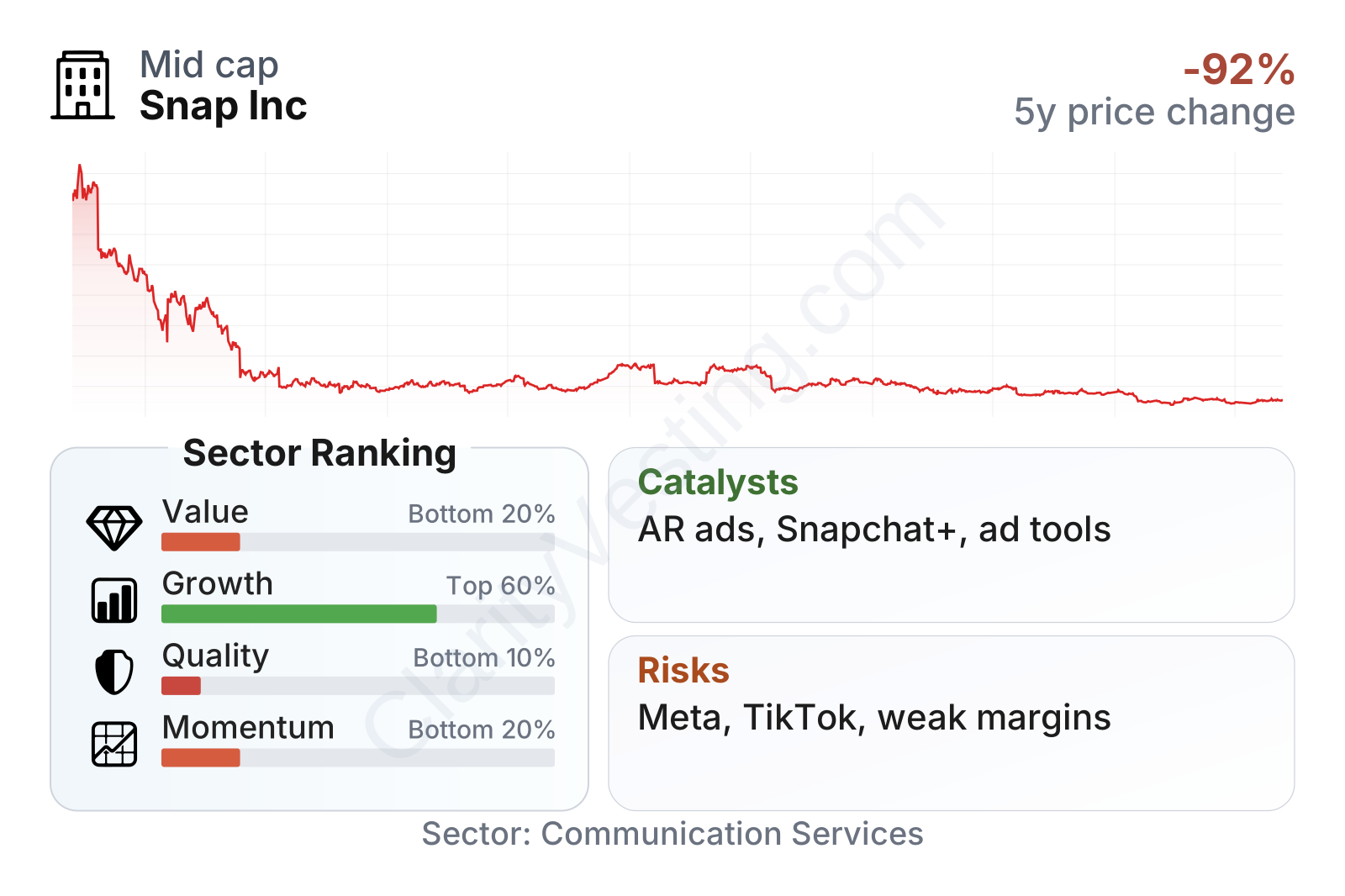
Snap sits in the mid-cap range and has share price volatility close to the broader market, but its recent stock performance has been much weaker than the sector. The table points to a mixed profile: growth is above the sector median, especially for recent revenue growth and five-year free cash flow expansion, while quality and momentum remain weak. In practical terms, the market is recognizing that the business is growing again, but it is still not rewarding the stock as it would a consistently profitable platform.
Growth
Snap operates in a sector with long-term growth potential. Digital advertising continues to take share from traditional media, and mobile video, creator content, and performance advertising remain important spending categories for brands. On top of that, augmented reality is still an emerging field with possible applications in advertising, shopping, and user engagement. These broader trends support the idea that Snap is in a growing part of the economy, even if competition is intense.
The company’s strategy also makes sense on paper. It is trying to combine three things: audience growth, stronger ad tools, and deeper monetization per user. Snapchat’s large base of daily active users gives it reach, but the more important issue is monetization quality. Snap has been working on machine-learning ad ranking, privacy-friendly measurement tools, and better direct-response products to attract performance advertisers, not just brand campaigns. That matters because performance ad budgets are usually more measurable and often more durable.
Revenue growth has clearly reaccelerated after the slowdown and contraction seen in 2022 and 2023. Recent year-over-year growth has moved back into the low-to-high teens, with the latest reading close to 19%, well above the sector median near 6%. That does not remove execution risk, but it does show that advertiser demand and product improvements are producing better top-line momentum again.
Cash generation has improved even faster than revenue. Free cash flow was negative in early 2024, then recovered strongly and has risen into the several-hundred-million-dollar range on a trailing basis. That is an encouraging sign because it suggests Snap is not only growing revenue, but also extracting more cash from that growth as spending discipline improves.
A meaningful catalyst is Snapchat+ and the broader subscription layer around the app. It is still small compared with advertising, but it adds a second revenue stream and shows that some users are willing to pay directly for premium features. Another potential catalyst is augmented reality advertising and commerce. Snap has invested for years in AR lenses, developer tools, and shopping features, and if brands increasingly use interactive formats to drive purchases, Snap could benefit disproportionately because AR is one of its clearest product differentiators.
Recent company updates have also emphasized continued user engagement gains, ad platform improvements, and investments in machine learning and creator monetization. None of these developments alone changes the business overnight, but together they support the view that Snap is trying to evolve from a niche social app into a more complete ad platform with stronger commercial tools.
Risks
This article is for informational purposes only and does not constitute financial advice. Some content is AI-generated. See Disclaimer


