Stock Analysis · SharkNinja Inc (SN)
Overview
SharkNinja is a consumer products company that designs, develops, markets, and sells household appliances and kitchen devices. Its best-known brands are Shark, focused mainly on cleaning and home environment products, and Ninja, centered on kitchen appliances, food preparation, and cooking. The company’s model is built around identifying consumer pain points, launching products with visible practical improvements, and supporting them with heavy retail distribution, advertising, and fast product refresh cycles.
Revenue comes primarily from product sales across two core brands and a broad mix of retail and digital channels. Based on recent company disclosures, the business is mainly organized around the following sources:
- Cleaning and home environment products under Shark: approximately 45% to 55% of revenue in recent periods. This includes vacuums, carpet extractors, hard floor cleaners, air purifiers, fans, and beauty-related devices sold under Shark-branded lines where applicable.
- Kitchen and food preparation products under Ninja: approximately 45% to 55% of revenue in recent periods. This includes blenders, multicookers, air fryers, coffee systems, frozen drink makers, ovens, and other countertop cooking appliances.
- Geographic mix: the United States remains the largest market, while international markets represent a smaller but expanding share. Company filings indicate that North America still dominates sales, with international contribution growing through Europe and selected other regions.
- Channel mix: revenue is generated through traditional retailers, e-commerce marketplaces, direct-to-consumer websites, and distributors. Precise percentages can move from quarter to quarter, but retail partners remain the largest route to market.
What stands out is the operating profile behind those sales. Over the last several years, revenue has expanded strongly, while gross profit and operating income have risen even faster. That suggests SharkNinja has not only been selling more units, but also improving product mix and pricing power enough to support better profitability.
The business mix has become more favorable over time: revenue has climbed from the low-$3 billion range earlier in the decade to more than $6 billion recently, while net income has risen much faster than sales. Research and development spending has also increased materially, which is consistent with a company relying on steady product launches rather than one-time hits.
Key Figures
| Metric | Value | Sector ⓘ |
|---|---|---|
| Date | Sep 12, 2026 | |
| Context | ||
| Sector | Consumer Cyclical | |
| Industry | Furnishings, Fixtures & Appliances | |
| Market Cap ⓘ | $22.76B | |
| Beta ⓘ | 1.20 | |
Value (Cheapness) | ||
| P/E Ratio ⓘ | 33.22 | 17.10 |
| FCF Yield ⓘ | 3.52% | 8.53% |
| EBIT / EV ⓘ | 4.01% | 6.46% |
| PEG ⓘ | 2.23 | |
Growth (Business expansion) | ||
| Revenue Growth ⓘ | 22.20% | 5.75% |
| RPS Growth (5Y CAGR) ⓘ | 13.84% | 9.14% |
| EPS Growth (5Y CAGR) ⓘ | N/A | -18.21% |
| Margin Growth (5Y Trend) ⓘ | 3.27% | -0.23% |
| FCF Growth (5Y CAGR) ⓘ | 29.42% | 4.91% |
Quality (Business durability) | ||
| ROIC (Latest) ⓘ | 21.32% | 12.61% |
| ROIC (5Y Median) ⓘ | 19.54% | 10.72% |
| Net Debt / EBIT (Latest) ⓘ | 0.14 | 2.10 |
| Net Debt / EBIT (5Y Median) ⓘ | 0.90 | 2.32 |
| Operating Margin (Latest) ⓘ | 13.38% | 9.25% |
| Operating Margin (5Y Median) ⓘ | 11.51% | 9.64% |
| Debt to Equity (Latest) ⓘ | 32.11% | 75.78% |
| Profit Margin (Latest) ⓘ | 10.06% | 5.33% |
| Free Cash Flow (Latest) ⓘ | $801.93M | |
Momentum (Price trend) | ||
| 3Y Return ⓘ | +294.68% | +14.53% |
| 12M Return (excl. last month) ⓘ | +59.39% | +3.08% |
| 6M Return ⓘ | +58.14% | +0.55% |
| Price vs. 200-Day MA ⓘ | +23.91% | -0.54% |
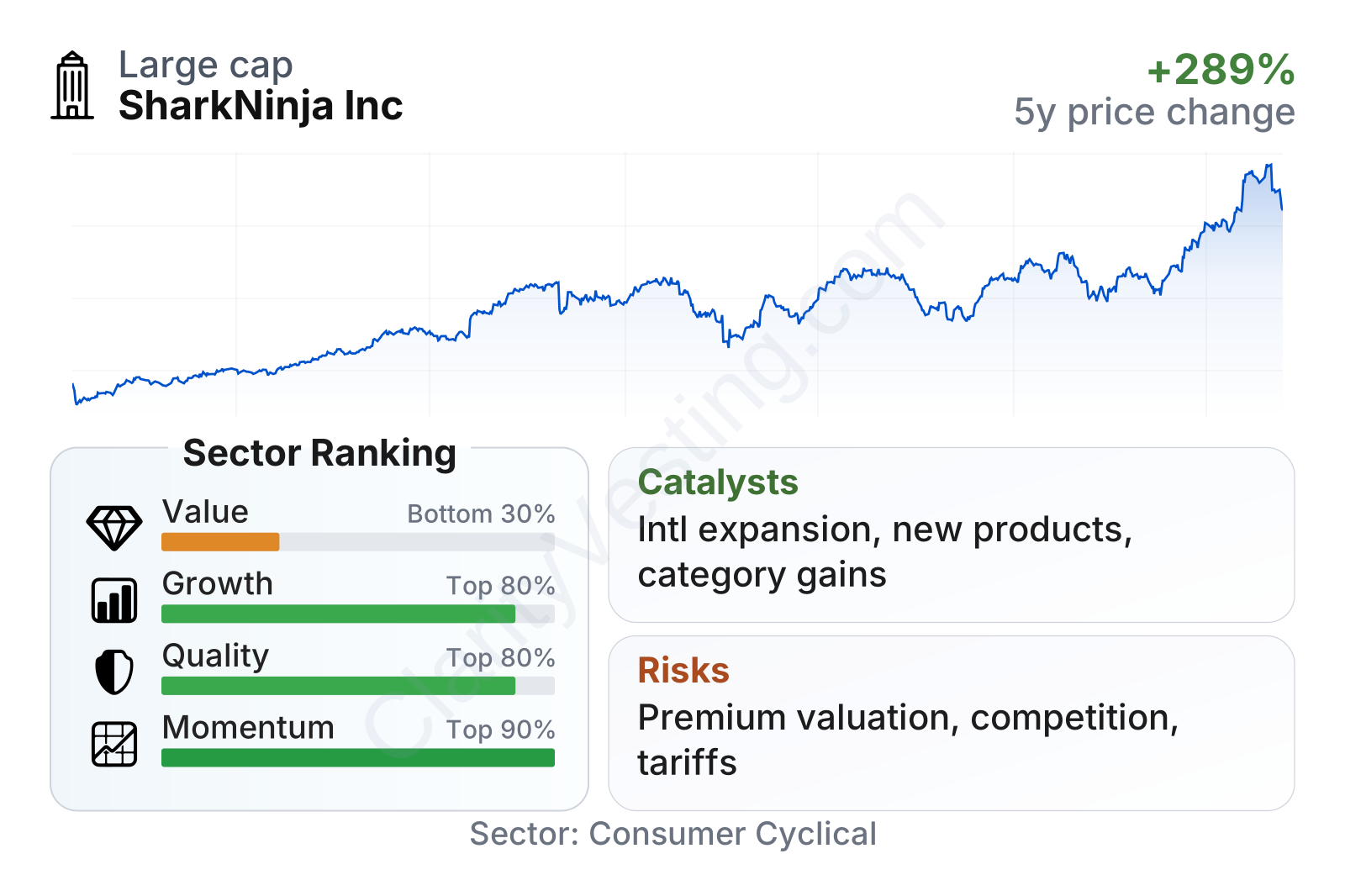
SharkNinja currently sits in a strong position on growth, quality, and market performance relative to most companies in its sector, while looking weak on traditional valuation measures. Revenue growth is running well above the sector median, profitability is clearly stronger than average, and leverage remains low. The trade-off is that the stock market is already recognizing much of that strength, with earnings and cash flow multiples above sector norms.
The company is now a large consumer appliance name rather than a small emerging player, and its share price has been highly constructive over the past three years. With a beta a little above 1, the stock has tended to move somewhat more than the broader market, but not in an extreme way.
Growth
SharkNinja operates in categories that are mature on the surface but still offer room for innovation-driven growth. Household appliances, small kitchen equipment, home cleaning, and home environment products are not new industries, yet consumer demand can shift quickly when a company introduces products that save time, improve convenience, or perform better than older alternatives. That is exactly where SharkNinja has built its strategy.
The company’s growth strategy appears coherent for the long term. It is based on frequent product launches, expansion into adjacent categories, broader international reach, and scaling brands that already have high consumer recognition. Instead of depending on one flagship device, SharkNinja continues to add products around everyday household use cases. That reduces reliance on a single trend and makes it easier to deepen shelf space at major retailers.
Recent revenue growth has remained strong even after the company’s earlier rapid expansion. Year-over-year growth has generally stayed in the mid-teens to low-30% range across recent periods, with the latest reading above 20%. That is well ahead of the sector median and suggests demand has remained resilient rather than fading after a post-pandemic spike.
Cash generation is also improving in a meaningful way. Free cash flow has increased sharply over the last two years, moving from roughly $100 million to nearly $400 million on the quarterly trailing basis shown, while trailing twelve-month free cash flow in the latest metrics is above $600 million. This matters because it indicates the business is converting growth into real financial flexibility, not just accounting earnings.
Several catalysts support the growth case. International expansion is one of the biggest. SharkNinja has been increasing its presence outside the United States, and global household appliance categories remain fragmented enough to give a strong brand room to gain share. Another catalyst is category extension: the company has continued pushing into beauty, beverages, outdoor cooking, and other appliance niches where brand trust and retail relationships can accelerate adoption.
Recent company communications have also emphasized new product pipelines and broader retail distribution. That combination can be powerful in consumer hardware: new products create demand, and better placement turns that demand into faster sales. If execution remains consistent, SharkNinja has a visible runway for expansion without needing a radical change in business model.
Risks
This article is for informational purposes only and does not constitute financial advice. Some content is AI-generated. See Disclaimer


