Stock Analysis · Semtech Corporation (SMTC)
Overview
Semtech Corporation is a semiconductor company that designs analog and mixed-signal chips used to move, protect, and connect data. In simple terms, its products help electronic devices communicate over networks, manage signals reliably, and operate with lower power consumption. The company serves industrial, communications, data center, and consumer-related markets, with a business mix that has changed meaningfully after the acquisition of Sierra Wireless.
Based on the company’s latest fiscal 2026 reporting, revenue is mainly organized into three product groups.
- Signal Integrity: approximately 49% of revenue. This is now the largest business. It includes high-speed connectivity products used in data centers, AI clusters, telecom infrastructure, enterprise networking, and optical modules, where preserving signal quality becomes critical as data speeds rise.
- Analog Mixed Signal and Wireless: approximately 32% of revenue. This segment includes power and protection devices, sensing, timing, and wireless products used in industrial equipment, infrastructure, and a range of connected devices.
- IoT Systems: approximately 19% of revenue. This business includes cellular modules, routers, cloud-connected hardware, and services inherited largely from Sierra Wireless, aimed at industrial and enterprise Internet of Things deployments.
That revenue mix matters because it shows Semtech is no longer just a niche analog chip company. It now has meaningful exposure to faster-growing areas such as cloud infrastructure, AI-related interconnect demand, and industrial connectivity, while still keeping a base in lower-power analog components.
The broader financial flow also shows a company in transition. Revenue has climbed from about $741 million in fiscal 2022 to about $1.05 billion in fiscal 2026, but profitability was disrupted by acquisition costs, higher interest expense, and integration pressure before starting to recover more recently.
One clear trend is that sales have expanded materially over the last few years, while gross profit has also improved in absolute terms. At the same time, operating costs and financing costs rose sharply after the Sierra Wireless deal, which explains why accounting earnings lagged the top-line recovery.
Key Figures
| Metric | Value | Sector ⓘ |
|---|---|---|
| Date | Sep 12, 2026 | |
| Context | ||
| Sector | Technology | |
| Industry | Semiconductors | |
| Market Cap ⓘ | $15.61B | |
| Beta ⓘ | 2.35 | |
Value (Cheapness) | ||
| P/E Ratio ⓘ | 110.75 | 29.51 |
| FCF Yield ⓘ | 1.16% | 4.25% |
| EBIT / EV ⓘ | 0.57% | 2.85% |
| PEG ⓘ | 3.39 | |
Growth (Business expansion) | ||
| Revenue Growth ⓘ | 32.70% | 15.40% |
| RPS Growth (5Y CAGR) ⓘ | 1.26% | 8.56% |
| EPS Growth (5Y CAGR) ⓘ | -25.01% | -11.88% |
| Margin Growth (5Y Trend) ⓘ | -18.02% | 0.46% |
| FCF Growth (5Y CAGR) ⓘ | -2.53% | 9.80% |
Quality (Business durability) | ||
| ROIC (Latest) ⓘ | 13.43% | 9.44% |
| ROIC (5Y Median) ⓘ | 1.42% | 8.30% |
| Net Debt / EBIT (Latest) ⓘ | 3.69 | 0.54 |
| Net Debt / EBIT (5Y Median) ⓘ | 11.79 | 0.44 |
| Operating Margin (Latest) ⓘ | 7.41% | 9.58% |
| Operating Margin (5Y Median) ⓘ | 1.85% | 8.25% |
| Debt to Equity (Latest) ⓘ | 70.10% | 33.33% |
| Profit Margin (Latest) ⓘ | 13.12% | 7.14% |
| Free Cash Flow (Latest) ⓘ | $181.46M | |
Momentum (Price trend) | ||
| 3Y Return ⓘ | +636.09% | +45.48% |
| 12M Return (excl. last month) ⓘ | +165.60% | +23.48% |
| 6M Return ⓘ | +100.50% | +20.93% |
| Price vs. 200-Day MA ⓘ | +52.82% | +7.43% |
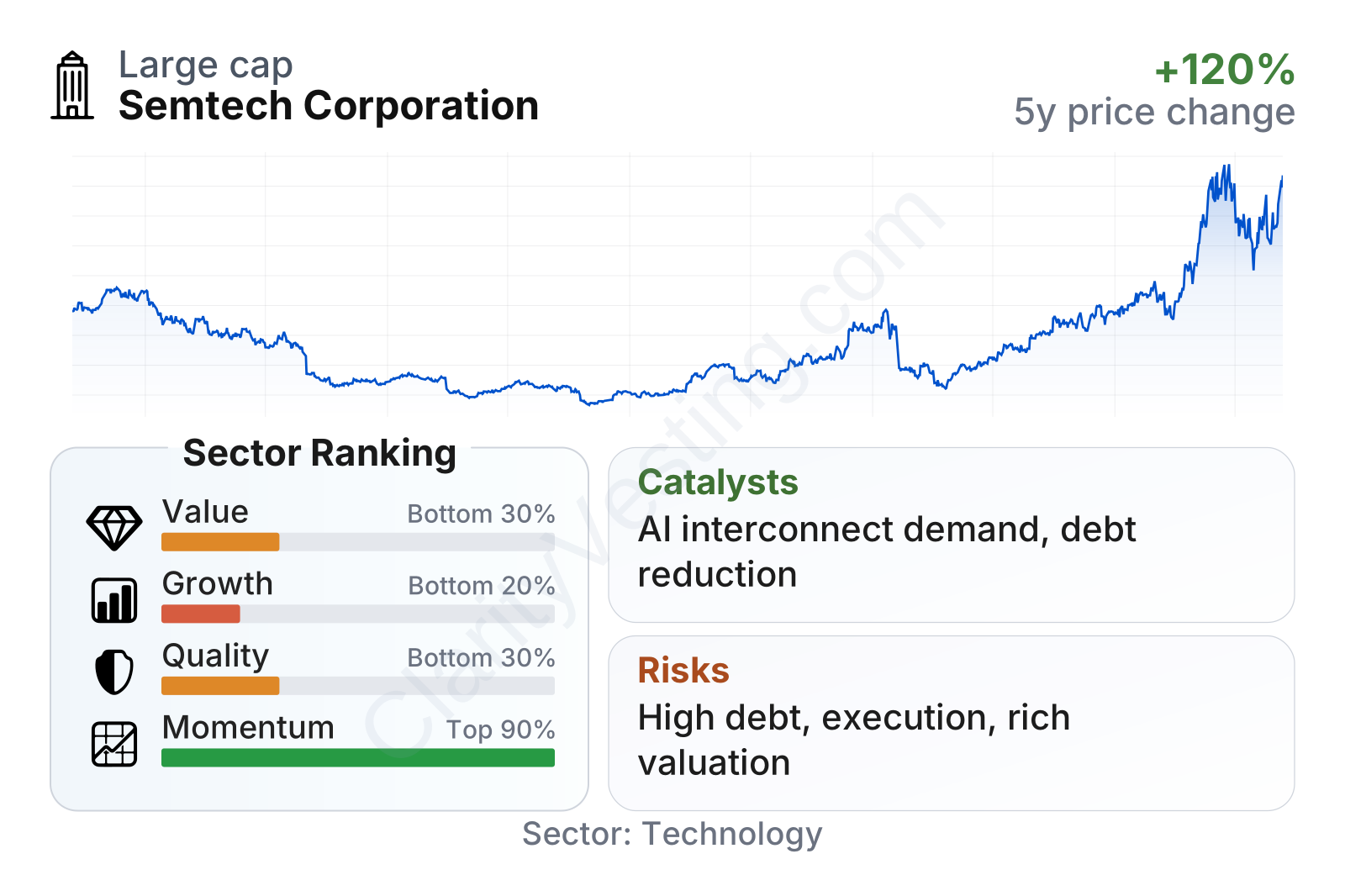
Semtech is now a mid-sized semiconductor company with unusually strong share-price momentum, but the underlying fundamentals are more mixed. The stock has rebounded dramatically from its 2023 lows, reflecting rising confidence in recovery and AI-related networking demand. Even so, the factor breakdown remains weak in value, growth, and quality relative to much of the technology sector. Profitability has improved from the trough, free cash flow is back in positive territory, and leverage is moving down, but the business still carries more balance-sheet risk and lower operating efficiency than the typical peer.
Growth
Semtech operates in parts of the semiconductor market that have real long-term demand drivers. High-speed data movement is benefiting from AI servers, optical networking upgrades, and the need for faster connections inside and between data centers. Industrial and enterprise IoT also remain structural growth areas, although that market tends to move in cycles and can be uneven from quarter to quarter.
The company’s strategy is coherent on paper. Its legacy strengths in analog and low-power connectivity have been complemented by Sierra Wireless in IoT systems and by a stronger emphasis on signal integrity products for high-performance infrastructure. This gives Semtech exposure to several growth themes at once rather than depending on a single product cycle.
The recent revenue pattern supports the view that the business is in recovery mode. Growth turned volatile during the downturn, but the latest year-over-year pace has accelerated strongly and is running well above the sector median. That does not erase the weaker multi-year record, yet it does suggest demand conditions have improved materially, especially in the businesses tied to infrastructure and connectivity upgrades.
Cash generation also looks healthier than it did during the low point. Free cash flow moved from negative territory in fiscal 2024 back to a clearly positive level by fiscal 2026. For a company coming out of an acquisition-heavy period, that improvement is important because it provides more room to reduce debt, fund product development, and absorb cyclical swings without relying as much on external financing.
A major catalyst is the buildout of AI infrastructure. Semtech has highlighted demand for its high-speed connectivity and signal conditioning products used in active copper cables, optical modules, retimers, and related systems. As computing clusters become faster and denser, signal integrity becomes more valuable, which can support both volume growth and a stronger strategic position. Recent company communications have also pointed to continued traction in cloud and data center applications, suggesting this is not just a distant opportunity but an active contributor to current momentum.
Risks
This article is for informational purposes only and does not constitute financial advice. Some content is AI-generated. See Disclaimer