Stock Analysis · Samsonite International SA (SMSEY)
Overview
Samsonite International S.A. is a global travel-lifestyle company best known for luggage, backpacks, business bags, and travel accessories. Its brand portfolio includes Samsonite, Tumi, American Tourister, Gregory, High Sierra, and several regional labels. In simple terms, the company sells products that people use to travel, commute, and carry personal items, with a business that spans premium, mid-range, and mass-market price points.
Revenue mainly comes from branded bag and travel products sold through wholesale partners, company-operated retail stores, and e-commerce. Based on recent annual reporting, the business mix is centered on a few major brands and broad geographic exposure.
- Samsonite brand: approximately 40% to 45% of revenue. This is the core luggage and travel goods franchise, covering suitcases, business bags, backpacks, and travel accessories.
- Tumi: approximately 25% to 30% of revenue. Tumi focuses more on the premium end, especially business bags, luggage, backpacks, and accessories.
- American Tourister: approximately 20% to 25% of revenue. This brand is positioned more toward affordable travel goods and casual bags.
- Other brands: approximately 5% to 10% of revenue. This includes Gregory, High Sierra, and smaller labels across outdoor, casual, and regional categories.
Geographically, Samsonite has historically been diversified across Asia, North America, Europe, and Latin America, which helps reduce dependence on a single market. Its channel mix also matters: direct-to-consumer sales through owned stores and websites usually support stronger margins, while wholesale broadens reach and volume.
Over the last several years, the company has rebuilt scale after the pandemic disruption in global travel, but more recently revenue and earnings have eased from the strongest rebound period. Even so, its operating profile remains materially stronger than it was before the recovery phase.
The business flow shows a company that recovered sharply from 2021 through 2023, then experienced softer sales and earnings in 2024 and 2025. Even with that cooling, gross profit and operating income remain well above 2021 levels, which suggests the underlying brand portfolio still supports healthy profitability.
Key Figures
| Metric | Value | Sector ⓘ |
|---|---|---|
| Date | Sep 12, 2026 | |
| Context | ||
| Sector | Consumer Cyclical | |
| Industry | Footwear & Accessories | |
| Market Cap ⓘ | $2.82B | |
| Beta ⓘ | 0.78 | |
Value (Cheapness) | ||
| P/E Ratio ⓘ | 9.84 | 17.10 |
| FCF Yield ⓘ | 14.24% | 8.53% |
| EBIT / EV ⓘ | 14.05% | 6.46% |
| PEG ⓘ | 1.69 | |
Growth (Business expansion) | ||
| Revenue Growth ⓘ | 2.20% | 5.75% |
| RPS Growth (5Y CAGR) ⓘ | 15.68% | 9.14% |
| EPS Growth (5Y CAGR) ⓘ | 5.83% | -18.21% |
| Margin Growth (5Y Trend) ⓘ | 11.31% | -0.23% |
| FCF Growth (5Y CAGR) ⓘ | 2.73% | 4.91% |
Quality (Business durability) | ||
| ROIC (Latest) ⓘ | N/A | 12.61% |
| ROIC (5Y Median) ⓘ | 13.51% | 10.72% |
| Net Debt / EBIT (Latest) ⓘ | 2.99 | 2.10 |
| Net Debt / EBIT (5Y Median) ⓘ | 3.12 | 2.32 |
| Operating Margin (Latest) ⓘ | 16.43% | 9.25% |
| Operating Margin (5Y Median) ⓘ | 16.39% | 9.64% |
| Debt to Equity (Latest) ⓘ | 147.96% | 75.78% |
| Profit Margin (Latest) ⓘ | 8.26% | 5.33% |
| Free Cash Flow (Latest) ⓘ | $401.34M | |
Momentum (Price trend) | ||
| 3Y Return ⓘ | -40.01% | +14.53% |
| 12M Return (excl. last month) ⓘ | -14.78% | +3.08% |
| 6M Return ⓘ | -32.18% | +0.55% |
| Price vs. 200-Day MA ⓘ | -19.79% | -0.54% |
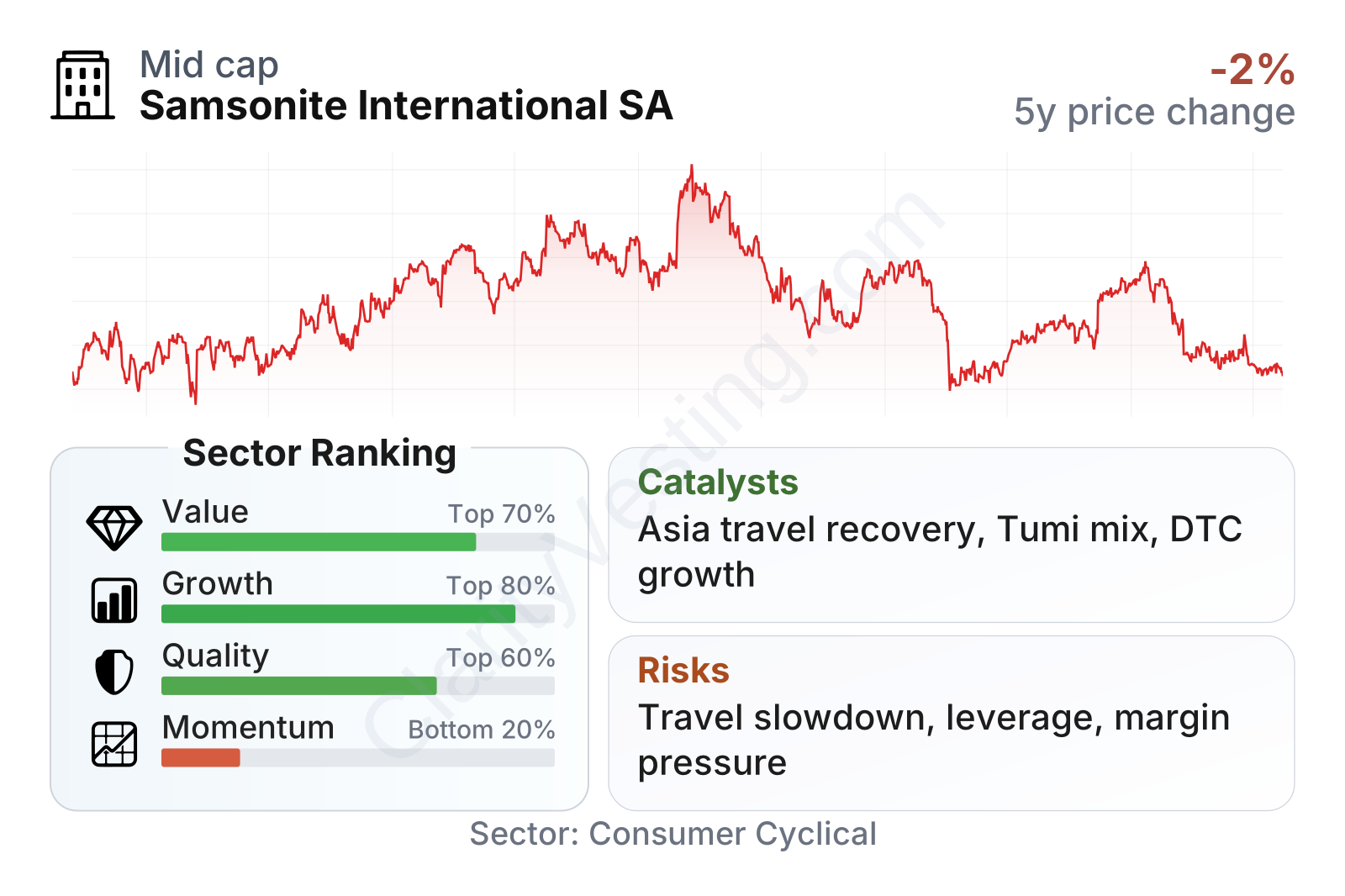
Samsonite is a mid-sized consumer company with a stock that has been volatile over the last few years. The share price surged during the travel recovery, then gave back a meaningful part of those gains. In the latest factor snapshot, valuation looks notably cheaper than the sector median, while profitability remains above many peers. Growth is mixed: long-term expansion has been solid, but recent year-over-year revenue growth has been subdued. Momentum is clearly weak, meaning the market has recently taken a cautious view despite still-healthy cash generation and margins.
Growth
Samsonite operates in a sector tied to travel activity, tourism, business mobility, and consumer discretionary spending. Over the long run, that can be an attractive market because rising middle-class travel, international tourism, and premiumization in branded luggage all support demand. The challenge is that this is not a straight-line growth market. It tends to move with economic confidence, airline traffic, and consumer appetite for non-essential purchases.
The company’s strategy broadly makes sense for long-term expansion. It has a portfolio that covers multiple price points, a strong premium brand in Tumi, a broad global footprint, and a direct-to-consumer channel that can deepen customer relationships and protect margins. Samsonite has also been expanding its digital presence and using product innovation, brand marketing, and geographic reach to keep the portfolio relevant across both travel and everyday carry categories.
The revenue trend shows two distinct phases. First came the powerful post-pandemic rebound, with very high growth rates as travel normalized. Then came a normalization period, with several quarters of flat to negative year-over-year comparisons before a modest return to growth. That pattern matters: Samsonite is no longer benefiting from easy recovery comparisons, so future progress depends more on market share gains, product mix, and new demand rather than reopening momentum alone.
Cash generation remains one of the more encouraging parts of the profile. Free cash flow has stayed robust even as sales growth cooled, which suggests the company still converts a meaningful portion of earnings into cash. That gives Samsonite flexibility to manage debt, invest in stores and digital channels, and support brand development without depending heavily on external financing.
A practical catalyst is the continued normalization of international travel, especially in Asia, where branded luggage and travel accessories have room to grow over time. Another is mix improvement: higher direct-to-consumer penetration and continued strength in premium brands can support profitability even if unit growth is moderate. In recent company communications, management has also emphasized product innovation, retail execution, and disciplined cost control, all of which are relevant if the demand environment remains uneven.
Risks
This article is for informational purposes only and does not constitute financial advice. Some content is AI-generated. See Disclaimer


