Stock Analysis · Smurfit Kappa Group Plc (SMFTF)
Overview
Smurfit Kappa Group Plc is one of the world’s largest paper-based packaging companies. Its business is centered on making corrugated boxes, containerboard, cartonboard, and other packaging solutions used to protect, transport, display, and sell goods. The company serves a wide range of end markets such as food and beverage, consumer goods, e-commerce, industrial products, and retail. The core idea is simple: businesses need packaging every day, and Smurfit Kappa supplies both the paper and the finished packaging products.
The company’s revenue base is mainly driven by integrated paper-based packaging, with a business model that combines paper mills and converting plants. That matters because it gives the group more control over supply, costs, and product quality than a packaging company that depends heavily on outside paper suppliers. Following the combination with WestRock, the company became much larger and more geographically diversified, with meaningful operations in Europe and the Americas.
At a high level, revenue is broadly generated from the following activities, with packaging products remaining the largest contributor:
- Corrugated packaging and boxes: roughly the largest share, likely around half of group revenue.
- Paper and containerboard sales: a major second pillar, supported by the company’s mill network.
- Consumer packaging and specialty packaging: a smaller but strategically important segment, including shelf-ready and branded formats.
- Other packaging-related services: design, recycling support, and supply-chain-oriented packaging solutions.
The financial flow over the last several years shows a business that can produce very large gross profit in absolute dollars, but whose bottom-line results can move sharply when financing costs and integration-related pressures rise. Revenue expanded significantly after the recent merger, yet net income did not rise at the same pace, highlighting that scale alone is not enough unless margins and debt costs are kept under control.
Key Figures
| Metric | Value | Sector ⓘ |
|---|---|---|
| Date | Sep 12, 2026 | |
| Context | ||
| Sector | Consumer Cyclical | |
| Industry | Packaging & Containers | |
| Market Cap ⓘ | $24.67B | |
| Beta ⓘ | 0.96 | |
Value (Cheapness) | ||
| P/E Ratio ⓘ | N/A | 17.10 |
| FCF Yield ⓘ | 4.14% | 8.53% |
| EBIT / EV ⓘ | N/A | 6.46% |
| PEG ⓘ | N/A | |
Growth (Business expansion) | ||
| Revenue Growth ⓘ | -15.50% | 5.75% |
| RPS Growth (5Y CAGR) ⓘ | 11.32% | 9.14% |
| EPS Growth (5Y CAGR) ⓘ | -25.77% | -18.21% |
| Margin Growth (5Y Trend) ⓘ | -6.52% | -0.23% |
| FCF Growth (5Y CAGR) ⓘ | 34.11% | 4.91% |
Quality (Business durability) | ||
| ROIC (Latest) ⓘ | N/A | 12.61% |
| ROIC (5Y Median) ⓘ | 21.51% | 10.72% |
| Net Debt / EBIT (Latest) ⓘ | N/A | 2.10 |
| Net Debt / EBIT (5Y Median) ⓘ | 2.46 | 2.32 |
| Operating Margin (Latest) ⓘ | N/A | 9.25% |
| Operating Margin (5Y Median) ⓘ | 11.23% | 9.64% |
| Debt to Equity (Latest) ⓘ | N/A | 75.78% |
| Profit Margin (Latest) ⓘ | 6.73% | 5.33% |
| Free Cash Flow (Latest) ⓘ | $1.02B | |
Momentum (Price trend) | ||
| 3Y Return ⓘ | +22.89% | +14.53% |
| 12M Return (excl. last month) ⓘ | -23.22% | +3.08% |
| 6M Return ⓘ | +17.28% | +0.55% |
| Price vs. 200-Day MA ⓘ | +8.25% | -0.54% |
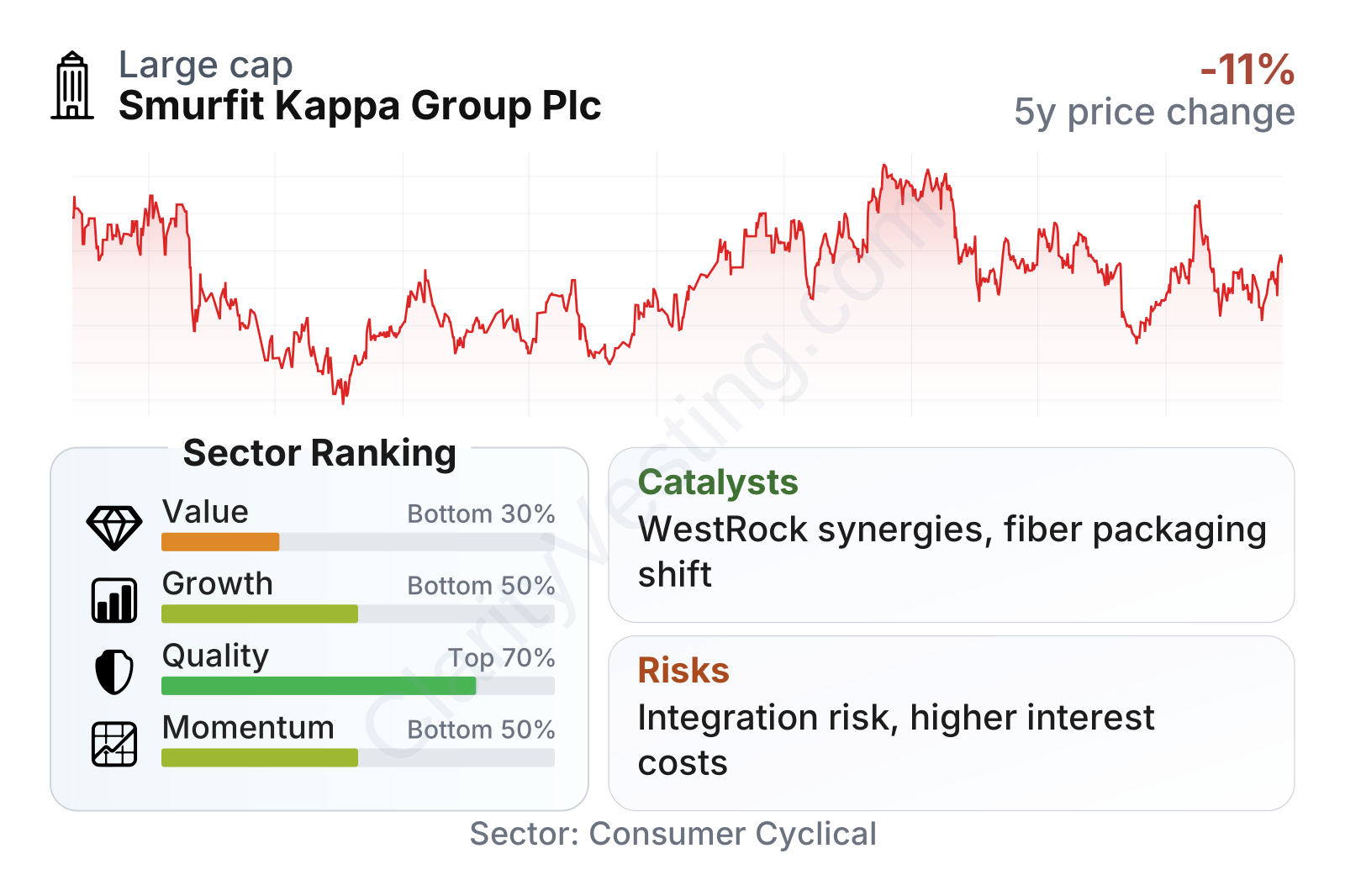
Smurfit Kappa stands at roughly a mid-to-large-cap scale with a market value near $25 billion and a beta close to 1, suggesting share-price volatility that is not far from the broader market. The stock’s profile is mixed. Quality is respectable, helped by strong long-term returns on invested capital and profit margins above the sector median. Growth indicators are more uneven: the recent year looks weak, but the longer multi-year picture for revenue per share and free cash flow is better. Value metrics appear less attractive relative to the sector, which suggests the market is not pricing the company as a deep bargain despite the recent share-price swings.
Price performance has also been inconsistent. Over three years, the shares have held up better than the sector median, but the more recent twelve-month trend has been noticeably weaker. At the same time, the rebound over the last six months shows that sentiment can recover quickly when investors start focusing again on integration progress, cash generation, or packaging demand.
Growth
Paper-based packaging is a mature industry, but it still has durable growth drivers. E-commerce continues to support demand for corrugated boxes, brand owners keep redesigning packaging to reduce waste, and regulators in many countries are encouraging a shift away from plastic toward recyclable fiber-based materials. This does not make the sector high-growth in the way software can be, but it does create a long runway for steady demand and product upgrades.
For Smurfit Kappa, the main strategic growth point is scale. The combination with WestRock materially increased its footprint, especially in North America, and broadened its customer relationships. A larger combined network can improve mill utilization, procurement leverage, logistics efficiency, and cross-selling opportunities. In practical terms, the company is trying to become a more powerful global packaging supplier for multinational customers that want consistency across regions.
The near-term revenue trend is clearly softer than the sector median, with the latest year showing a notable decline. That likely reflects a combination of cyclical demand pressure, price normalization after earlier inflation-driven peaks, and portfolio reshaping. However, the longer-term picture is stronger than that short-term decline suggests: five-year revenue per share growth remains ahead of the sector median, which indicates that the business has been able to build scale over time even through volatile industry conditions.
Cash generation is one of the more constructive elements in the current profile. Free cash flow over time has improved at a much faster pace than the sector median, and trailing free cash flow is comfortably above the billion-dollar mark. That gives the company flexibility to support integration, capital spending, and debt management. One of the clearest catalysts now is whether merger synergies and operating discipline can turn that strong cash profile into more durable earnings growth.
Recent company updates and investor materials have focused heavily on integration, synergy delivery, and the benefits of a broader geographic platform. Those themes matter more than short-term shipment fluctuations because, for a packaging producer of this size, even modest efficiency gains can have a large impact on earnings over several years.
Risks
This article is for informational purposes only and does not constitute financial advice. Some content is AI-generated. See Disclaimer