Stock Analysis · Super Micro Computer Inc (SMCI)
Overview
Super Micro Computer, usually called Supermicro, designs and sells high-performance servers, storage systems, full rack-scale solutions, and related software and support. In simple terms, it helps customers build the computing infrastructure behind cloud services, artificial intelligence workloads, enterprise data centers, and telecom networks. The company is known for assembling systems quickly around the latest chips from suppliers such as NVIDIA, AMD, and Intel, then customizing those systems for customer needs.
Its business model is centered on selling hardware platforms and complete systems rather than creating its own leading-edge chips. That makes Supermicro closer to an infrastructure integrator and system builder than to a semiconductor designer. The company emphasizes modular designs, energy efficiency, and faster time-to-market, which matters in periods when demand for AI servers shifts very quickly.
Based on the latest annual filing, revenue is overwhelmingly generated by product sales, while services contribute a much smaller share. The filing does not provide a detailed public percentage split for every subcategory, but the broad mix is clear.
- Server and storage systems, motherboards, subsystems, and related hardware: approximately 96% to 98%. This includes complete AI servers, enterprise servers, storage platforms, networking-related hardware, and components sold to data center, cloud, and enterprise customers.
- Support, service, and other revenue: approximately 2% to 4%. This includes technical support, maintenance, integration-related activity, and other non-product revenue.
Geographically, Supermicro serves a global customer base, with a meaningful share of demand tied to North America and Asia. Customer concentration can matter because very large cloud and AI deployments can create periods where a few buyers account for a large portion of sales.
The broader financial flow shows a business that has expanded revenue extremely fast over the last several years, but with hardware costs still absorbing most of each sales dollar. Gross profit and operating income have risen sharply in absolute terms, yet the company remains a relatively lower-margin business than many software or chip peers because it operates in hardware integration and manufacturing.
The operating profile has clearly scaled up: revenue has multiplied several times since 2022, gross profit has followed, and operating income has also expanded. At the same time, cost of revenue remains very high, which is normal for a server manufacturer and helps explain why rapid sales growth does not automatically translate into equally strong cash generation.
Key Figures
| Metric | Value | Sector ⓘ |
|---|---|---|
| Date | Sep 12, 2026 | |
| Context | ||
| Sector | Technology | |
| Industry | Computer Hardware | |
| Market Cap ⓘ | $24.18B | |
| Beta ⓘ | 2.00 | |
Value (Cheapness) | ||
| P/E Ratio ⓘ | 11.94 | 29.51 |
| FCF Yield ⓘ | -28.83% | 4.25% |
| EBIT / EV ⓘ | 9.61% | 2.85% |
| PEG ⓘ | 0.91 | |
Growth (Business expansion) | ||
| Revenue Growth ⓘ | 93.20% | 15.40% |
| RPS Growth (5Y CAGR) ⓘ | 54.10% | 8.56% |
| EPS Growth (5Y CAGR) ⓘ | 57.42% | -11.88% |
| Margin Growth (5Y Trend) ⓘ | 1.03% | 0.46% |
| FCF Growth (5Y CAGR) ⓘ | 120.40% | 9.80% |
Quality (Business durability) | ||
| ROIC (Latest) ⓘ | 16.33% | 9.44% |
| ROIC (5Y Median) ⓘ | 18.00% | 8.30% |
| Net Debt / EBIT (Latest) ⓘ | -0.28 | 0.54 |
| Net Debt / EBIT (5Y Median) ⓘ | 0.40 | 0.44 |
| Operating Margin (Latest) ⓘ | 7.64% | 9.58% |
| Operating Margin (5Y Median) ⓘ | 7.64% | 8.25% |
| Debt to Equity (Latest) ⓘ | 46.14% | 33.33% |
| Profit Margin (Latest) ⓘ | 5.71% | 7.14% |
| Free Cash Flow (Latest) ⓘ | -$6.97B | |
Momentum (Price trend) | ||
| 3Y Return ⓘ | +49.81% | +45.48% |
| 12M Return (excl. last month) ⓘ | -19.00% | +23.48% |
| 6M Return ⓘ | +29.77% | +20.93% |
| Price vs. 200-Day MA ⓘ | +27.34% | +7.43% |
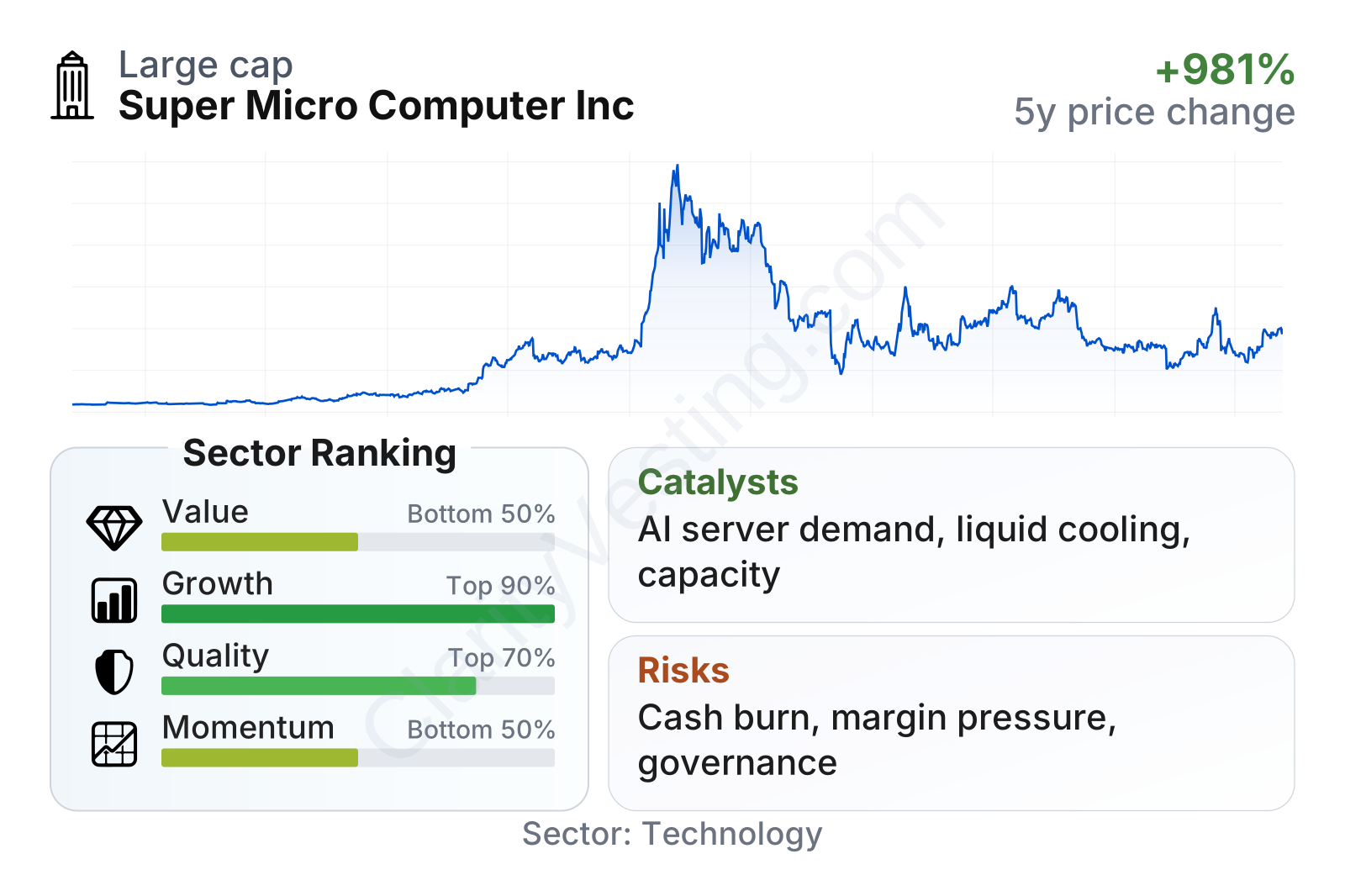
Supermicro is now a large technology hardware company by market value, but still much smaller than the biggest diversified infrastructure players. The stock has been volatile, with a very strong multiyear rise followed by a sharp pullback and then a partial recovery. In the latest factor snapshot, growth stands out as the strongest area, ranking near the top of the technology sector, while value appears mixed, quality is respectable but not elite, and recent momentum remains weaker than the company’s longer-term record.
The table also points to an important contrast: earnings-based valuation metrics are not especially stretched compared with the sector median, but free cash flow is currently a weak spot. That gap suggests the market is giving more weight to revenue growth and earnings power than to near-term cash conversion.
Growth
Supermicro operates in one of the strongest areas in technology: the build-out of AI infrastructure. As companies and cloud providers race to deploy more computing power, demand has spread beyond chips themselves to the servers, liquid-cooling systems, racks, networking integration, and power-efficient designs needed to run them. That is exactly where Supermicro is positioned.
The company’s strategy also makes sense for this phase of the market. Rather than betting on one processor architecture, it works across multiple chip suppliers and focuses on speed, customization, and system-level integration. That flexibility can be valuable when customers want rapid deployment of AI clusters and do not want to wait for slower product cycles from larger competitors.
Revenue growth has been extraordinary, even by technology standards. The latest year-over-year growth rate is close to 93%, far above the sector median near 16%, and the company’s five-year revenue-per-share growth rate is also several times higher than the typical peer. The pattern has not been smooth, but it shows that Supermicro has been a major beneficiary of the AI server spending wave.
Cash generation is the more complicated part of the growth picture. Free cash flow has swung sharply and is currently deeply negative on a trailing basis. That does not automatically mean the growth is low quality; in hardware businesses, large working-capital needs, inventory builds, and spending to support fast customer ramps can temporarily pressure cash flow. Still, it means growth is currently consuming cash instead of consistently producing it.
One of the clearest catalysts is the ongoing shift toward full rack-scale AI systems and liquid-cooled infrastructure. As AI clusters become denser and more power-hungry, customers increasingly need integrated solutions rather than basic standalone servers. Supermicro has been investing in manufacturing capacity and direct liquid cooling capabilities, which could support larger deployments and higher-value system sales if demand remains strong.
Recent company communications have also highlighted expanding manufacturing capabilities in the United States and internationally. That matters because large customers increasingly care about supply chain resilience, speed of delivery, and the ability to scale capacity quickly. In a market where timing can decide contract wins, manufacturing readiness can be a meaningful competitive asset.
Risks
This article is for informational purposes only and does not constitute financial advice. Some content is AI-generated. See Disclaimer