Stock Analysis · Soitec S.A (SLOIF)
Overview
Soitec S.A. is a French semiconductor materials company. Instead of making finished chips, it produces advanced engineered wafers that chipmakers use as a starting platform. These wafers are designed to improve speed, power efficiency, radio-frequency performance, and heat management. The company is best known for silicon-on-insulator, or SOI, technology, which has become important in smartphones, automotive electronics, cloud infrastructure, and some industrial applications.
Its business sits in a specialized part of the semiconductor supply chain. That matters because Soitec is not competing directly with giant foundries or chip designers; it sells high-value materials that can be difficult to replace once qualified in a customer’s manufacturing process. This tends to create longer product cycles and sticky customer relationships, although it also means demand can swing sharply when semiconductor customers reduce inventories or delay orders.
Revenue mainly comes from selling engineered substrates, with mobile communications still the largest end market, while automotive and industrial are increasingly important. Based on company disclosures, the broad revenue mix can be summarized approximately as follows:
- Mobile communications: roughly around half of revenue in recent years, mainly RF-SOI wafers used in smartphone radio-frequency components.
- Automotive and industrial: roughly around one-quarter to one-third, supported by power electronics and sensing applications, including silicon carbide-related activity.
- Edge and cloud AI / computing infrastructure: a smaller but growing share, tied to advanced substrates for data processing and connectivity.
- Other engineered substrate activities and licensing/services: a limited residual share.
Over the last several years, the business expanded strongly before running into a more difficult phase marked by lower demand, weaker profitability, and a sharp revenue drop in the latest fiscal year. The operating picture has therefore shifted from expansion to reset, which is central to any long-term assessment.
The multi-year operating bridge shows a clear pattern: Soitec moved from rising revenue and healthy operating profit in fiscal 2023 to shrinking sales and a loss in fiscal 2026. Gross profit compressed heavily, while research spending stayed meaningful. That combination suggests management is still funding technology and future programs even during a downturn, but it also shows how sensitive earnings are to volume changes.
Key Figures
| Metric | Value | Sector ⓘ |
|---|---|---|
| Date | Sep 12, 2026 | |
| Context | ||
| Sector | Technology | |
| Industry | Semiconductor Equipment & Materials | |
| Market Cap ⓘ | $5.79B | |
| Beta ⓘ | 1.88 | |
Value (Cheapness) | ||
| P/E Ratio ⓘ | N/A | 29.51 |
| FCF Yield ⓘ | 1.96% | 4.25% |
| EBIT / EV ⓘ | N/A | 2.85% |
| PEG ⓘ | 17.97 | |
Growth (Business expansion) | ||
| Revenue Growth ⓘ | -34.60% | 15.40% |
| RPS Growth (5Y CAGR) ⓘ | -7.95% | 8.56% |
| EPS Growth (5Y CAGR) ⓘ | -28.35% | -11.88% |
| Margin Growth (5Y Trend) ⓘ | -25.86% | 0.46% |
| FCF Growth (5Y CAGR) ⓘ | 16.39% | 9.80% |
Quality (Business durability) | ||
| ROIC (Latest) ⓘ | 4.36% | 9.44% |
| ROIC (5Y Median) ⓘ | 7.30% | 8.30% |
| Net Debt / EBIT (Latest) ⓘ | 0.56 | 0.54 |
| Net Debt / EBIT (5Y Median) ⓘ | 0.16 | 0.44 |
| Operating Margin (Latest) ⓘ | 6.74% | 9.58% |
| Operating Margin (5Y Median) ⓘ | 22.51% | 8.25% |
| Debt to Equity (Latest) ⓘ | 46.56% | 33.33% |
| Profit Margin (Latest) ⓘ | -37.15% | 7.14% |
| Free Cash Flow (Latest) ⓘ | $113.32M | |
Momentum (Price trend) | ||
| 3Y Return ⓘ | -15.79% | +45.48% |
| 12M Return (excl. last month) ⓘ | +258.31% | +23.48% |
| 6M Return ⓘ | +143.22% | +20.93% |
| Price vs. 200-Day MA ⓘ | +70.01% | +7.43% |
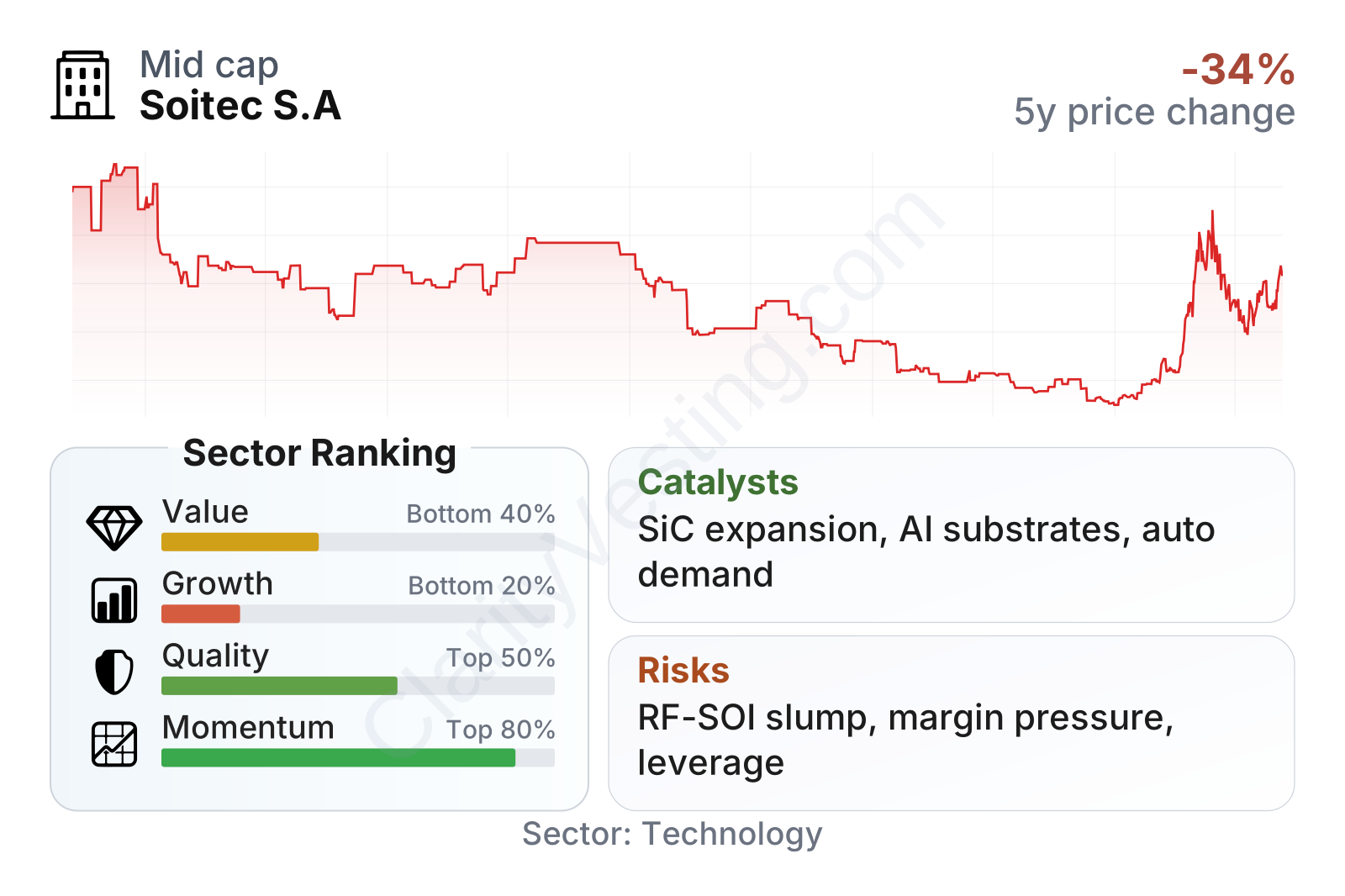
Soitec currently has a market value of about $4.8 billion, placing it in the mid-cap range rather than among the largest semiconductor names. The share price has been extremely volatile over the last several years: after a long decline from 2021 into late 2025, it rebounded sharply into early 2026. That kind of movement usually signals that the market is trying to price a business with strong long-term potential but weak near-term visibility.
The broader profile is mixed. On valuation, the stock screens cheaper than many technology peers on earnings multiples, but that comes after a major deterioration in growth and profitability. On growth and quality factors, its standing is weaker than much of the sector because revenue recently fell sharply, returns on capital are low at the moment, and margins have compressed. Momentum is the one area that looks notably stronger, reflecting the strong recent recovery in the share price.
Growth
Soitec operates in a sector with attractive long-term drivers. Semiconductor content keeps rising in smartphones, vehicles, connected devices, data centers, and power electronics. The company’s niche is especially relevant where chips need better energy efficiency, better radio performance, or improved thermal behavior. Those are not temporary themes. In that sense, the company remains exposed to structural growth areas even though current results are weak.
The strategy also makes sense on paper. Soitec has focused on engineered substrates rather than commodity wafers, and it has expanded beyond its historical smartphone concentration toward automotive, industrial power, and advanced computing. That diversification matters because the smartphone market is mature and cyclical. If management succeeds, the business mix should gradually become less dependent on one end market and more supported by longer-cycle applications such as electric vehicles, power conversion, and data infrastructure.
The problem is timing. The latest yearly revenue trend is deeply negative, far below the sector median. That does not automatically invalidate the long-term thesis, but it shows the company is still in a correction phase rather than a clean recovery. For long-horizon analysis, the key question is not whether the end markets are promising, but whether Soitec can turn those themes into consistent volume growth again after the recent setback.
Cash generation is a more encouraging point than earnings alone suggest. Free cash flow remains positive on a trailing basis, and over a longer five-year view it has grown faster than the sector median. That indicates the company still has some financial capacity to support investment and navigate the downturn. It does not erase the operational weakness, but it reduces the immediate pressure that would exist if both profits and cash flow had collapsed at the same time.
Recent company communications have highlighted ongoing work in silicon carbide and advanced substrate applications tied to automotive electrification and high-performance computing. These are meaningful catalysts because they target markets where performance requirements are rising and where specialized materials can command better economics than standard semiconductor inputs. If those programs scale as intended, they could help rebuild growth on a broader base than the legacy smartphone business.
Risks
This article is for informational purposes only and does not constitute financial advice. Some content is AI-generated. See Disclaimer


