Stock Analysis · Silgan Holdings Inc (SLGN)
Overview
Silgan Holdings is a packaging manufacturer focused on everyday consumer and healthcare products. Its containers and dispensing systems are used for food, beverages, household goods, personal care items, pharmaceuticals, and pet food. In simple terms, Silgan makes the metal cans, plastic containers, and pumps or sprayers that many large consumer brands need to get products onto store shelves.
The business is built around long production runs, close customer relationships, and packaging formats that are often essential rather than optional. That usually makes demand steadier than in many other consumer-related industries, even if volumes can still move with food consumption patterns, customer inventory swings, and raw material costs.
Based on recent company reporting, Silgan’s revenue comes mainly from three operating segments:
- Dispensing and Specialty Closures: about 42% to 45% of revenue. This segment includes dispensing pumps, sprayers, specialty closures, and attractive packaging used in fragrance, beauty, personal care, healthcare, home care, food, and beverage applications.
- Metal Containers: about 34% to 37% of revenue. This business mainly supplies steel and aluminum containers for shelf-stable food and pet food, along with ends and related components.
- Custom Containers: about 20% to 23% of revenue. This segment produces plastic containers for food, consumer health, home care, lawn and garden, and industrial uses.
That mix matters because Silgan is no longer only a traditional food can producer. Over time, it has added more dispensing and specialty packaging, which tends to broaden end markets and can support better margins than commodity-style container manufacturing.
The overall earnings picture shows a business with large raw-material and production costs relative to revenue, which is normal in packaging. The more notable trend is that operating income recovered after a weaker 2024 and improved again in 2025, while interest expense remained meaningful because the company carries a sizable debt load.
Key Figures
| Metric | Value | Sector ⓘ |
|---|---|---|
| Date | Sep 12, 2026 | |
| Context | ||
| Sector | Consumer Cyclical | |
| Industry | Packaging & Containers | |
| Market Cap ⓘ | $4.08B | |
| Beta ⓘ | 0.68 | |
Value (Cheapness) | ||
| P/E Ratio ⓘ | 15.07 | 17.10 |
| FCF Yield ⓘ | 8.41% | 8.53% |
| EBIT / EV ⓘ | N/A | 6.46% |
| PEG ⓘ | 0.84 | |
Growth (Business expansion) | ||
| Revenue Growth ⓘ | 6.80% | 5.75% |
| RPS Growth (5Y CAGR) ⓘ | 4.42% | 9.14% |
| EPS Growth (5Y CAGR) ⓘ | -20.76% | -18.21% |
| Margin Growth (5Y Trend) ⓘ | -0.90% | -0.23% |
| FCF Growth (5Y CAGR) ⓘ | 6.84% | 4.91% |
Quality (Business durability) | ||
| ROIC (Latest) ⓘ | N/A | 12.61% |
| ROIC (5Y Median) ⓘ | 7.13% | 10.72% |
| Net Debt / EBIT (Latest) ⓘ | N/A | 2.10 |
| Net Debt / EBIT (5Y Median) ⓘ | 5.92 | 2.32 |
| Operating Margin (Latest) ⓘ | N/A | 9.25% |
| Operating Margin (5Y Median) ⓘ | 9.22% | 9.64% |
| Debt to Equity (Latest) ⓘ | 203.15% | 75.78% |
| Profit Margin (Latest) ⓘ | 4.05% | 5.33% |
| Free Cash Flow (Latest) ⓘ | $342.75M | |
Momentum (Price trend) | ||
| 3Y Return ⓘ | -5.55% | +14.53% |
| 12M Return (excl. last month) ⓘ | -10.66% | +3.08% |
| 6M Return ⓘ | -4.29% | +0.55% |
| Price vs. 200-Day MA ⓘ | -6.87% | -0.54% |
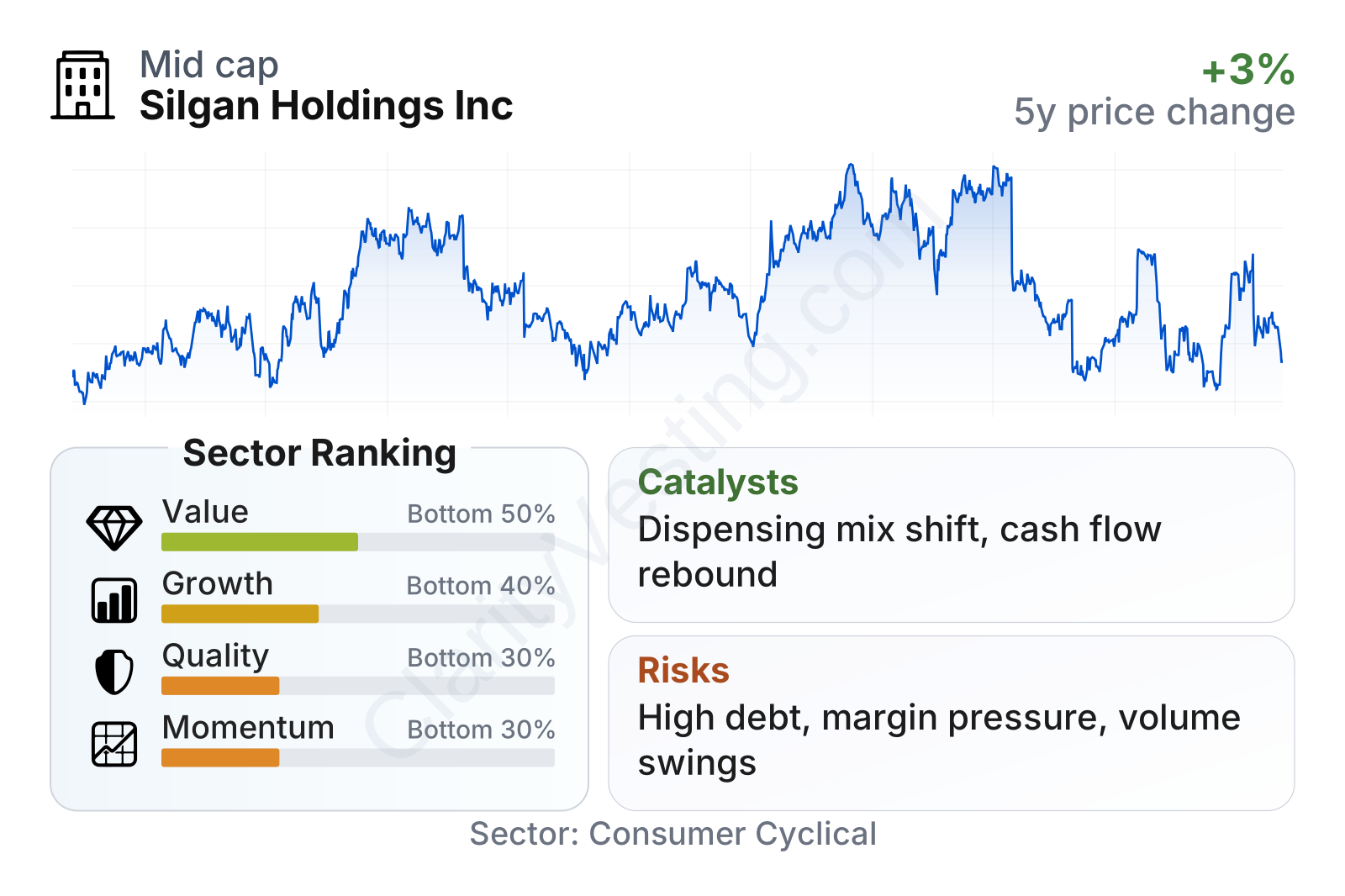
Silgan is a mid-sized packaging company with a relatively low beta, meaning its share price has historically moved less sharply than the broader market. On valuation, earnings multiples sit below the sector median, but that discount comes with trade-offs: growth ranks in the lower part of the sector over a multi-year view, profitability is below median, and leverage is clearly above average. Free cash flow remains an important strength, helping offset some of the weaker quality indicators.
The stock-price history also reflects that mixed picture. Shares had periods of strong performance through 2024 and early 2025, but momentum weakened afterward, which suggests the market became more cautious about growth durability, margins, or balance-sheet risk.
Growth
Silgan operates in a sector that is not usually associated with rapid expansion, but it can still produce steady long-term growth through market-share gains, product mix improvements, and acquisitions. Consumer packaging demand tends to be supported by recurring needs in food, household, healthcare, and personal care categories. That gives the company exposure to markets with ongoing demand rather than highly discretionary end uses.
The company’s strategy has generally made sense for long-term development. Silgan has spent years shifting part of its mix toward dispensing systems and specialty closures, which are usually more differentiated than standard containers. Those products can carry better economics because customers care about functionality, design, and product compatibility, not just unit price. The company has also used acquisitions as a major growth tool, especially in dispensing and specialty packaging.
Recent sales trends show why Silgan can look uneven from one period to the next. Revenue growth was strong in 2022, turned negative through much of 2023 and part of 2024, then rebounded in late 2024 and 2025 before another sharp decline in the latest reading. For a packaging company, this kind of pattern can reflect both acquisition effects and customer inventory changes rather than a simple deterioration in end demand. Even so, it shows that Silgan is not delivering smooth, linear expansion.
Cash generation is a more encouraging part of the picture. Free cash flow has improved materially over time, with a particularly strong jump in the latest trailing period. For a manufacturer with meaningful capital needs and debt obligations, this matters a lot. Stronger cash flow can support debt reduction, dividends, buybacks, and acquisition capacity without relying as heavily on external financing.
A visible catalyst for Silgan remains the continued expansion of dispensing and specialty closures. This segment benefits from customer demand for convenience features, premium packaging, and product differentiation in beauty, fragrance, healthcare, and home care. Another catalyst is operational recovery after weaker periods in food and consumer packaging volumes. If demand normalizes while the company keeps cost discipline, earnings can improve even without dramatic industry growth.
Recent company updates have also pointed to ongoing portfolio refinement and efforts to integrate acquired businesses. That can create opportunity if Silgan keeps lifting the share of its sales that comes from higher-value packaging formats rather than relying mainly on mature can volumes.
Risks
This article is for informational purposes only and does not constitute financial advice. Some content is AI-generated. See Disclaimer


