Stock Analysis · Silicon Laboratories Inc (SLAB)
Overview
Silicon Laboratories is a semiconductor company focused on wireless connectivity for the Internet of Things, often shortened to IoT. In simple terms, it designs chips, software, and development tools that help everyday products connect to networks and communicate with other devices. Its technology is used in areas such as smart homes, industrial automation, smart buildings, connected health products, asset tracking, and utility infrastructure.
The company has become much more specialized over the past few years. After selling other businesses, Silicon Labs is now centered on low-power wireless chips and related software. That makes it easier to understand than many diversified chip companies: its future depends largely on whether more devices around the world need secure, energy-efficient wireless connections.
Based on the company’s recent filings, revenue is primarily generated from wireless IoT products and related support, with a strong concentration in connected-device applications rather than broad consumer electronics.
- Wireless products and solutions: approximately 100% of revenue. This includes system-on-chip and microcontroller products, modules, security software, protocol stacks, and development tools used for standards such as Zigbee, Thread, Matter, Bluetooth, Wi-Fi, and proprietary wireless technologies.
- Geographic exposure: the business is sold globally through direct customers and distribution partners, with meaningful exposure to industrial and commercial end markets rather than a single consumer product cycle.
One notable financial pattern is that gross profit remains sizeable even after the 2024 downturn, showing that the company still has healthy product economics before operating expenses. The problem has been that research and development spending stayed very high while revenue dropped, which pushed operating income and net income into negative territory. In 2025, revenue recovered materially, but profitability had not fully caught up.
Key Figures
| Metric | Value | Sector ⓘ |
|---|---|---|
| Date | Sep 12, 2026 | |
| Context | ||
| Sector | Technology | |
| Industry | Semiconductors | |
| Market Cap ⓘ | $7.35B | |
| Beta ⓘ | 1.36 | |
Value (Cheapness) | ||
| P/E Ratio ⓘ | N/A | 29.51 |
| FCF Yield ⓘ | -0.07% | 4.25% |
| EBIT / EV ⓘ | -0.46% | 2.85% |
| PEG ⓘ | 3.12 | |
Growth (Business expansion) | ||
| Revenue Growth ⓘ | 18.30% | 15.40% |
| RPS Growth (5Y CAGR) ⓘ | 10.19% | 8.56% |
| EPS Growth (5Y CAGR) ⓘ | -76.50% | -11.88% |
| Margin Growth (5Y Trend) ⓘ | N/A | 0.46% |
| FCF Growth (5Y CAGR) ⓘ | N/A | 9.80% |
Quality (Business durability) | ||
| ROIC (Latest) ⓘ | -2.25% | 9.44% |
| ROIC (5Y Median) ⓘ | -1.18% | 8.30% |
| Net Debt / EBIT (Latest) ⓘ | N/A | 0.54 |
| Net Debt / EBIT (5Y Median) ⓘ | N/A | 0.44 |
| Operating Margin (Latest) ⓘ | -3.68% | 9.58% |
| Operating Margin (5Y Median) ⓘ | -3.77% | 8.25% |
| Debt to Equity (Latest) ⓘ | N/A | 33.33% |
| Profit Margin (Latest) ⓘ | -4.57% | 7.14% |
| Free Cash Flow (Latest) ⓘ | -$5.43M | |
Momentum (Price trend) | ||
| 3Y Return ⓘ | +80.84% | +45.48% |
| 12M Return (excl. last month) ⓘ | +67.21% | +23.48% |
| 6M Return ⓘ | +9.04% | +20.93% |
| Price vs. 200-Day MA ⓘ | +12.36% | +7.43% |
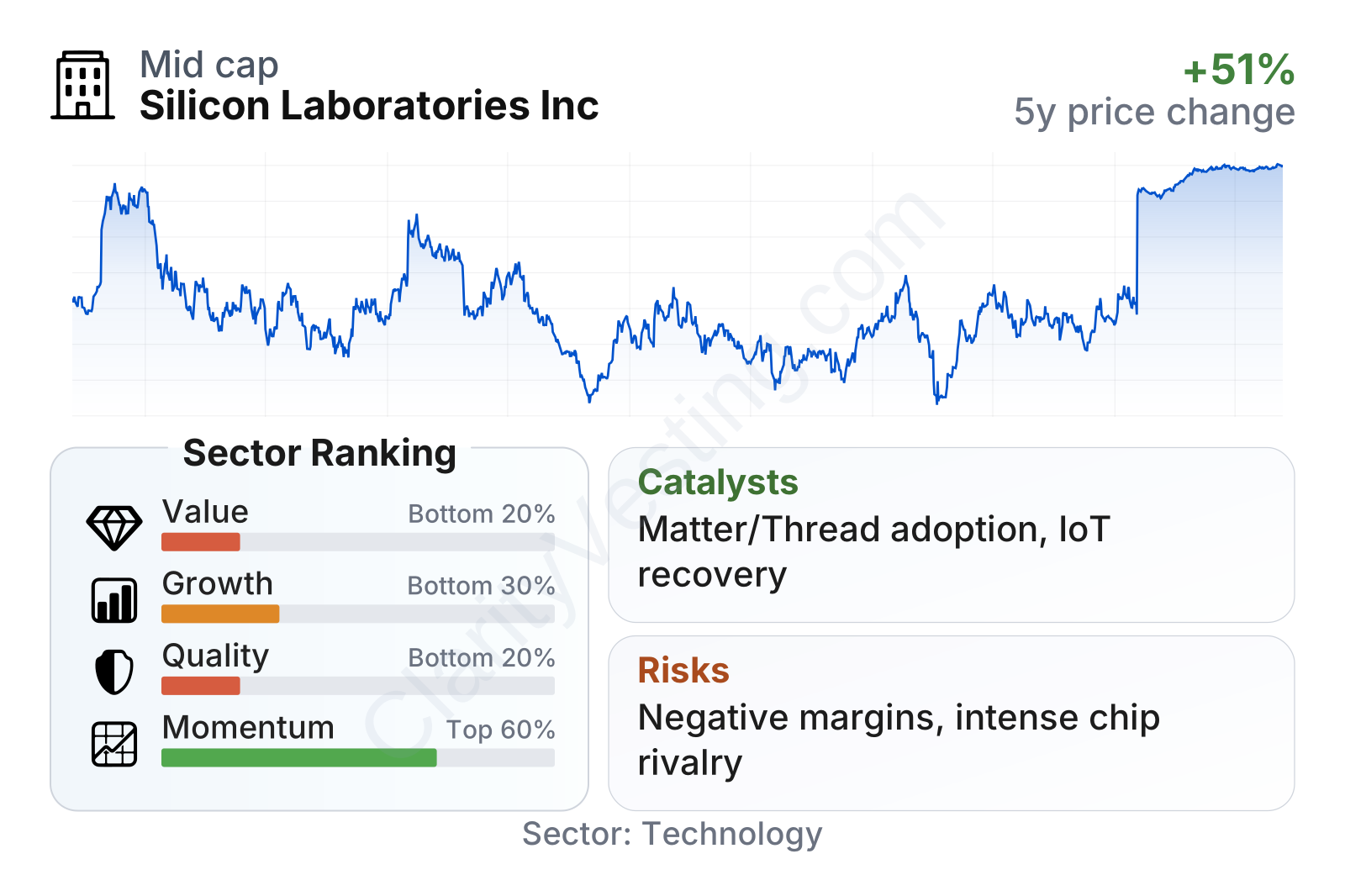
Silicon Labs is a mid-sized semiconductor company with a stock that has been volatile, which is common for specialized chip names. Its recent share-price performance has been strong over longer periods, but the underlying fundamentals still look mixed. Growth has improved again, yet profitability, cash generation, and returns on capital remain weaker than the sector median. The factor summary reflects that contrast: momentum is relatively solid, while value, quality, and overall business efficiency still rank in the lower part of the semiconductor group.
Growth
Silicon Labs operates in a sector that still has a credible long-term tailwind. The IoT market continues to expand as more buildings, factories, appliances, meters, sensors, and medical devices add connectivity. A particularly important trend is the shift toward low-power, always-connected devices that can run for long periods on small batteries. That is exactly where Silicon Labs has positioned itself.
Its strategy also makes sense in that context. Rather than competing everywhere in semiconductors, the company has narrowed its focus to wireless IoT. That gives it a clearer product roadmap around connected edge devices, software integration, security, and support for multiple communication standards. This specialization can matter because many customers want not only a chip, but also ready-to-use software, certification support, and interoperability across ecosystems.
The recent revenue pattern looks like a classic semiconductor inventory cycle followed by recovery. Sales fell sharply through 2023 and much of 2024, then rebounded strongly from late 2024 onward. Growth has moderated from the initial rebound, but recent year-over-year gains have still remained in the high-teens to around 20% range, slightly above the sector median. That suggests the recovery is real, even if it is no longer in the snapback phase.
Cash generation has also improved from deeply negative levels seen during the downturn. Free cash flow turned positive in 2025 and remained positive more recently, although at a much lower level than would normally be expected from a fully healthy semiconductor business. This is encouraging because it shows the recovery is reaching cash flow, not just revenue, but it also indicates that the company is still in a rebuilding phase rather than a fully normalized earnings cycle.
Several business catalysts stand out. Matter and Thread adoption in smart home products can support demand for Silicon Labs’ multi-protocol wireless chips. Industrial automation and smart infrastructure are another important opportunity because these end markets often value reliability, long product lifecycles, and low-power performance more than the lowest possible chip price. In addition, the company has continued to release new Series 3 platform products and software tools aimed at AI-enabled edge devices and more capable connected products, which could expand its content per device over time.
Recent company updates have also pointed to improving customer inventory conditions and a broader recovery in demand across IoT categories. That matters because the sharp downturn was not caused only by lost competitiveness; it was also driven by customers working through excess inventory. As those conditions normalize, Silicon Labs has a better chance to convert design wins into shipments.
Risks
This article is for informational purposes only and does not constitute financial advice. Some content is AI-generated. See Disclaimer


