Stock Analysis · Skywater Technology Inc (SKYT)
Overview
SkyWater Technology is a U.S.-based semiconductor manufacturer. In simple terms, it makes chips for customers that need specialized production rather than the very largest mass-market chip factories. The company presents itself as a domestic, trusted foundry and technology partner, which matters in areas such as aerospace and defense, industrial systems, and other applications where supply-chain security, customization, and U.S. manufacturing can be important.
Its business is not centered on one blockbuster consumer chip. Instead, SkyWater works across manufacturing, engineering, and technology services. That makes the company different from giant semiconductor names that mainly win through scale and leading-edge production. SkyWater’s role is more focused on specialized process technologies, development programs, and production for customers that need flexibility and often long product life cycles.
Based on company reporting, revenue is mainly organized into two segments.
- Wafer Services, about 80% to 90% of revenue: this is the larger activity and includes semiconductor manufacturing services, such as producing wafers for customers using SkyWater’s fabrication capabilities.
- Advanced Technology Services, about 10% to 20% of revenue: this includes development work, process transfer, co-development programs, and engineering services tied to specialized technologies and customer programs.
Within that mix, the company has highlighted demand tied to government, aerospace and defense, industrial, and other specialized end markets rather than heavy exposure to mainstream smartphone or PC chip cycles. The business model is therefore a blend of manufacturing volume and higher-value technical collaboration.
The long-term financial progression has been notable: revenue rose from roughly $163 million in 2021 to about $442 million in 2025, while gross profit moved from negative territory to a clearly positive level. That shift suggests a business becoming larger and more economically viable, although its cash generation still remains uneven.
The operating picture improved sharply over the last several years. Revenue expanded strongly, gross profit turned positive, and operating income swung from losses to a solid profit by 2025. The main point is that SkyWater is no longer just trying to scale revenue; it has started to show that higher sales can translate into much better profitability, at least on an accounting basis.
Key Figures
| Metric | Value | Sector ⓘ |
|---|---|---|
| Date | Sep 12, 2026 | |
| Context | ||
| Sector | Technology | |
| Industry | Semiconductors | |
| Market Cap ⓘ | $1.60B | |
| Beta ⓘ | 3.27 | |
Value (Cheapness) | ||
| P/E Ratio ⓘ | 13.87 | 29.51 |
| FCF Yield ⓘ | -6.22% | 4.25% |
| EBIT / EV ⓘ | 5.56% | 2.85% |
| PEG ⓘ | N/A | |
Growth (Business expansion) | ||
| Revenue Growth ⓘ | 164.80% | 15.40% |
| RPS Growth (5Y CAGR) ⓘ | 22.07% | 8.56% |
| EPS Growth (5Y CAGR) ⓘ | -48.50% | -11.88% |
| Margin Growth (5Y Trend) ⓘ | N/A | 0.46% |
| FCF Growth (5Y CAGR) ⓘ | -11.74% | 9.80% |
Quality (Business durability) | ||
| ROIC (Latest) ⓘ | 41.60% | 9.44% |
| ROIC (5Y Median) ⓘ | -1.05% | 8.30% |
| Net Debt / EBIT (Latest) ⓘ | 2.26 | 0.54 |
| Net Debt / EBIT (5Y Median) ⓘ | N/A | 0.44 |
| Operating Margin (Latest) ⓘ | 17.65% | 9.58% |
| Operating Margin (5Y Median) ⓘ | -0.85% | 8.25% |
| Debt to Equity (Latest) ⓘ | 5.52% | 33.33% |
| Profit Margin (Latest) ⓘ | 18.40% | 7.14% |
| Free Cash Flow (Latest) ⓘ | -$99.29M | |
Momentum (Price trend) | ||
| 3Y Return ⓘ | +231.90% | +45.48% |
| 12M Return (excl. last month) ⓘ | +253.86% | +23.48% |
| 6M Return ⓘ | -3.51% | +20.93% |
| Price vs. 200-Day MA ⓘ | +16.99% | +7.43% |
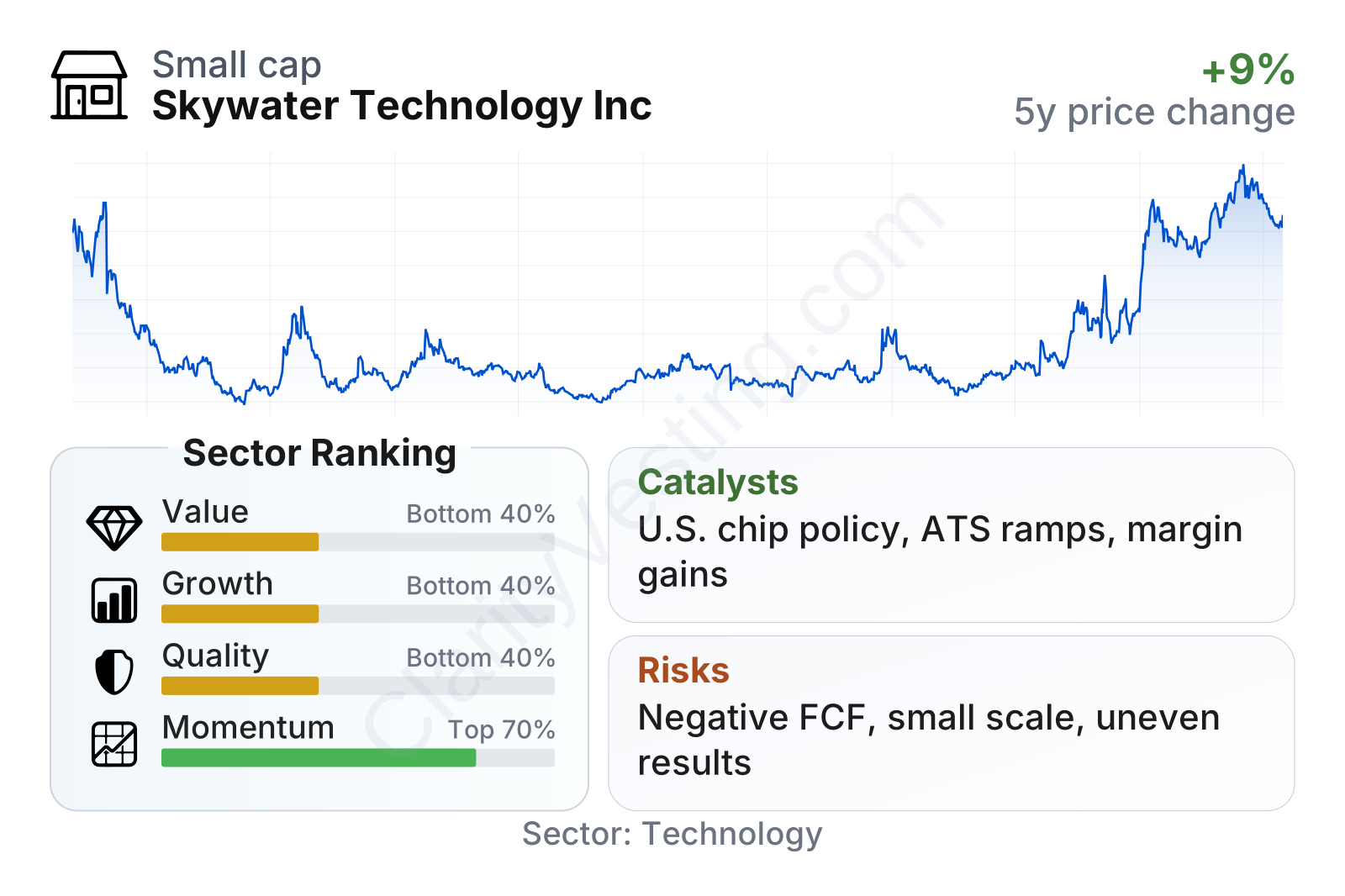
SkyWater is still a relatively small public semiconductor company, and the stock has been highly volatile. After a steep drop following its early public-market period, the shares later recovered dramatically, which fits a business that has shifted from persistent losses toward reported profitability. In the factor summary, valuation looks inexpensive versus much of the semiconductor sector on earnings, but that is offset by weak free cash flow and a still-mixed growth and quality profile. Momentum has been strong over longer periods, yet the company’s high beta shows that the stock can move far more sharply than the broader market.
Growth
SkyWater operates in a part of the semiconductor market that is supported by durable themes: domestic chip production, supply-chain resilience, specialty manufacturing, and U.S. government interest in rebuilding strategic semiconductor capacity. That does not make growth automatic, but it does place the company in an area where industry support and customer demand can remain active for years.
The company’s strategy is also logical for its size. Rather than competing head-on with the largest foundries at the most advanced nodes, SkyWater focuses on specialized processes, customer collaboration, and U.S.-based manufacturing. For many clients, especially in defense, industrial, and regulated applications, a trusted domestic partner can matter more than using the absolute smallest transistor technology. That gives SkyWater a narrower but potentially durable lane.
Recent growth has been very strong, with year-over-year revenue expansion accelerating sharply after a weaker stretch in 2025. Over a five-year view, revenue per share growth has also been well above the sector median. This suggests that recent momentum is not only a short-term bounce, but part of a broader scaling trend. The challenge is that revenue growth has not yet translated into consistently smooth business performance from quarter to quarter.
Cash generation remains the more complicated part of the growth case. Free cash flow improved meaningfully and even turned positive for a period, but it moved back into deeply negative territory more recently. For a capital-intensive chip manufacturer, that can happen when spending rises for capacity, equipment, or program execution. Even so, it means growth is currently more convincing on revenue and earnings than on steady cash conversion.
A major catalyst is the broader U.S. semiconductor policy environment. Public programs aimed at strengthening domestic production and secure supply chains can create opportunities for a company with existing U.S. manufacturing infrastructure and a specialty-foundry profile. In addition, SkyWater has emphasized strategic customer and technology relationships in recent company communications, which can support future production ramps if those programs move from development into larger commercial volumes.
Another positive signal is the company’s move from long-running losses toward much stronger operating margins and net margins in the most recent periods. If that improvement is supported by repeatable customer demand rather than one-off items, it could materially change how the market judges the business over time.
Risks
This article is for informational purposes only and does not constitute financial advice. Some content is AI-generated. See Disclaimer


