Stock Analysis · Seek Ltd (SKLTY)
Overview
Seek Ltd is an online employment marketplace company best known for connecting job seekers with employers. Its core business is digital job advertising, but the group has broadened its platform into adjacent services such as talent sourcing, employer branding, and education-related activities. While the U.S. listing SKLTY is an ADR, the underlying business is primarily exposed to Australia, New Zealand, and selected Asian markets.
The company’s revenue base is still centered on employment classifieds and recruitment solutions. Based on recent company reporting and segment disclosures, the business mix is broadly concentrated in the following areas:
- Employment marketplace operations in Australia and New Zealand: approximately 60% to 70% of group revenue. This includes job ads, recruiter tools, employer subscriptions, and related hiring products.
- Asian employment platforms: approximately 20% to 30% of revenue. This reflects Seek’s interests in online job platforms across parts of Asia, where scale and profitability can vary by market.
- Education and other services: approximately 5% to 15% of revenue. This includes training, career-related services, and smaller corporate activities depending on the reporting period.
What stands out in the business model is that Seek operates a platform with meaningful recurring demand from employers. Hiring activity moves with the economy, but digital job matching remains an essential service. Over time, this can produce strong cash generation when volumes are healthy and costs are controlled.
Recent operating flows also show a business that recovered revenue after a difficult 2024 period, with sales rising into fiscal 2026 while operating income stayed positive. At the same time, the path from operating profit to net income has been less smooth, suggesting that non-operating items, financing costs, and one-off charges still matter for the final result.
The broad financial picture suggests a company with high gross profit characteristics, moderate cost intensity at the platform level, and earnings that can swing materially below the operating line. That combination is typical of digital marketplace businesses that are profitable at the core level but still exposed to valuation changes, restructuring, and macro-sensitive hiring cycles.
Key Figures
| Metric | Value | Sector ⓘ |
|---|---|---|
| Date | Sep 12, 2026 | |
| Context | ||
| Sector | Communication Services | |
| Industry | Internet Content & Information | |
| Market Cap ⓘ | $3.15B | |
| Beta ⓘ | 0.91 | |
Value (Cheapness) | ||
| P/E Ratio ⓘ | N/A | 18.61 |
| FCF Yield ⓘ | 27.71% | 13.68% |
| EBIT / EV ⓘ | 12.63% | 4.54% |
| PEG ⓘ | 2.99 | |
Growth (Business expansion) | ||
| Revenue Growth ⓘ | 20.60% | 5.40% |
| RPS Growth (5Y CAGR) ⓘ | 2.90% | 4.62% |
| EPS Growth (5Y CAGR) ⓘ | 0.94% | -18.01% |
| Margin Growth (5Y Trend) ⓘ | -10.86% | 1.10% |
| FCF Growth (5Y CAGR) ⓘ | 10.08% | 5.88% |
Quality (Business durability) | ||
| ROIC (Latest) ⓘ | N/A | 8.38% |
| ROIC (5Y Median) ⓘ | 7.41% | 8.32% |
| Net Debt / EBIT (Latest) ⓘ | 1.95 | 1.99 |
| Net Debt / EBIT (5Y Median) ⓘ | 3.32 | 2.94 |
| Operating Margin (Latest) ⓘ | 23.81% | 14.89% |
| Operating Margin (5Y Median) ⓘ | 30.03% | 12.96% |
| Debt to Equity (Latest) ⓘ | 59.53% | 59.59% |
| Profit Margin (Latest) ⓘ | -28.91% | 8.77% |
| Free Cash Flow (Latest) ⓘ | $873.44M | |
Momentum (Price trend) | ||
| 3Y Return ⓘ | -32.96% | +46.64% |
| 12M Return (excl. last month) ⓘ | -37.10% | +2.16% |
| 6M Return ⓘ | -14.23% | +5.05% |
| Price vs. 200-Day MA ⓘ | -20.43% | +2.88% |
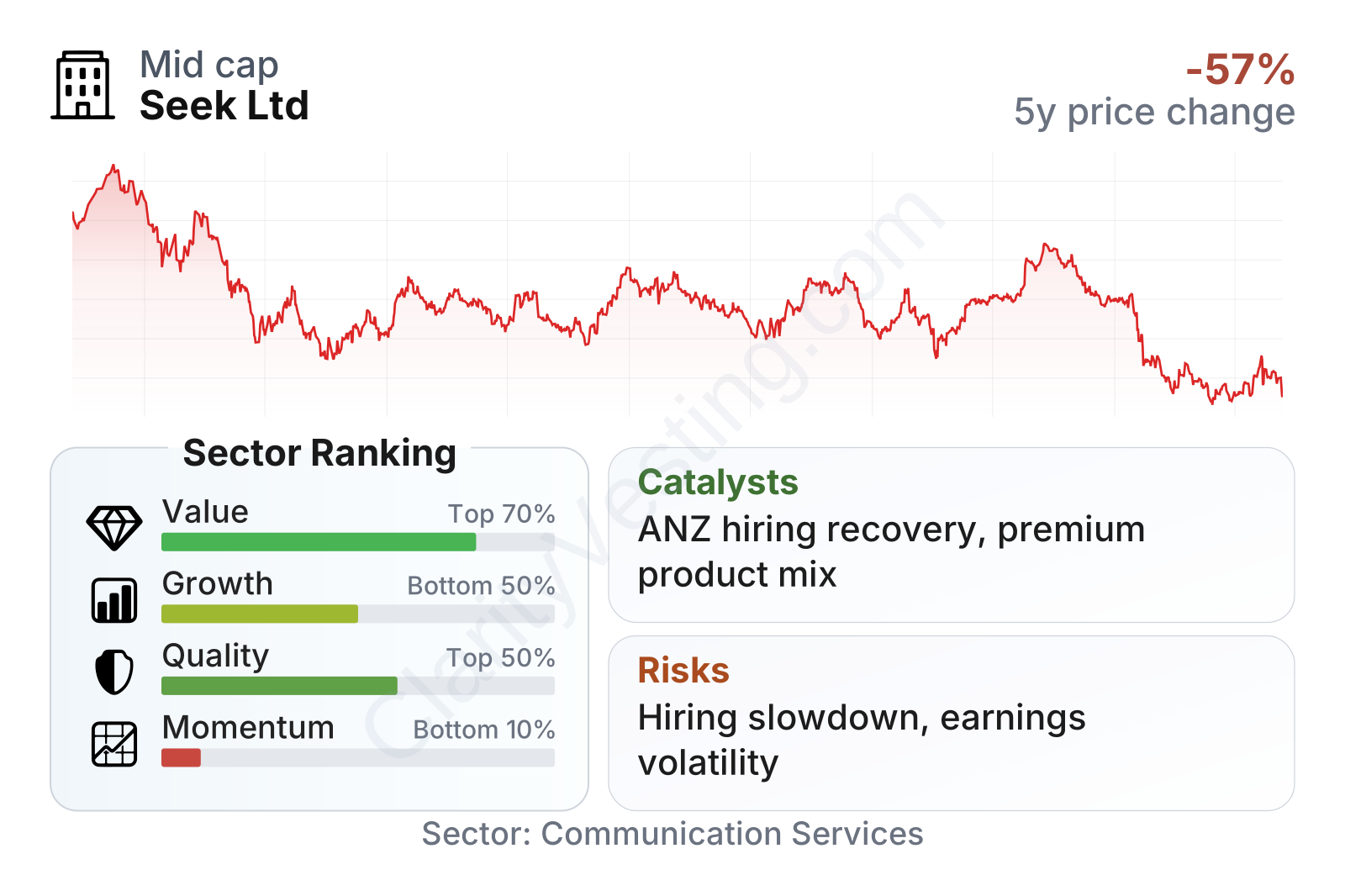
Seek is a mid-sized listed company with relatively modest share-price volatility compared with many internet businesses. On valuation and cash generation, it screens better than much of its sector: free cash flow yield and EBIT relative to enterprise value are comfortably ahead of the sector median. Growth and quality are closer to the middle of the pack overall, but with some strong sub-metrics such as operating margin and cash flow expansion. The weakest area is momentum, where the stock has materially lagged the broader sector over recent months and over a multi-year period.
Growth
Seek operates in a sector with long-term structural support. Recruitment continues to move online, employers increasingly rely on software tools to screen and manage candidates, and labor markets remain more dynamic than they were a decade ago. That creates room for platforms that already have strong traffic, established employer relationships, and recognizable brands.
Its strategy also makes sense for future expansion. The company is not simply selling job ads; it has been building a broader hiring ecosystem around candidate matching, recruiter productivity, and premium employer services. This matters because job boards can become commoditized if they only compete on listings. A deeper product stack can raise customer retention and support better pricing.
Recent growth has been encouraging. Year-over-year revenue growth is running well above the sector median, showing that the business has recently reaccelerated after a more uneven period. That is especially important because Seek’s longer five-year revenue-per-share growth has been more moderate, so the latest improvement suggests that current initiatives and market conditions are helping offset earlier softness.
Cash generation has strengthened noticeably. Trailing free cash flow has climbed sharply from late 2024 to mid-2025, and the latest annualized figure remains very strong. For a digital platform, that is a meaningful signal because free cash flow gives a clearer view of how much financial flexibility the business has for debt reduction, product investment, acquisitions, or shareholder returns.
A practical catalyst is the company’s leverage to employment activity in its main markets. If hiring volumes remain resilient in Australia and New Zealand, Seek can benefit quickly because marketplace economics tend to scale well. Another useful catalyst is product mix: higher-value recruiter tools and matching solutions can lift revenue even without dramatic increases in job ad volumes. In Asia, improved execution or stronger profitability from strategic holdings could also become an additional driver if those markets mature more favorably.
Risks
This article is for informational purposes only and does not constitute financial advice. Some content is AI-generated. See Disclaimer


