Stock Analysis · SJM Holdings Ltd (SJMHF)
Overview
SJM Holdings Ltd is a Macau-based casino and hospitality company. It operates gaming tables, slot machines, hotel rooms, food and beverage outlets, retail space, and related entertainment facilities. The group is closely associated with the Grand Lisboa brand and is one of the long-established names in Macau gaming, a market that depends heavily on tourism from mainland China, Hong Kong, and nearby Asian regions.
The business is still mainly driven by casino activity, while hotels, restaurants, and other non-gaming services play a supporting role. Based on the company’s recent annual reporting structure and Macau industry disclosures, revenue is largely generated from the following areas:
- Gaming revenue: approximately 85% to 90% of total revenue. This includes mass-market table games, slot machines, and VIP-related gaming activity where applicable. Mass-market play has become the most important part of Macau’s post-pandemic recovery.
- Hotel, food and beverage, and mall or rental-related income: approximately 10% to 15%. This includes hotel rooms, restaurants, catering, retail leasing, and other resort services linked to its integrated properties.
Within gaming, market-wide industry trends suggest that mass-market and premium-mass play matter more than traditional junket-driven VIP business than they did several years ago. That shift is important because it changes what makes a casino operator successful: location, property quality, hotel capacity, and customer experience now matter more than access to junket networks.
The income profile also shows that revenue recovered strongly from 2022 into 2024, but profit conversion stayed weak because operating costs and interest expense remained heavy. Revenue has therefore improved faster than shareholder returns.
The broad pattern is a sharp recovery in revenue and gross profit after the pandemic trough, but with profitability still restrained by high operating expenses and financing costs. That helps explain why the company could return to roughly break-even at the net income level in 2024 and then slip back into a small loss afterward.
Key Figures
| Metric | Value | Sector ⓘ |
|---|---|---|
| Date | Nov 21, 2026 | |
| Context | ||
| Sector | Consumer Cyclical | |
| Industry | Resorts & Casinos | |
| Market Cap ⓘ | $994.25M | |
| Beta ⓘ | 0.63 | |
Value (Cheapness) | ||
| P/E Ratio ⓘ | N/A | 17.13 |
| P/B Ratio ⓘ | N/A | 2.72 |
| FCF Yield ⓘ | 14.67% | 7.52% |
| Dividend Yield ⓘ | N/A | 2.43% |
| EBIT / EV ⓘ | 7.10% | 7.11% |
| PEG ⓘ | 0.04 | |
Growth (Business expansion) | ||
| Revenue Growth ⓘ | -20.80% | 5.30% |
| RPS Growth (5Y CAGR) ⓘ | 24.76% | 8.77% |
| EPS Growth (5Y CAGR) ⓘ | N/A | -11.05% |
| BVPS Growth (5Y CAGR) ⓘ | -13.83% | 5.47% |
| Margin Growth (5Y Trend) ⓘ | N/A | -0.16% |
| FCF Growth (5Y CAGR) ⓘ | N/A | 5.66% |
| DPS Growth (5Y CAGR) ⓘ | 1.17% | 9.76% |
Quality (Business durability) | ||
| ROIC (Latest) ⓘ | 5.12% | 11.36% |
| ROA (Latest) ⓘ | -1.12% | 5.53% |
| ROIC (5Y Median) ⓘ | -0.27% | 10.58% |
| ROA (5Y Median) ⓘ | -3.93% | 5.35% |
| Net Debt / EBIT (Latest) ⓘ | 11.13 | 2.11 |
| Net Debt / EBIT (5Y Median) ⓘ | N/A | 2.24 |
| Net Debt / EBITDA (Latest) ⓘ | 4.30 | 1.51 |
| Net Debt / Assets ⓘ | 56.67% | 21.74% |
| EBITDA / Interest ⓘ | 1.93 | 9.63 |
| Operating Margin (Latest) ⓘ | 6.77% | 9.20% |
| Operating Margin (5Y Median) ⓘ | -1.21% | 9.64% |
| Debt to Equity (Latest) ⓘ | 237.05% | 74.26% |
| Profit Margin (Latest) ⓘ | -2.16% | 5.47% |
| Free Cash Flow (Latest) ⓘ | $145.81M | |
Momentum (Price trend) | ||
| 3Y Return ⓘ | -57.96% | +15.79% |
| 12M Return (excl. last month) ⓘ | -47.22% | -0.63% |
| 6M Return ⓘ | -44.00% | +1.17% |
| Price vs. 200-Day MA ⓘ | -39.04% | +0.36% |
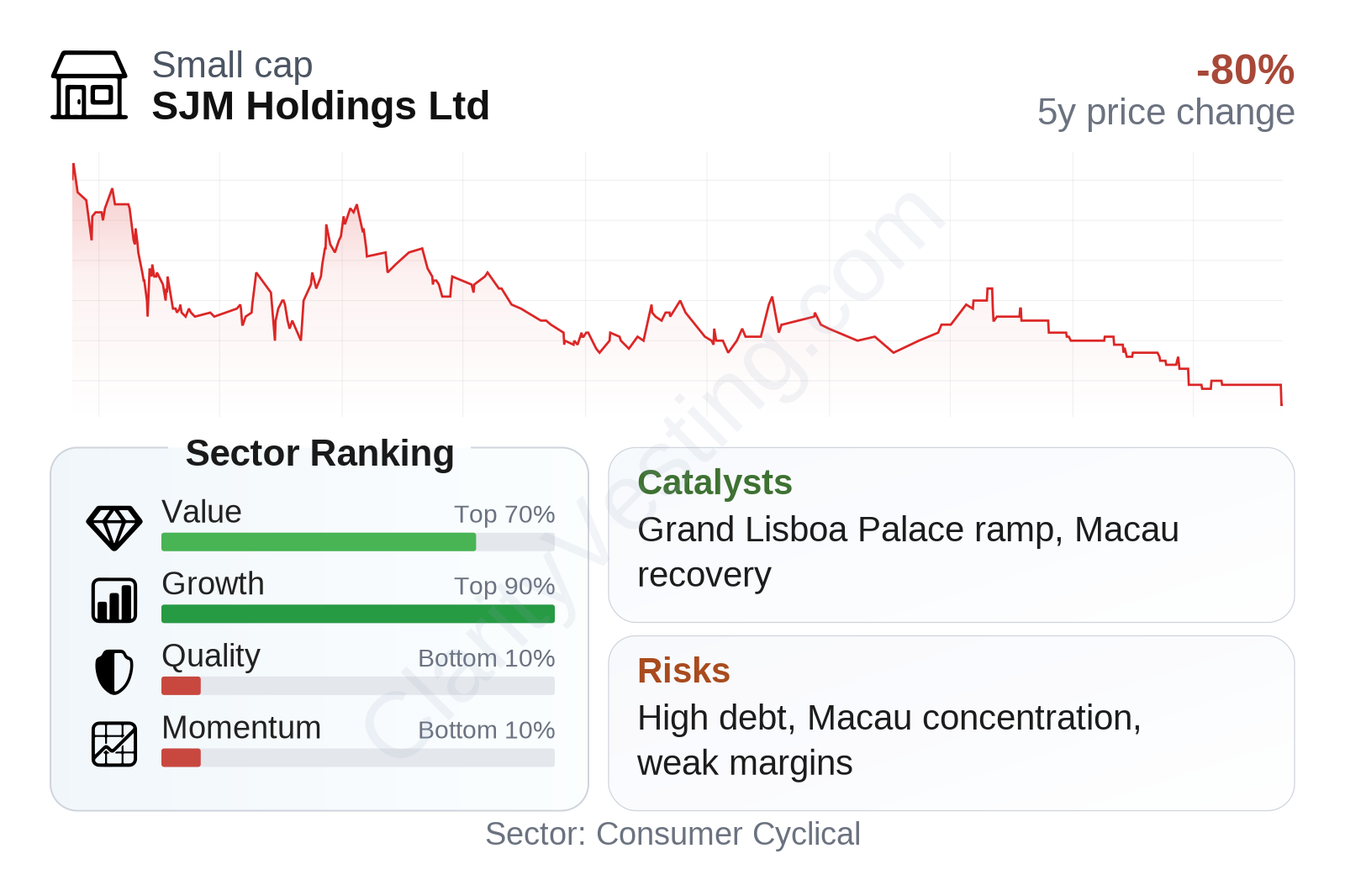
SJM Holdings is now a relatively small listed company by market value, and the share price trend has been notably weak over the last several years. The stock has fallen substantially from its 2021 level and remains far below its longer-term average, reflecting investor caution around Macau demand, debt, and earnings quality.
The metric profile is mixed. On valuation, the company looks inexpensive on cash-flow-based measures, with free cash flow yield above the sector median and an EBIT-to-enterprise-value level roughly in line with peers. Growth characteristics are more complicated: the latest year shows a revenue decline of about 21%, yet the five-year revenue-per-share growth rate remains strong because of the rebound from depressed pandemic levels. The weakest area is business quality, where returns on assets and invested capital trail the sector, while leverage is much higher than average. Momentum is also poor, with recent price performance ranking near the bottom of the sector.
Growth
SJM operates in a sector that can grow over the long run, but it is not a smooth growth industry. Macau gaming benefits from structural drivers such as rising regional wealth, tourism flows, premium leisure spending, and limited licensed capacity in one of the world’s most concentrated casino markets. At the same time, results are highly cyclical because they depend on travel conditions, consumer confidence, regulation, and the pace of recovery in mainland Chinese visitation.
The company’s strategy makes sense in principle. Macau has been moving toward a more diversified resort model, and SJM has been expanding beyond pure gaming through hotel rooms, dining, retail, and entertainment. This is especially relevant for Grand Lisboa Palace, which is intended to strengthen the group’s position in Cotai, the part of Macau that captures much of the premium tourist traffic and integrated-resort demand. A stronger presence in Cotai matters because older city-center casino assets are less naturally aligned with where large-scale tourism spending has migrated.
One potentially important catalyst is the gradual improvement in utilization at Grand Lisboa Palace and related non-gaming facilities. If room occupancy, retail traffic, and mass-market gaming volumes continue to build, operating leverage could improve because a portion of resort costs is fixed. Another positive factor is that Macau’s post-reopening environment has favored mass-market play over junket-led VIP gaming, which can produce a healthier and more stable revenue mix for operators that execute well on property quality and customer capture.
Recent company communications and Macau government disclosures have also highlighted ongoing investment commitments under the renewed gaming concession framework. Those commitments can support future foot traffic if they translate into better entertainment offerings, tourism appeal, and property upgrades. For SJM, the key question is not whether Macau can recover further, but whether the company can capture enough of that recovery to improve margins meaningfully.
Risks
This article is for informational purposes only and does not constitute financial advice. Some content is AI-generated. See Disclaimer