Stock Analysis · Sitime Corporation (SITM)
Overview
SiTime Corporation designs and sells precision timing products used in electronic systems. In simple terms, its chips help devices keep highly accurate time and stable frequency, which is essential for communications, data transfer, processing, and synchronization. The company positions its products as modern replacements for older quartz-based timing parts, using MEMS, analog, and software-based technologies to improve performance, size, durability, and power efficiency.
Its products are used across a wide range of end markets, including communications infrastructure, data centers, industrial equipment, automotive electronics, aerospace, mobile devices, and Internet of Things applications. This matters because timing parts are small in cost compared with the full system, but they can be critical to reliability and performance.
SiTime reports revenue mainly from product sales rather than from separate service lines. Based on company disclosures, revenue is best understood by end market exposure rather than by a large number of business segments, since the company operates as a single segment.
- Communications, enterprise, and data center applications — the largest revenue contributor in recent periods. This includes networking equipment, cloud and AI infrastructure, and other high-performance systems that require precise synchronization.
- Industrial, automotive, and aerospace — a meaningful and growing source of sales, supported by demand for robust components that can operate in harsh environments.
- Mobile, consumer, and IoT devices — a smaller but still relevant contributor, covering smartphones, wearables, connected devices, and other compact electronics.
Because SiTime does not regularly provide a precise public percentage split for every one of these categories in each filing, any detailed breakdown beyond this level would be too uncertain for a general long-term review. The important point is that the business is tied to broad electronics demand, with increasing exposure to infrastructure and higher-value applications.
The company’s financial profile shows a business that went through a sharp downturn in 2023, then began recovering with much faster revenue growth through 2025 and into 2026. Gross profit has remained meaningful, but operating costs have stayed elevated because SiTime continues to spend heavily on research and go-to-market expansion.
The long-term pattern is easy to understand: revenue fell hard in the industry slowdown, then rebounded strongly, while research and development and selling expenses kept rising throughout the cycle. That combination explains why growth has returned faster than profitability.
Key Figures
| Metric | Value | Sector ⓘ |
|---|---|---|
| Date | Sep 12, 2026 | |
| Context | ||
| Sector | Technology | |
| Industry | Semiconductors | |
| Market Cap ⓘ | $19.04B | |
| Beta ⓘ | 2.86 | |
Value (Cheapness) | ||
| P/E Ratio ⓘ | N/A | 29.51 |
| FCF Yield ⓘ | 0.30% | 4.25% |
| EBIT / EV ⓘ | 0.03% | 2.85% |
| PEG ⓘ | 3.82 | |
Growth (Business expansion) | ||
| Revenue Growth ⓘ | 126.50% | 15.40% |
| RPS Growth (5Y CAGR) ⓘ | 6.04% | 8.56% |
| EPS Growth (5Y CAGR) ⓘ | -8.33% | -11.88% |
| Margin Growth (5Y Trend) ⓘ | N/A | 0.46% |
| FCF Growth (5Y CAGR) ⓘ | 8.23% | 9.80% |
Quality (Business durability) | ||
| ROIC (Latest) ⓘ | 0.52% | 9.44% |
| ROIC (5Y Median) ⓘ | -3.56% | 8.30% |
| Net Debt / EBIT (Latest) ⓘ | -121.25 | 0.54 |
| Net Debt / EBIT (5Y Median) ⓘ | N/A | 0.44 |
| Operating Margin (Latest) ⓘ | 1.06% | 9.58% |
| Operating Margin (5Y Median) ⓘ | -12.95% | 8.25% |
| Debt to Equity (Latest) ⓘ | 128.54% | 33.33% |
| Profit Margin (Latest) ⓘ | 3.01% | 7.14% |
| Free Cash Flow (Latest) ⓘ | $56.59M | |
Momentum (Price trend) | ||
| 3Y Return ⓘ | +470.35% | +45.48% |
| 12M Return (excl. last month) ⓘ | +214.10% | +23.48% |
| 6M Return ⓘ | +96.87% | +20.93% |
| Price vs. 200-Day MA ⓘ | +25.40% | +7.43% |
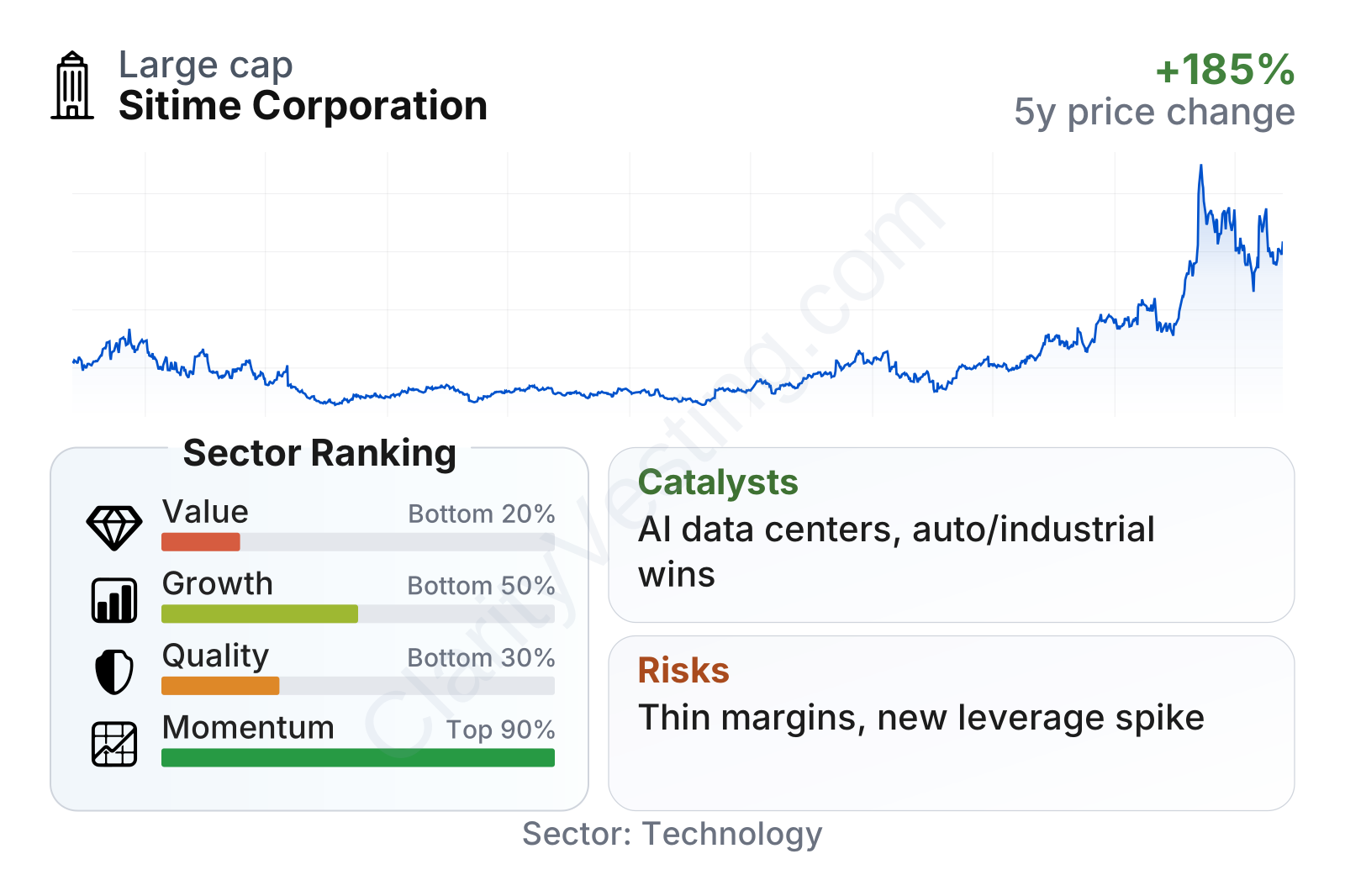
SiTime is now a large mid-cap semiconductor company with unusually strong share-price momentum for the sector. The stock has risen far faster than the typical technology hardware peer over 6 months, 12 months, and 3 years, showing that the market has become much more optimistic about its outlook. At the same time, the table points to a weaker current standing on value, profitability, and capital efficiency. In other words, the market is paying up for future expectations rather than rewarding a highly mature earnings profile today.
Growth
SiTime operates in an attractive part of the semiconductor industry. Precise timing is becoming more important as electronics systems become faster, more connected, and more complex. That trend is visible in AI servers, data centers, networking equipment, advanced industrial systems, and next-generation vehicles. In these applications, timing errors can affect signal quality, synchronization, and system uptime, so performance can matter more than the component’s ticket price.
The company’s strategy is coherent for that backdrop. Rather than competing only in basic commodity timing parts, SiTime has focused on premium products where reliability, programmability, environmental resistance, and precision are more valuable. This gives it a route to higher content per system and a better chance to expand even if unit volumes across consumer electronics stay uneven.
The revenue trend has turned sharply upward. After a deep contraction in 2023, growth reaccelerated in 2024, stayed strong through 2025, and reached triple-digit year-over-year growth by mid-2026. That pace is far above the sector median and suggests that SiTime is benefiting from both an end-market recovery and share gains in higher-performance timing applications.
Cash generation also improved. Free cash flow was negative during the downturn, but it moved back into positive territory over the trailing twelve months. That does not mean the business has become consistently high-margin yet, but it does show that the recovery is reaching the cash line and not only the revenue line.
A major catalyst is the buildout of AI and cloud infrastructure. Public company materials and investor communications have highlighted strong demand for precision timing in data center and networking platforms, where performance requirements are rising. Another catalyst is automotive and industrial adoption, where product qualification cycles are long and design wins can produce revenue for years. SiTime has also expanded its product portfolio, including higher-end clocking and synchronization solutions, which can increase its addressable market beyond basic oscillators.
Recent company updates have reinforced that the recovery is not limited to a single quarter. The combination of fast top-line growth, improving cash flow, and positioning in AI-related infrastructure gives SiTime a credible growth case, even though the business is still in a rebuilding phase on margins.
Risks
This article is for informational purposes only and does not constitute financial advice. Some content is AI-generated. See Disclaimer


