Stock Analysis · Silicon Motion Technology (SIMO)
Overview
Silicon Motion Technology is a semiconductor company focused on controllers used to manage how data is stored and moved inside flash memory devices. In simple terms, its chips act like the “traffic managers” for NAND storage, helping SSDs and embedded storage run reliably and efficiently. The company sells these controllers to device makers and storage manufacturers rather than directly to consumers.
Its business is concentrated in storage-related semiconductors, especially SSD controllers for PCs, servers, and other devices, as well as embedded storage controllers used in smartphones, automotive systems, and industrial equipment. Silicon Motion also develops related firmware and platform solutions that are tightly linked to these controller products.
Based on company disclosures, revenue is mainly driven by the following areas:
- SSD controllers: the largest revenue source, generally estimated at more than 50% of total sales in recent periods. This includes controllers for client SSDs and, increasingly, higher-performance solutions for enterprise and specialized applications.
- Embedded storage controllers: roughly 20% to 35% of sales depending on the cycle. This category includes controllers for eMMC and UFS storage used in smartphones, IoT devices, automotive, and industrial products.
- Ferri and other storage solutions: approximately 10% to 20%. These products combine controller technology with software and design support for embedded and industrial uses.
- Licensing, modules, and other revenue: a small portion of total sales, varying by quarter.
The broad financial flow shows a business with solid gross profit generation but meaningful spending on research and development, which is normal for a chip designer. Revenue and profit fell sharply during the 2023 industry downturn, then recovered in 2024 and 2025, while research spending continued to rise. That pattern suggests management is prioritizing future product depth even through a cyclical slowdown.
Key Figures
| Metric | Value | Sector ⓘ |
|---|---|---|
| Date | Sep 12, 2026 | |
| Context | ||
| Sector | Technology | |
| Industry | Semiconductors | |
| Market Cap ⓘ | $8.99B | |
| Beta ⓘ | 1.70 | |
Value (Cheapness) | ||
| P/E Ratio ⓘ | 32.47 | 29.51 |
| FCF Yield ⓘ | -1.34% | 4.25% |
| EBIT / EV ⓘ | 2.45% | 2.85% |
| PEG ⓘ | 0.70 | |
Growth (Business expansion) | ||
| Revenue Growth ⓘ | 127.00% | 15.40% |
| RPS Growth (5Y CAGR) ⓘ | 41.44% | 8.56% |
| EPS Growth (5Y CAGR) ⓘ | -3.68% | -11.88% |
| Margin Growth (5Y Trend) ⓘ | -10.99% | 0.46% |
| FCF Growth (5Y CAGR) ⓘ | -54.74% | 9.80% |
Quality (Business durability) | ||
| ROIC (Latest) ⓘ | N/A | 9.44% |
| ROIC (5Y Median) ⓘ | 15.30% | 8.30% |
| Net Debt / EBIT (Latest) ⓘ | -0.07 | 0.54 |
| Net Debt / EBIT (5Y Median) ⓘ | -1.44 | 0.44 |
| Operating Margin (Latest) ⓘ | 17.51% | 9.58% |
| Operating Margin (5Y Median) ⓘ | 15.82% | 8.25% |
| Debt to Equity (Latest) ⓘ | 5.65% | 33.33% |
| Profit Margin (Latest) ⓘ | 22.06% | 7.14% |
| Free Cash Flow (Latest) ⓘ | -$120.45M | |
Momentum (Price trend) | ||
| 3Y Return ⓘ | +483.96% | +45.48% |
| 12M Return (excl. last month) ⓘ | +216.06% | +23.48% |
| 6M Return ⓘ | +137.82% | +20.93% |
| Price vs. 200-Day MA ⓘ | +51.65% | +7.43% |
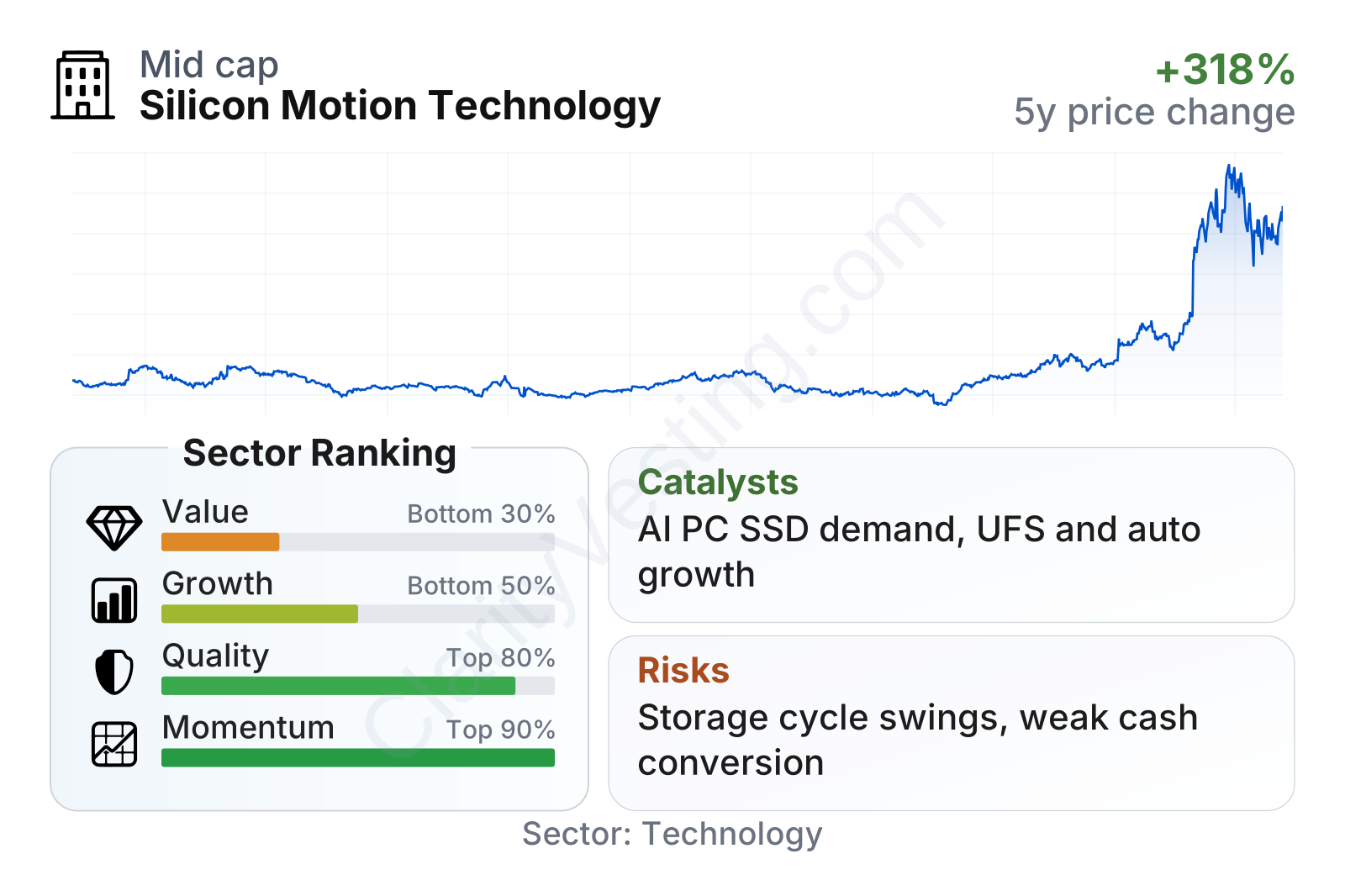
Silicon Motion is a mid-sized semiconductor company with a stock that has been far more volatile than the broader market, as shown by its high beta. The share price performance has been extremely strong over the last year and over three years, clearly ahead of most companies in its sector, which means expectations are much higher now than they were during the industry slowdown.
The metrics table points to a mixed profile. On valuation, the earnings multiple sits around the sector median rather than at an obvious discount, while free cash flow yield is currently weak because cash generation has recently turned negative. On quality, the picture is much stronger: operating margin, profit margin, returns on capital over time, and balance-sheet strength all compare favorably with many semiconductor peers.
Growth indicators also need nuance. Recent year-over-year revenue growth is very strong, and five-year revenue per share growth has been excellent, but earnings and cash flow trends have been less steady. In short, Silicon Motion combines strong profitability and financial discipline with the kind of cyclicality that can make headline growth numbers look better or worse depending on timing.
Growth
Silicon Motion operates in a part of the semiconductor market that has long-term structural support. The world continues to create and store more data, and that drives demand for NAND flash memory in PCs, smartphones, data centers, vehicles, and connected devices. Every increase in storage performance or capacity requires more capable controllers, which plays directly into the company’s niche.
The company’s strategy is logical for that backdrop. It focuses on controller design rather than owning expensive factories, which keeps capital intensity lower than for integrated chip manufacturers. It has also been investing heavily in research and development to support new controller generations, including products aligned with faster SSD standards and more advanced embedded storage. That spending pressures near-term cash flow, but it can strengthen product relevance if design wins turn into volume shipments.
Revenue growth has been highly cyclical, moving from a steep decline in 2023 to a powerful rebound in 2024 and an even stronger acceleration into 2026. The most recent growth rate is far above the sector median, which indicates that Silicon Motion is participating in a strong recovery phase rather than merely tracking the industry.
A visible catalyst is the company’s exposure to SSD controller upgrades linked to AI-capable PCs, notebook refresh cycles, and higher storage content per device. Another opportunity comes from embedded storage in automotive and industrial applications, where qualification cycles are longer and customer relationships can be stickier than in consumer electronics.
Recent company updates have also highlighted continued progress in new controller platforms and customer programs. For a business like Silicon Motion, those product transitions matter because controller suppliers can benefit when customers move to newer storage standards or require more sophisticated firmware and power-management features.
Cash generation, however, has not followed revenue as smoothly. Free cash flow was positive for several years and then turned negative recently. That does not automatically signal a broken business, but it does show that the current expansion phase is consuming more cash, likely through working capital and product investment. For long-term analysis, this is an area that deserves attention because sustained growth is more valuable when it converts into cash.
Risks
This article is for informational purposes only and does not constitute financial advice. Some content is AI-generated. See Disclaimer


