Stock Analysis · SharonAI Holdings Inc (SHAZ)
Overview
SharonAI Holdings Inc is a small technology company in information technology services with a business centered on artificial intelligence infrastructure. Based on its public filings and investor materials, the company is focused on building capacity for AI-related computing and digital infrastructure rather than operating as a large, diversified software platform. That makes it easier to understand, but it also means the business is still in an early and volatile stage.
The company’s reported revenue base is currently modest. Public filings indicate that revenue has been tied to a narrow set of operating activities, and the business has not yet shown the broad, stable mix that is common in more mature technology companies. Detailed segment disclosure appears limited, so a precise split is not available from the latest public information. At this stage, the main economic picture is less about a balanced revenue mix and more about whether management can scale infrastructure, convert demand into contracts, and improve unit economics.
- Core operating revenue: the large majority of current revenue appears to come from the company’s main AI and technology service activities.
- Other revenue sources: no material secondary revenue stream is clearly disclosed as a separate contributor in the latest public information.
The financial flow also shows how early the business still is. Revenue improved meaningfully from 2024 to 2025, but costs and operating expenses grew much faster than sales. Gross profit moved from negative to slightly positive, which is a constructive sign, yet overhead and expansion costs remained far above the revenue base, leaving the company deeply unprofitable.
Key Figures
| Metric | Value | Sector ⓘ |
|---|---|---|
| Date | Sep 12, 2026 | |
| Context | ||
| Sector | Technology | |
| Industry | Information Technology Services | |
| Market Cap ⓘ | $2.03B | |
| Beta ⓘ | 6.07 | |
Value (Cheapness) | ||
| P/E Ratio ⓘ | N/A | 29.51 |
| FCF Yield ⓘ | -15.52% | 4.25% |
| EBIT / EV ⓘ | -5.66% | 2.85% |
| PEG ⓘ | N/A | |
Growth (Business expansion) | ||
| Revenue Growth ⓘ | 412.30% | 15.40% |
| RPS Growth (5Y CAGR) ⓘ | N/A | 8.56% |
| EPS Growth (5Y CAGR) ⓘ | N/A | -11.88% |
| Margin Growth (5Y Trend) ⓘ | N/A | 0.46% |
| FCF Growth (5Y CAGR) ⓘ | N/A | 9.80% |
Quality (Business durability) | ||
| ROIC (Latest) ⓘ | -8.12% | 9.44% |
| ROIC (5Y Median) ⓘ | N/A | 8.30% |
| Net Debt / EBIT (Latest) ⓘ | N/A | 0.54 |
| Net Debt / EBIT (5Y Median) ⓘ | N/A | 0.44 |
| Operating Margin (Latest) ⓘ | -2164.85% | 9.58% |
| Operating Margin (5Y Median) ⓘ | N/A | 8.25% |
| Debt to Equity (Latest) ⓘ | 89.70% | 33.33% |
| Profit Margin (Latest) ⓘ | N/A | 7.14% |
| Free Cash Flow (Latest) ⓘ | -$314.39M | |
Momentum (Price trend) | ||
| 3Y Return ⓘ | +1381527.91% | +45.48% |
| 12M Return (excl. last month) ⓘ | +342200.00% | +23.48% |
| 6M Return ⓘ | +200.66% | +20.93% |
| Price vs. 200-Day MA ⓘ | +8.93% | +7.43% |
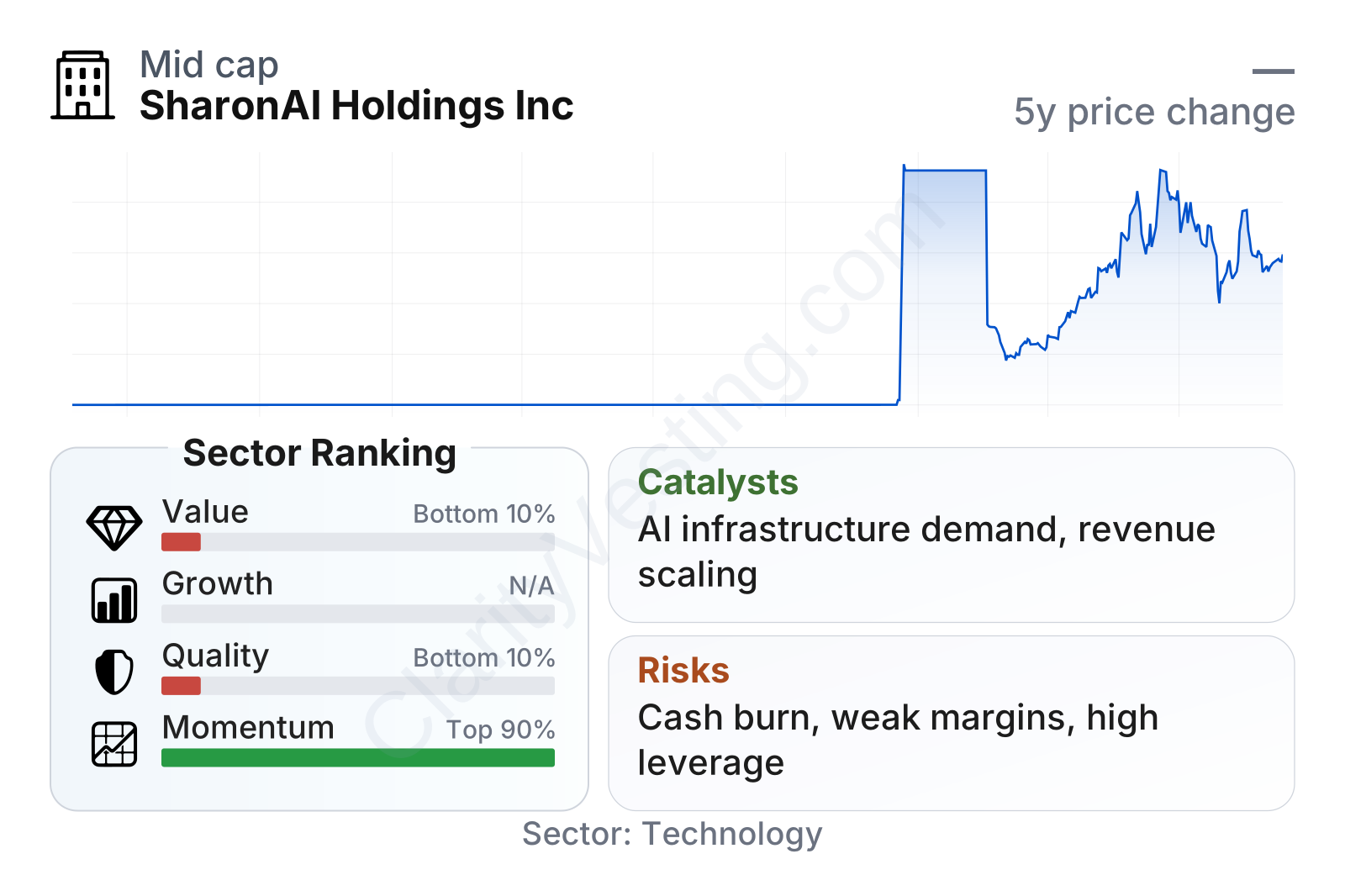
SharonAI’s profile is unusual. It has reached a roughly mid-sized market capitalization by stock market standards, but its operating footprint remains very small relative to that valuation. The metrics table points to a weak fundamental profile today: value and quality rank near the bottom of the technology sector, mainly because free cash flow is negative, returns on invested capital are negative, and operating profitability is far below sector norms. Growth looks extreme on a year-over-year basis, but that is partly because the starting revenue level was very low. Momentum has been strong over multi-year and prior 12-month periods, although the stock has also shown major swings more recently. The beta above 6 underlines that this is a highly volatile security.
Growth
SharonAI operates in a sector with real long-term demand potential. AI infrastructure, compute capacity, and related services remain areas where spending could stay elevated for years if enterprises continue adopting large-scale AI tools. That backdrop is important because small companies linked to AI can benefit disproportionately if they secure enough capital, customers, and execution discipline.
The company’s strategic logic is understandable: position itself around a market theme that is attracting strong interest, then use that attention to build assets and commercial relationships. In principle, that can create upside if AI infrastructure demand remains tight. In practice, the key test is whether that demand turns into recurring and profitable revenue instead of simply justifying expansion spending.
Recent revenue growth has been highly uneven. After very strong year-over-year expansion in earlier periods, growth weakened sharply, turned slightly negative for one quarter, and then rebounded to a very high rate in the latest reading. That pattern suggests the company is still dealing with a lumpy revenue base rather than a smooth scaling trajectory. For a young infrastructure business, that is not unusual, but it does reduce visibility.
Cash generation is the bigger issue. Free cash flow has moved deeper into negative territory, showing that growth is currently being funded by cash burn rather than by internally generated resources. A company can justify this for a period if it is building capacity ahead of demand, but the burden of proof becomes higher as losses widen.
One potentially important catalyst is simply the broader AI buildout itself. If SharonAI can translate industry demand into signed contracts, fuller utilization of its infrastructure, and better gross margins, the operating profile could change quickly because the current revenue base is so small. That said, the latest publicly visible numbers still show a business in transition rather than one that has already reached commercial scale.
Risks
This article is for informational purposes only and does not constitute financial advice. Some content is AI-generated. See Disclaimer


