Stock Analysis · Shake Shack Inc (SHAK)
Overview
Shake Shack Inc is a restaurant company centered on premium fast-casual burgers, chicken, hot dogs, fries, shakes, frozen custard, and drinks. The brand started as a single New York City food stand and has expanded into a global chain with company-operated restaurants in the United States and licensed restaurants in international markets. Its positioning sits between traditional quick-service chains and more upscale casual dining: the food is served quickly, but the brand leans on quality ingredients, urban locations, digital ordering, and a recognizable lifestyle-oriented image.
The business makes most of its money from sales at company-operated Shacks. A smaller but important stream comes from licensing, where partners operate restaurants and pay fees and royalties. Based on recent annual reporting, the revenue mix is approximately:
- Company-operated restaurant sales: about 94% to 96% of revenue. This includes food and beverage sales at restaurants the company runs directly.
- Licensing revenue: about 3% to 5% of revenue. This comes from royalties and fees paid by licensed operators, mainly in international markets and selected travel or special locations.
- Other revenue: about 1% or less. This can include merchandise, gift card breakage, and other smaller items.
That structure matters because company-operated sales create scale and brand control, while licensing can support expansion with lower capital needs and usually higher incremental margins.
Over the last several years, revenue has climbed from roughly $740 million in 2021 to about $1.25 billion in 2024, showing that unit expansion has remained the main engine of the business. Recent annual figures also indicate that the company has moved from losses into positive net income, although margins are still relatively thin for the sector.
The broad pattern shows a business that has grown steadily at the top line, but where labor, food, occupancy, and corporate expenses still absorb a large share of sales. More recently, the path to profit has improved, which is important for a chain still in expansion mode.
Key Figures
| Metric | Value | Sector ⓘ |
|---|---|---|
| Date | Sep 12, 2026 | |
| Context | ||
| Sector | Consumer Cyclical | |
| Industry | Restaurants | |
| Market Cap ⓘ | $2.64B | |
| Beta ⓘ | 1.66 | |
Value (Cheapness) | ||
| P/E Ratio ⓘ | 64.95 | 17.10 |
| FCF Yield ⓘ | 0.37% | 8.53% |
| EBIT / EV ⓘ | 1.95% | 6.46% |
| PEG ⓘ | 2.55 | |
Growth (Business expansion) | ||
| Revenue Growth ⓘ | 17.20% | 5.75% |
| RPS Growth (5Y CAGR) ⓘ | 16.22% | 9.14% |
| EPS Growth (5Y CAGR) ⓘ | -66.81% | -18.21% |
| Margin Growth (5Y Trend) ⓘ | 7.30% | -0.23% |
| FCF Growth (5Y CAGR) ⓘ | N/A | 4.91% |
Quality (Business durability) | ||
| ROIC (Latest) ⓘ | 5.53% | 12.61% |
| ROIC (5Y Median) ⓘ | 1.76% | 10.72% |
| Net Debt / EBIT (Latest) ⓘ | -0.69 | 2.10 |
| Net Debt / EBIT (5Y Median) ⓘ | 29.24 | 2.32 |
| Operating Margin (Latest) ⓘ | 4.20% | 9.25% |
| Operating Margin (5Y Median) ⓘ | 1.30% | 9.64% |
| Debt to Equity (Latest) ⓘ | 48.35% | 75.78% |
| Profit Margin (Latest) ⓘ | 2.56% | 5.33% |
| Free Cash Flow (Latest) ⓘ | $9.82M | |
Momentum (Price trend) | ||
| 3Y Return ⓘ | +2.05% | +14.53% |
| 12M Return (excl. last month) ⓘ | -33.96% | +3.08% |
| 6M Return ⓘ | -26.68% | +0.55% |
| Price vs. 200-Day MA ⓘ | -19.27% | -0.54% |
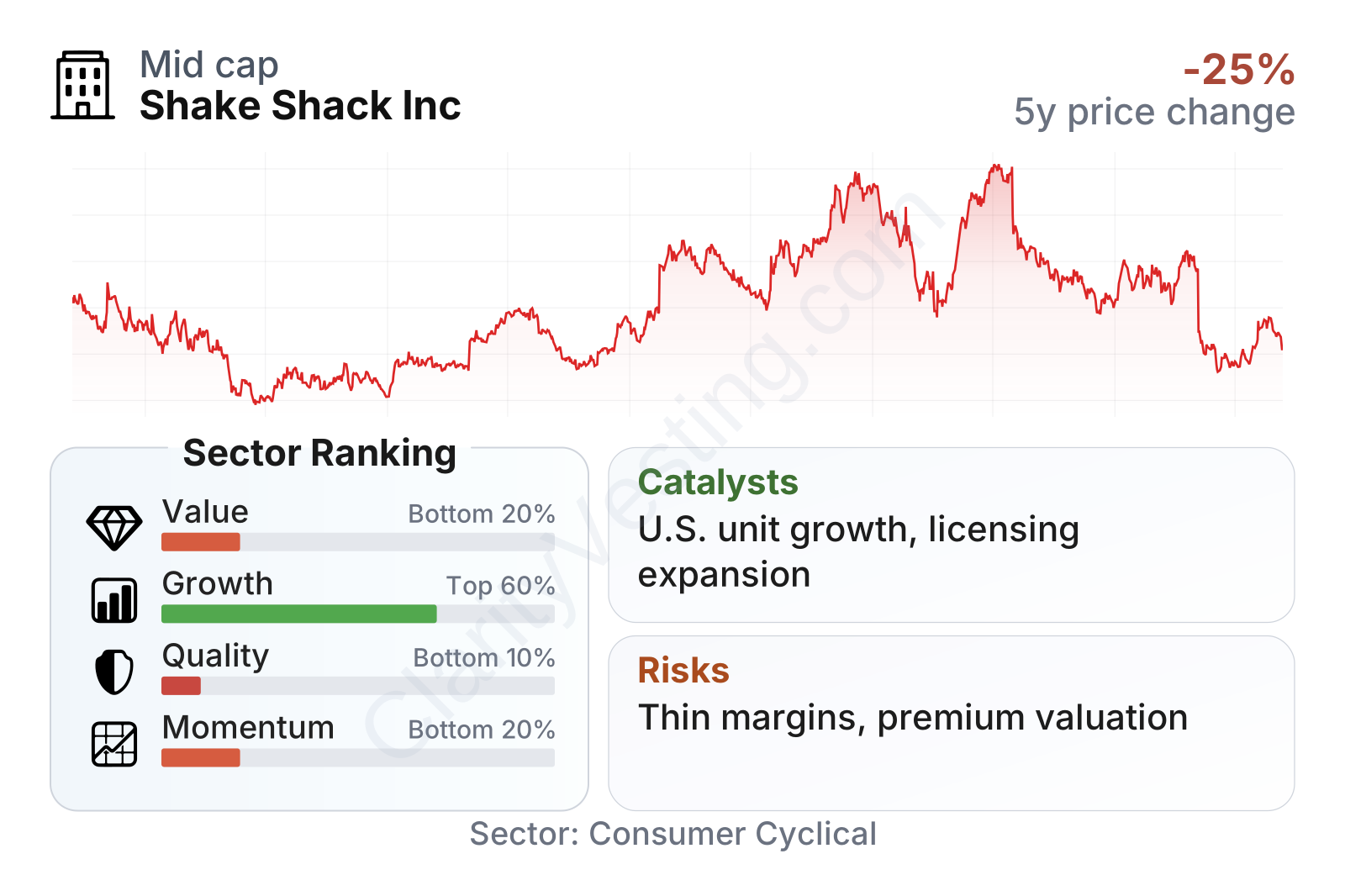
Shake Shack stands out more for growth than for current valuation or profitability. Revenue expansion is stronger than the restaurant sector median, and the longer-term trend in operating margin has improved. At the same time, the stock screens as expensive relative to peers, while returns on invested capital and margins remain below typical sector levels. The business also shows weak recent share-price momentum, which suggests the market has become more cautious about the pace and quality of future earnings growth.
The stock has been volatile. After a strong run into late 2024, the share price fell sharply by mid-2026. That kind of movement is not unusual for restaurant companies that trade on future expansion expectations, but it does mean sentiment can change quickly when same-store sales, margins, or development pace disappoint.
Growth
Shake Shack operates in a part of the restaurant industry that still has room to grow. Fast-casual dining has benefited from consumers looking for better food quality than traditional fast food without moving into full-service restaurant pricing and time commitment. Within that segment, burgers remain a very large category, and Shake Shack’s brand has unusual recognition for a chain that is still much smaller than the biggest national players.
The company’s strategy for growth is straightforward and sensible: open more company-operated restaurants in the U.S., add licensed units internationally, improve the sales productivity of existing stores, and use digital tools to drive frequency and order mix. Management has consistently emphasized format expansion, including suburban, urban, drive-thru, and travel-oriented locations. If execution holds, that gives the brand a longer runway than a mature chain with limited white space.
Revenue growth has remained strong, generally running in the low-teens to low-20s range in recent periods. The latest year-over-year growth rate is around 17%, well above the sector median near 6%. That suggests Shake Shack is still gaining scale faster than a typical restaurant peer, mostly through new openings and ongoing brand expansion rather than only price increases.
Cash generation has also improved meaningfully. Free cash flow was negative in earlier periods, then turned clearly positive in 2025 and stayed positive into 2026. That transition matters because a growing restaurant chain eventually needs to prove that new units are not just adding revenue, but also contributing real cash after capital spending.
A practical catalyst for future growth is international licensing. Licensed restaurants can extend the brand with less balance-sheet pressure than company-owned expansion. Another catalyst is operational improvement in newer formats, especially drive-thru and other convenience-focused stores, which could widen the addressable market beyond dense urban trade areas. Menu innovation, kiosk ordering, and app-based engagement can also help lift average check and repeat visits if traffic remains healthy.
Recent company communications have continued to highlight development plans and unit growth, which keeps the expansion thesis intact. The key opportunity is not that Shake Shack has already reached best-in-class economics, but that it still has room to improve margins while increasing its restaurant base.
Risks
This article is for informational purposes only and does not constitute financial advice. Some content is AI-generated. See Disclaimer


