Stock Analysis · The Sage Group plc (SGPYY)
Overview
The Sage Group plc is a business software company focused mainly on small and mid-sized businesses. Its products help companies handle accounting, payroll, human resources, payments, and broader financial administration. In simple terms, Sage sells software that helps businesses run their back office. The company has been moving steadily toward subscription-based and cloud-connected products, which makes its revenue more recurring and generally more predictable than one-time software sales.
Sage’s revenue base is spread across solutions for finance and operations, with accounting and enterprise resource planning at the center. Based on recent annual reporting and company materials, the business is driven primarily by subscription software and related services, with recurring revenue representing the large majority of group sales. Sage also reports performance by geography and customer segment, but the clearest long-term picture is that customers pay ongoing fees for software used in daily business processes.
The main revenue sources can be summarized as follows:
- Recurring software revenue: about 95%+ of total revenue. This includes subscriptions, maintenance, and other repeatable customer payments tied to core accounting, payroll, HR, and finance software.
- Non-recurring revenue: about 5%- of total revenue. This includes items such as software licenses, professional services, and other one-time or lower-visibility sales.
- By customer need, the largest functional areas are accounting and finance management, followed by payroll/HR and broader business management tools. Exact percentages by product family are not consistently disclosed in a simple public split.
- By geography, Sage is strongest in the United Kingdom, Europe, and North America, with the U.S. and U.K. as especially important markets.
The economics of the business are attractive for a software provider. Revenue has risen from about $1.8 billion in fiscal 2021 to roughly $2.5 billion in fiscal 2025, while cost of revenue has stayed relatively low relative to sales. That points to a high gross margin model, which is one reason software companies can convert growth into cash efficiently once they achieve scale.
The operating picture shows a business with high gross profit, heavy spending on sales and administration, and meaningful ongoing product investment. More recently, profit conversion has improved as revenue expanded faster than the cost base.
Key Figures
| Metric | Value | Sector ⓘ |
|---|---|---|
| Date | Jul 18, 2026 | |
| Context | ||
| Sector | Technology | |
| Industry | Software - Application | |
| Market Cap ⓘ | $10.28B | |
| Beta ⓘ | 0.30 | |
Value (Cheapness) | ||
| P/E Ratio ⓘ | 21.82 | 31.76 |
| FCF Yield ⓘ | 9.68% | 4.18% |
| EBIT / EV ⓘ | N/A | 2.56% |
| PEG ⓘ | 0.96 | |
Growth (Business expansion) | ||
| Revenue Growth ⓘ | 9.70% | 13.50% |
| RPS Growth (5Y CAGR) ⓘ | 10.56% | 8.57% |
| EPS Growth (5Y CAGR) ⓘ | N/A | -21.87% |
| Margin Growth (5Y Trend) ⓘ | 1.35% | 0.41% |
| FCF Growth (5Y CAGR) ⓘ | 10.03% | 9.76% |
Quality (Business durability) | ||
| ROIC (Latest) ⓘ | 37.24% | 8.54% |
| ROIC (5Y Median) ⓘ | 14.00% | 8.12% |
| Net Debt / EBIT (Latest) ⓘ | 1.38 | 0.38 |
| Net Debt / EBIT (5Y Median) ⓘ | 1.72 | 0.38 |
| Operating Margin (Latest) ⓘ | 21.46% | 9.58% |
| Operating Margin (5Y Median) ⓘ | 20.10% | 8.25% |
| Debt to Equity (Latest) ⓘ | 919.09% | 33.52% |
| Profit Margin (Latest) ⓘ | 14.62% | 6.96% |
| Free Cash Flow (Latest) ⓘ | $995.26M | |
Momentum (Price trend) | ||
| 3Y Return ⓘ | -0.99% | +30.91% |
| 12M Return (excl. last month) ⓘ | -34.55% | +28.90% |
| 6M Return ⓘ | -17.55% | +5.38% |
| Price vs. 200-Day MA ⓘ | -9.76% | +7.61% |
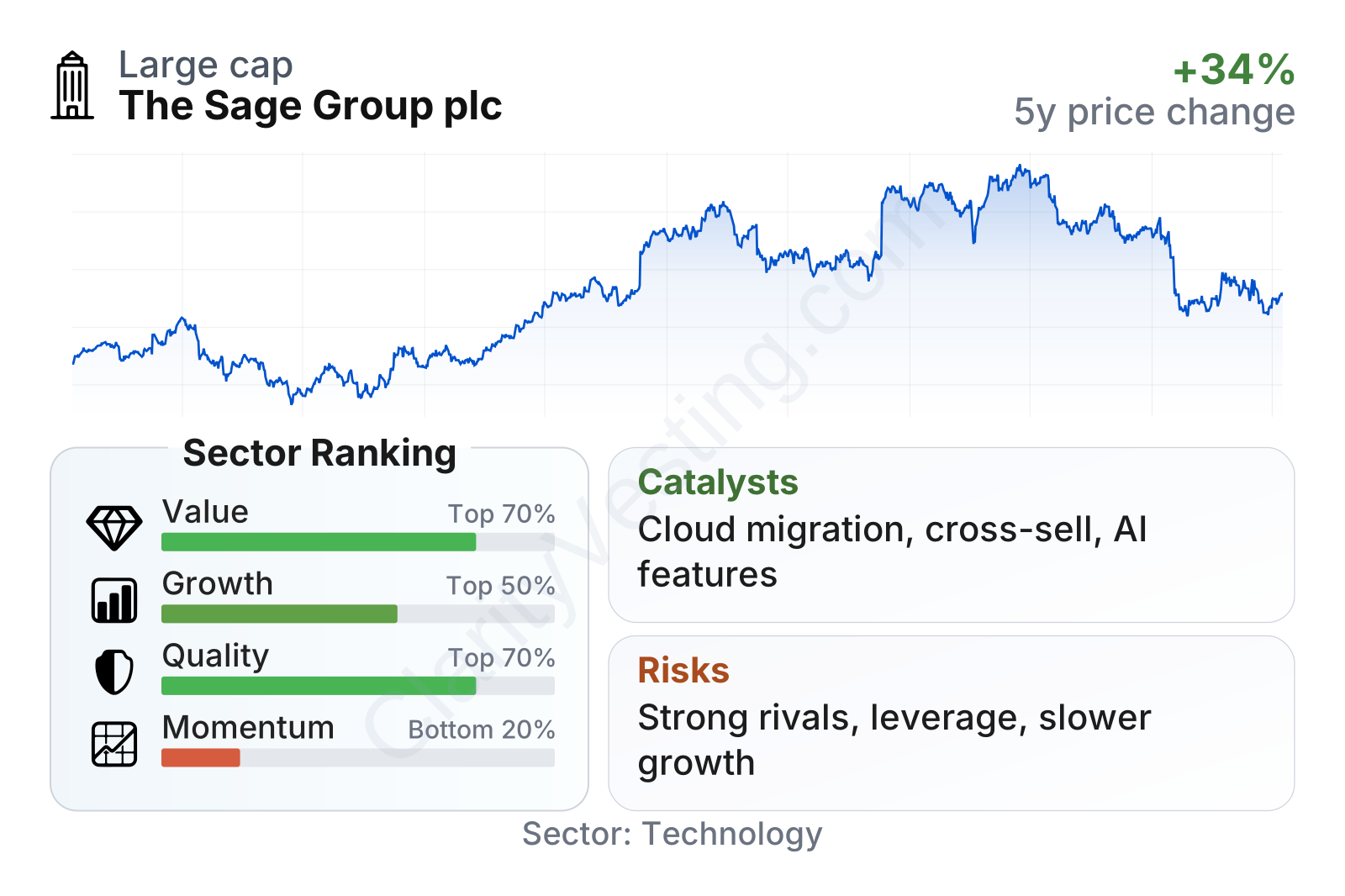
Sage stands out for business quality and cash generation more than for fast headline growth. Profitability is well above the sector median, return on invested capital is especially strong, and free cash flow generation is robust for a company of this size. Growth is respectable rather than exceptional, while recent share price momentum has been weak compared with much of the software sector. The stock also appears less expensive than many software peers on earnings, while offering a notably stronger free cash flow yield.
Growth
Sage operates in a favorable long-term market. Small and mid-sized businesses continue to digitize core functions such as accounting, payroll, invoicing, compliance, and payments. That is not a short-lived trend. Many smaller companies still use fragmented systems, spreadsheets, or older desktop tools, so there is room for cloud migration, product upgrades, and add-on services. This makes Sage’s end market structurally attractive even if it is not the fastest-growing corner of software.
The company’s strategy also looks coherent. Sage has been focusing on subscription software, cloud connectivity, and products that are deeply embedded in customers’ day-to-day processes. That matters because accounting and payroll tools are difficult to replace once they are installed and integrated into a business. It can create sticky customer relationships, recurring revenue, and opportunities to sell adjacent tools such as payments, HR, and analytics.
Recent revenue growth has been steady, generally landing in the high-single-digit range after a stronger phase in 2022 and early 2023. That is slower than the software sector median today, but it is still healthy for a mature company serving essential business functions. Over a five-year view, revenue per share growth has slightly outpaced the sector median, suggesting that Sage has been able to build durable expansion even without the rapid growth rates seen in younger software names.
Cash generation is an important part of the growth profile. Free cash flow has climbed materially over the past several years and now sits near $1.0 billion on a trailing basis. That gives Sage flexibility to fund product development, acquisitions, debt service, and shareholder distributions without putting major strain on the balance sheet. A company does not need extreme revenue growth to create value if it can consistently convert sales into cash at a high rate.
One notable catalyst is the continued migration of customers toward cloud-native and subscription offerings, particularly in finance and payroll. Another is cross-selling within the installed customer base. Sage already has trusted relationships with many businesses, so adding payments, compliance, and HR features can lift revenue per customer without requiring the same level of customer acquisition spending as a new logo strategy. Public company updates have also highlighted AI-enabled product features and automation tools, which could support retention and product relevance over time, although these features are more likely to strengthen the existing platform than transform growth overnight.
Risks
The biggest business risk is competition. Sage is a strong brand in small and mid-sized business software, but it does not dominate global business software the way the largest enterprise platforms do. In accounting and financial management, it faces Intuit, Xero, Microsoft, Oracle NetSuite, SAP in larger customer tiers, and many localized payroll and compliance vendors. Competition can affect pricing, customer acquisition costs, and the pace at which customers adopt newer Sage products.
Sage does have competitive advantages, but they are practical rather than dramatic. Its products are embedded in routine business processes, switching can be disruptive, and it has long-standing relationships in regulated and compliance-heavy workflows such as payroll and accounting. Those are real strengths. However, the company is not the clear global leader across all segments. It is better described as an established specialist with strong positions in selected markets rather than the undisputed category leader everywhere.
A financial risk worth watching is leverage presentation. Net debt relative to EBIT is manageable at roughly 1.4x, but the debt-to-equity ratio is unusually high because equity has become quite small relative to debt and other balance sheet items. That does not automatically indicate distress, but it can make the capital structure look more aggressive than many software peers.
The debt-to-equity trend has moved sharply above the sector median over time. Even though Sage’s cash generation helps offset this concern, the balance sheet deserves attention because higher leverage leaves less room for error if growth slows, costs rise, or acquisition plans become more ambitious.
Margin risk looks more balanced. Sage’s profitability is clearly strong, but software companies can see pressure from product investment, cloud infrastructure spending, wage inflation, and sales spending if competition intensifies.
Profit margins remain comfortably above the sector median and have recovered from the softer levels seen in 2023. That supports the view that Sage is running an efficient business, but it also means the market may expect margins to stay elevated. If operating discipline weakens, sentiment could react quickly.
There is no widely reported public event suggesting a major scandal or governance breakdown at the company. The more relevant risk is execution: Sage needs to keep modernizing its products while protecting its installed base from cloud-native rivals and larger software ecosystems.
Valuation
Sage sits in an interesting position on valuation. On current earnings, the stock trades around 21x, below the software sector median near 32x. On free cash flow, it looks even more favorable, with a yield around 10% versus roughly 4% for the sector median. Those figures suggest the market is not pricing Sage like a high-growth software company, even though it still delivers solid recurring growth and above-average profitability.
The historical earnings multiple has compressed significantly from much higher levels seen during 2023 through early 2025. Even after that decline, the stock has often traded above the sector median on a trailing basis, but the gap has narrowed a lot. In other words, valuation has become less demanding at the same time that the business continues to post strong margins and cash generation.
The main reason the valuation is not lower is quality. Sage generates strong returns on capital, recurring revenue is very high, and the company converts a meaningful share of revenue into profit and cash. The main reason the valuation is not higher is growth. Revenue is expanding at a healthy but not exceptional pace, and recent stock performance suggests the market has become less willing to pay premium software multiples for steady growers.
In context, the current price looks more consistent with a durable, mature software platform than with an aggressive growth name. That seems broadly aligned with the company’s fundamentals: reliable cash flows, strong margins, moderate growth, and some leverage-related caution.
Conclusion
Sage appears to be a financially strong software company built around essential business functions that customers are reluctant to disrupt. Its recurring revenue base, high margins, and powerful cash generation create a sturdy operating profile, and the long-term shift toward digital finance, payroll, and compliance tools supports continued expansion. The company is not a breakout growth platform, but it does not need to be one to remain relevant.
The main tension is between quality and pace. Sage looks stronger than many peers on profitability and cash flow, yet less exciting on growth and recent market momentum. Competitive pressure is real, especially from cloud-focused software providers, and the elevated debt-to-equity profile adds a point to monitor even if cash flow remains healthy. Still, the overall picture is of a mature software business with durable economics rather than a company facing structural decline.
At current valuation levels, the market seems to recognize Sage’s resilience but is no longer assigning the kind of premium usually reserved for faster software names. That leaves the company positioned as a high-quality, slower-compounding technology business whose appeal rests on consistency, recurring revenue, and disciplined execution more than on rapid expansion.
Sources:
- The Sage Group plc — Annual Report and Accounts 2025
- The Sage Group plc — Full Year 2025 Results
- The Sage Group plc — Investor Relations presentations and factsheets
- The Sage Group plc — Annual Report and Accounts 2024
- Wikipedia — The Sage Group
This article is for informational purposes only and does not constitute financial advice. Some content is AI-generated. See Disclaimer