Stock Analysis · Sweetgreen Inc (SG)
Stock Analysis · Sweetgreen Inc (SG)

Overview

Sweetgreen is a fast-casual restaurant company focused on salads, grain bowls, protein plates, and other meals positioned around freshness, convenience, and a health-oriented brand image. The company operates primarily in the United States and combines physical restaurants with a strong digital ordering model, including its own app and website as well as delivery partnerships. Its concept targets customers who want quick-service food but with more premium ingredients and a menu that fits wellness and lifestyle trends.

The business is still centered overwhelmingly on restaurant sales. Based on company disclosures, revenue comes mainly from company-operated restaurants rather than franchising or packaged consumer products. A simple way to think about Sweetgreen’s revenue mix is:

  • Company-operated restaurant sales: roughly the vast majority of revenue, close to all of total sales.
  • Delivery and digital orders: these are channels within restaurant sales rather than a separate reporting segment, but they are strategically important because digital ordering has been a major part of the model.
  • Other revenue: a very small share, including items such as loyalty-related activity, partnerships, or limited ancillary sources when disclosed.

What makes Sweetgreen different is not just the menu. Management has also emphasized operational technology, including its Infinite Kitchen automated assembly format, which is designed to improve throughput, labor efficiency, and consistency. That matters because restaurant businesses usually live or die by store-level economics, not just by brand popularity.

Looking at the business over the last several years, revenue expanded significantly from 2021 through 2024, while the cost structure also remained heavy. In 2025, sales were roughly flat and losses widened again, showing a company that has built scale but has not yet turned that scale into durable profitability.

The long-term pattern is clear: sales have nearly doubled since 2021, but higher food, labor, occupancy, and corporate costs have absorbed much of that progress. Gross profit improved meaningfully through 2024 before weakening in 2025, which helps explain why enthusiasm around the brand has not yet translated into consistently strong earnings.

Key Figures

MetricValueSector
DateJul 18, 2026
Context
SectorConsumer Cyclical
IndustryRestaurants
Market Cap $1.04B
Beta 2.17
Value
(Cheapness)
P/E Ratio 73.0818.58
FCF Yield -11.58%7.99%
EBIT / EV 1.45%5.91%
PEG N/A
Growth
(Business expansion)
Revenue Growth -2.90%5.50%
RPS Growth (5Y CAGR) 16.68%9.20%
EPS Growth (5Y CAGR) N/A-26.43%
Margin Growth (5Y Trend) N/A-0.18%
FCF Growth (5Y CAGR) -6.70%5.02%
Quality
(Business durability)
ROIC (Latest) 9.82%12.03%
ROIC (5Y Median) -20.94%10.82%
Net Debt / EBIT (Latest) 10.742.12
Net Debt / EBIT (5Y Median) N/A2.25
Operating Margin (Latest) 2.75%9.28%
Operating Margin (5Y Median) -19.72%9.64%
Debt to Equity (Latest) 72.83%75.23%
Profit Margin (Latest) 2.49%5.28%
Free Cash Flow (Latest) -$120.69M
Momentum
(Price trend)
3Y Return -33.51%+10.68%
12M Return (excl. last month) -37.00%+5.26%
6M Return +29.73%-2.41%
Price vs. 200-Day MA +25.79%+1.55%
Better than sector median
Slightly worse than sector median
More than 20% worse than sector median

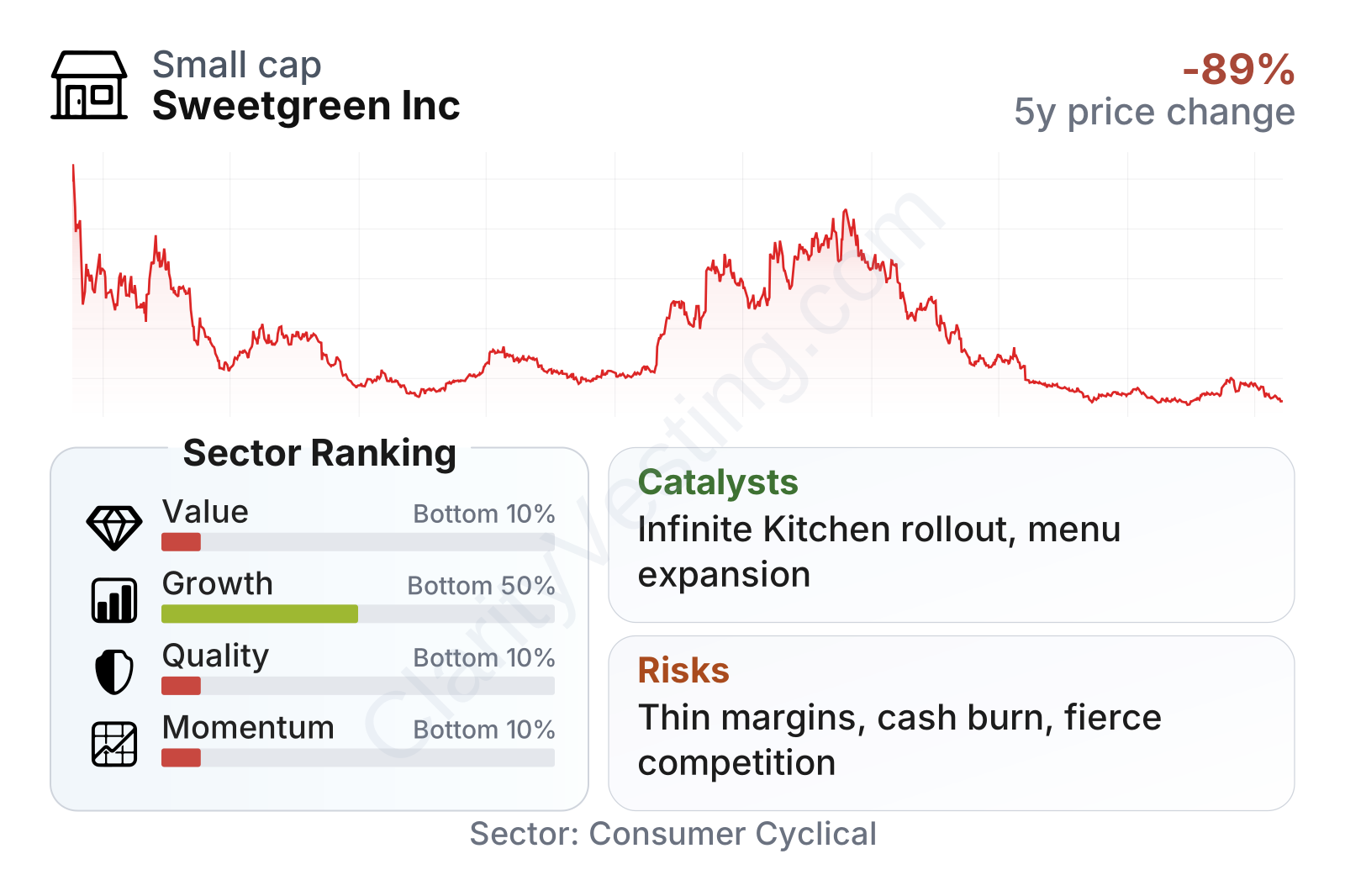
Sweetgreen currently looks like a small-cap restaurant company with a volatile share price, a relatively expensive earnings multiple, and weaker quality metrics than much of the sector. Growth characteristics are more mixed than the brand’s image might suggest: the five-year revenue trajectory has been strong, but the latest year-over-year sales trend has turned slightly negative. Profitability has improved from deeply negative levels, yet cash generation remains weak and free cash flow is still meaningfully below zero.

The stock’s history also shows how sentiment has swung sharply. After a strong post-IPO start, the shares fell heavily, then rebounded in 2024 before dropping again and partially recovering in 2026. That kind of movement usually reflects a market that is still trying to decide whether Sweetgreen is evolving into a scalable premium restaurant platform or remains an interesting brand with difficult economics.

Growth

Sweetgreen operates in a part of the restaurant industry that still has attractive long-term demand drivers. Consumers continue to spend on convenience, digital ordering, and better-for-you food options, especially in urban and higher-income markets where Sweetgreen has traditionally been strongest. In that sense, the company is aligned with favorable consumer habits, even if the broader restaurant sector remains highly competitive and sensitive to pricing.

The company’s strategy for future expansion is logical on paper. It is opening more restaurants, refining menu and labor efficiency, and investing in Infinite Kitchen locations that could improve unit economics if the format scales well. This is important because Sweetgreen’s long-term case depends less on novelty and more on proving it can open stores with attractive returns while protecting margins.

Recent revenue momentum, however, has cooled. After several quarters of very strong growth in 2022 through 2024, the pace slowed substantially and slipped slightly negative in the latest period. That suggests expansion is no longer being driven by easy post-pandemic comparisons, and future growth will need to come from stronger same-store sales, better traffic, and disciplined new unit openings.

Cash flow is another area to watch closely. Sweetgreen had made visible progress in narrowing cash burn compared with earlier years, but trailing free cash flow has moved deeper into negative territory again. For a growing restaurant chain, that is not automatically alarming because new stores require investment, but it does mean expansion is still expensive and not yet self-funding.

A meaningful catalyst is the continued rollout and refinement of automated kitchen assembly. If the model reduces labor intensity, raises throughput at busy times, and shortens payback periods on new restaurants, it could change how the market views Sweetgreen’s scale potential. Another opportunity is geographic expansion beyond its historically dense urban footprint, especially if management can adapt the format to suburban demand without diluting the brand.

Recent company updates have also kept attention on menu innovation, loyalty engagement, and restaurant pipeline execution. Those are not dramatic one-time events, but in this business they matter because repeated small improvements in traffic, mix, and labor efficiency can reshape margins over time.

Risks

Sweetgreen’s biggest risk is that the brand remains more proven than the economics. The company has demonstrated customer awareness and a differentiated identity, but restaurant-level and corporate profitability have been inconsistent. That leaves little room for mistakes when food inflation, wage pressure, or softer traffic hit results.

Balance sheet leverage is not extreme by restaurant standards, and debt to equity is actually somewhat below the sector median, but the trend had been moving upward before easing in the latest period. More importantly, net debt relative to EBIT remains elevated because earnings are still thin. In simple terms, the balance sheet is manageable only if operating performance continues to stabilize.

Margins illustrate both progress and fragility. Sweetgreen has climbed from very large losses to a small positive net margin in the latest trailing period, which is a real improvement. Still, profitability remains below the sector norm, and the margin history shows how quickly gains can reverse. That is especially relevant in a concept built around fresh ingredients, where waste, sourcing costs, and labor efficiency all matter.

Competition is intense. Sweetgreen is not the overall leader in restaurants, and even within fast-casual it faces pressure from large diversified chains and niche health-focused concepts. Its competitive set includes Chipotle in premium customizable meals, Cava in Mediterranean fast-casual, Panera in lunch-oriented convenience, and many regional salad or healthy bowl chains. Compared with these peers, Sweetgreen stands out for brand positioning and digital integration, but it lacks the scale, margin cushion, and operating history of the strongest operators.

The company does have advantages. It has a recognizable brand, strong relevance with health-conscious consumers, high digital engagement, and a format that may become more efficient if automation works at scale. But these strengths are not yet wide enough to count as a dominant moat. Brand loyalty in restaurants can be powerful, yet customers are still price-sensitive and willing to switch when value weakens.

Another risk is volatility. The stock’s beta is high, meaning the shares have tended to move more sharply than the broader market. That usually happens when a company is still in transition, with sentiment tied closely to quarterly traffic, margin updates, and new-store performance rather than to stable mature earnings.

There has not been a major public scandal defining the company recently, based on company filings and releases, but execution risk itself is significant. If new formats underperform, if restaurant openings slow, or if traffic softens while costs stay high, the path toward sustained profitability could extend much longer than the market expects.

Valuation

Sweetgreen’s valuation is difficult to call cheap on current fundamentals. The company trades on a high earnings multiple compared with the sector, and that measure is only of limited comfort because earnings are still thin and have only recently turned positive. On free cash flow, the picture is weaker, since cash generation remains negative.

The earnings multiple sits far above the sector median, which means the market is assigning value to the possibility of future improvement rather than rewarding an already mature profit engine. That can be justified only if store expansion, automation, and margin recovery begin to work together in a more visible way. Without that, the valuation looks demanding for a business whose recent sales growth has slowed and whose cash burn has worsened again.

At the same time, valuation is not purely about current profit levels for a young restaurant chain. If Sweetgreen can prove that newer restaurants are productive, that Infinite Kitchen lowers labor friction, and that same-store sales can return to healthier growth, the market may continue to value it more like an emerging platform than a conventional restaurant operator. The problem is that the evidence is still incomplete.

In practical terms, the current pricing seems to reflect a business with attractive brand potential but unfinished financial proof. That makes the shares look more growth-dependent than balance-sheet- or cash-flow-supported.

Conclusion

Sweetgreen is an easy company to understand and a harder one to judge. The core concept is appealing: convenient, health-oriented meals, strong digital engagement, and a brand that fits long-term consumer trends. Management is also pushing on the right levers, especially restaurant expansion and automation, which could improve the economics if execution stays on track.

The challenge is that the financial profile still lags the ambition. Revenue has expanded substantially over the last few years, but that progress has not yet produced reliable cash flow or sector-level margins. Recent growth has slowed, free cash flow remains negative, and the valuation still asks the market to look ahead rather than rely on what the business already consistently delivers.

Overall, Sweetgreen appears better positioned as a promising but not yet fully proven restaurant platform. The brand, category alignment, and technology push are real positives, yet the company still needs to show that these strengths can translate into durable profitability at scale. The broad direction remains interesting, but the current setup leans more on future execution than on present financial strength.

Sources:

  • Sweetgreen, Inc. — Form 10-Q for the quarter ended March 30, 2026
  • Sweetgreen, Inc. — Form 10-K for the fiscal year ended December 29, 2025
  • Sweetgreen Investor Relations — earnings releases and shareholder materials published in 2026
  • SEC EDGAR — Sweetgreen, Inc. filings database
  • Sweetgreen Investor Relations — public webcast and presentation materials for 2026 quarterly results
  • Wikipedia — Sweetgreen basic company history and corporate overview

This article is for informational purposes only and does not constitute financial advice. Some content is AI-generated. See Disclaimer


Sign up for exclusive research and insights.

Unsubscribe anytime.
