Stock Analysis · Frasers Group plc (SDIPF)
Overview
Frasers Group plc is a U.K.-based retail group centered on sportswear, premium fashion, and consumer brands. The business is best known for Sports Direct, but it also operates chains and online platforms across footwear, fashion, outdoor, lifestyle, and fitness. Alongside retailing third-party brands, Frasers owns and licenses some of its own labels, runs e-commerce operations, and has built a portfolio of strategic investments in other retail and consumer businesses.
For a long-term reader, the important point is that Frasers is not a single-brand retailer. It is a multi-banner operator with a strong value-and-sports heritage, expanding into higher-end retail and international channels. That mix can provide more than one route to growth, but it also makes the group more complex to analyze than a straightforward apparel chain.
The largest revenue sources are generally organized by business segment as follows:
- UK Sports Retail: the core activity and the largest contributor, typically around 55% to 65% of group revenue in recent years. This includes Sports Direct and related sportswear, footwear, and equipment sales in the U.K.
- Premium Lifestyle: usually around 15% to 25% of revenue. This includes higher-end fashion and lifestyle banners such as Flannels and related premium retail operations.
- International Retail: generally around 15% to 20% of revenue. This covers sports and lifestyle retail activities outside the U.K.
- Brands: usually around 3% to 8% of revenue. This includes owned brands, licensing, wholesale, and intellectual property-related income.
That revenue mix shows a company still driven mainly by mass-market sports retail, while trying to lift margins and brand perception through premium fashion, stronger digital execution, and a broader brand portfolio.
The income flow over the last few years also shows a useful pattern: revenue expanded strongly from 2022 to 2024, fell in 2025, and then recovered in 2026. Gross profit has held up better than sales, suggesting some resilience in pricing and mix, but earnings remain sensitive to operating costs and rising finance expenses.
Key Figures
| Metric | Value | Sector ⓘ |
|---|---|---|
| Date | Sep 12, 2026 | |
| Context | ||
| Sector | Consumer Cyclical | |
| Industry | Specialty Retail | |
| Market Cap ⓘ | $3.90B | |
| Beta ⓘ | 1.24 | |
Value (Cheapness) | ||
| P/E Ratio ⓘ | 8.49 | 17.10 |
| FCF Yield ⓘ | 7.48% | 8.53% |
| EBIT / EV ⓘ | N/A | 6.46% |
| PEG ⓘ | 0.67 | |
Growth (Business expansion) | ||
| Revenue Growth ⓘ | 12.40% | 5.75% |
| RPS Growth (5Y CAGR) ⓘ | 5.55% | 9.14% |
| EPS Growth (5Y CAGR) ⓘ | 35.45% | -18.21% |
| Margin Growth (5Y Trend) ⓘ | 2.64% | -0.23% |
| FCF Growth (5Y CAGR) ⓘ | 17.76% | 4.91% |
Quality (Business durability) | ||
| ROIC (Latest) ⓘ | N/A | 12.61% |
| ROIC (5Y Median) ⓘ | 13.36% | 10.72% |
| Net Debt / EBIT (Latest) ⓘ | 1.77 | 2.10 |
| Net Debt / EBIT (5Y Median) ⓘ | 3.13 | 2.32 |
| Operating Margin (Latest) ⓘ | 12.65% | 9.25% |
| Operating Margin (5Y Median) ⓘ | 10.51% | 9.64% |
| Debt to Equity (Latest) ⓘ | 104.42% | 75.78% |
| Profit Margin (Latest) ⓘ | 7.04% | 5.33% |
| Free Cash Flow (Latest) ⓘ | $291.52M | |
Momentum (Price trend) | ||
| 3Y Return ⓘ | +12.38% | +14.53% |
| 12M Return (excl. last month) ⓘ | -3.71% | +3.08% |
| 6M Return ⓘ | -4.82% | +0.55% |
| Price vs. 200-Day MA ⓘ | -1.39% | -0.54% |
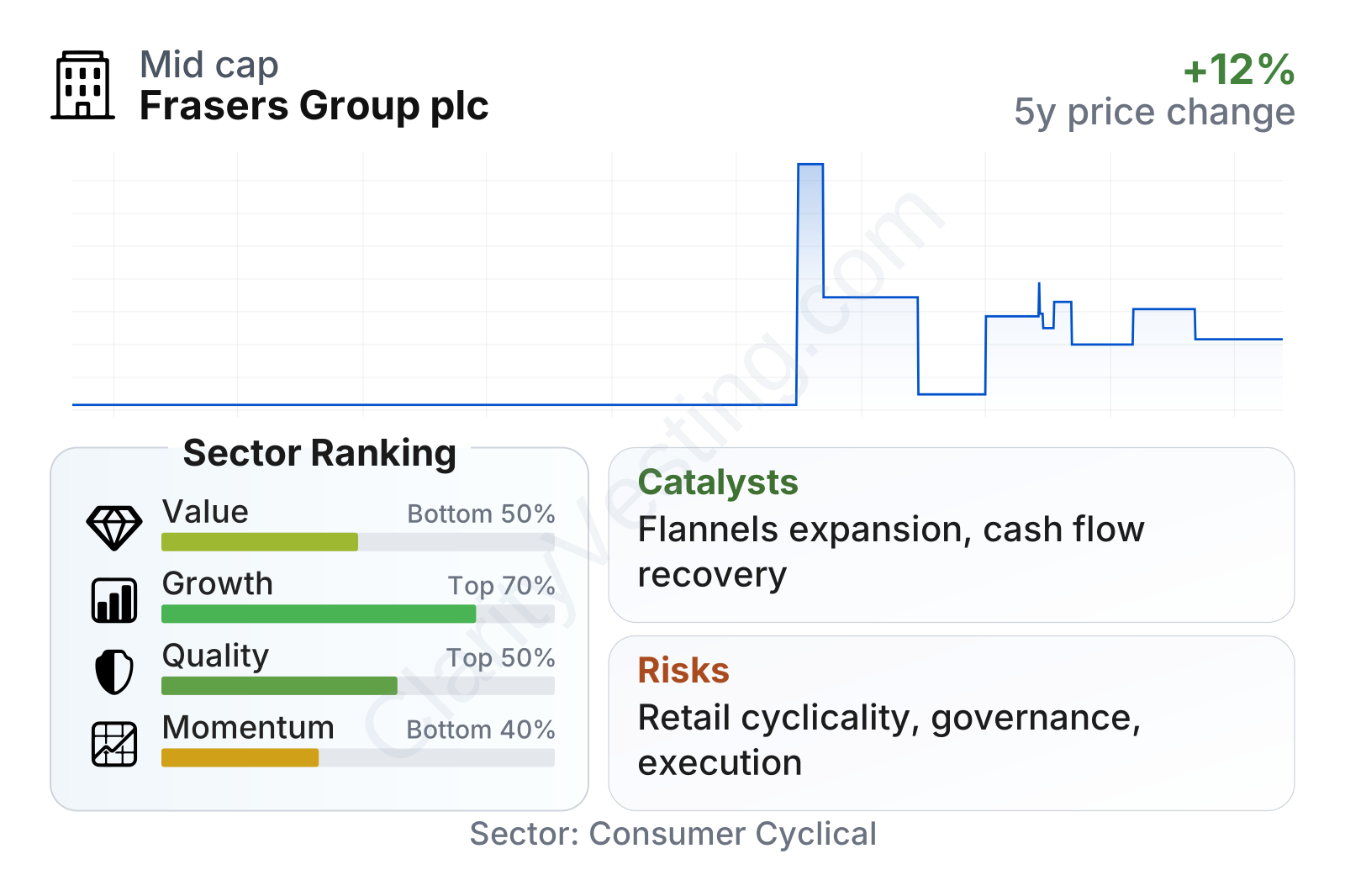
Frasers sits in the mid-cap range and its share price has been more volatile than the broader market, with a beta a little above 1. On valuation, the earnings multiple is clearly below the sector median, while the PEG ratio points to a price that does not look demanding relative to recent earnings growth. On quality, profitability appears better than many sector peers, with operating margin around 13% versus a sector median near 9%, profit margin near 7% versus roughly 5%, and debt-to-equity around 36%, well below the sector median near 75%.
The growth profile is mixed in a constructive way. Recent year-over-year revenue growth of about 15% is comfortably above the sector median of about 6%, and five-year free cash flow growth has been strong. At the same time, five-year revenue-per-share growth has been less impressive than the sector median, which suggests the group’s expansion has not been perfectly smooth. Overall, the numbers point to a business with solid profitability and cash generation, but not one with a straight-line growth record.
Growth
Frasers operates in segments of retail that should remain relevant over the long run. Sportswear has structural support from casual dress trends, health and fitness spending, and the blending of athletic and everyday clothing. Premium fashion is more cyclical, but it can offer better margins and stronger brand differentiation when executed well. E-commerce and omnichannel retail also continue to favor companies that can combine store networks, brand access, fulfillment, and customer data.
Frasers’ strategy is built around this logic. The group has been upgrading stores, pushing its “elevation” strategy in premium retail, investing in digital capabilities, and building relationships with major global brands. It has also used minority stakes and partnerships to widen its influence across retail categories. That approach can create optionality: the company can grow through store productivity, international rollout, online gains, premium mix, and monetization of owned brands.
Recent growth has been uneven, but the direction is still notable. After a softer 2025, sales recovered in the latest annual period and recent year-over-year growth is ahead of most sector peers. Over a longer period, earnings per share and operating margins have improved more clearly than revenue per share, which suggests management has been working not only on scale but also on efficiency and mix.
Cash generation is an important part of the case. Trailing free cash flow is in the hundreds of millions of dollars, and the five-year growth rate in free cash flow is well above the sector median. That matters because retail growth is more attractive when it is funded by internally generated cash rather than by constant balance sheet strain.
A meaningful catalyst is the continued build-out of higher-end retail through Flannels and related concepts. If Frasers keeps lifting average selling prices and store productivity without damaging volumes, the group could gradually become less dependent on lower-margin sports retail. Another catalyst is international expansion and deeper brand partnerships, especially if those improve product access and strengthen the online offering.
Recent company communications have also emphasized ongoing investment in stores, digital capability, and brand relationships. Those are not short-term boosts, but they can become important drivers if they translate into steadier margins and more consistent cross-channel growth.
Risks
This article is for informational purposes only and does not constitute financial advice. Some content is AI-generated. See Disclaimer


